Sponsored
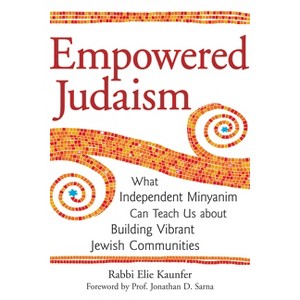
Empowered Judaism - by Elie Kaunfer (Paperback)
In Stock
Sponsored
About this item
Highlights
- The inside story and practical lessons from independent minyanim, one of the most exciting developments in contemporary Judaism.
- Author(s): Elie Kaunfer
- 226 Pages
- Religion + Beliefs, Judaism
Description
About the Book
The inside story and practical lessons from independent minyanim, one of the most exciting developments in contemporary Judaism. Offers refreshing perspectives on volunteer leadership, strong Jewish community and contemporary struggles in American Judaism.Book Synopsis
The inside story and practical lessons from independent minyanim, one of the most exciting developments in contemporary Judaism. Offers refreshing perspectives on volunteer leadership, strong Jewish community and contemporary struggles in American Judaism.Review Quotes
Elie Kaunfer knows what's ailing American Jewry and he has the cure. Kaunfer, a dynamic young rabbi, named in 2009 to Newsweek's list of 50 most influential rabbis in the US, is cofounder of several successful ventures in Jewish living, beginning with Minyan Hadar in 2000. What he calls "Empowered Judaism," could also be termed engaged or serious Judaism, a Judaism whose practitioners are fluent in Hebrew and conversant in the Tanakh, the Talmud and the other sources of the Jewish tradition and are able to study them and draw upon them on a daily basis for their own personal growth and the benefit of their communities. The lack of such individuals has been a serious weakness of the non-Orthodox movements for generations and Kaunfer and his visionary cohort of teachers and rabbinic leaders have undertaken to address this deficiency in American Jewish life. The book under review begins with Kaunfer's personal spiritual quest, but centers mainly on his involvement with Minyan Hadar and Yeshivat Hadar. Minyan Hadar is an extraordinarily successful independent minyan that meets weekly on the Upper West Side in Manhattan. Totally egalitarian and featuring a full traditional davening, it has succeeded and runs services marked by spirited singing and a consistently high level of quality in prayer leading and Torah reading. Kaunfer offers an account of how this was achieved and his group's experiences are instructive and worthy of study and emulation. There have been many spinoffs in the last decade and his latest venture is Yeshivat Hadar, the first fully egalitarian Yeshiva in North America. The yeshiva and its talented staff model Judaism at its best-dedicated to serious worship, study and social action, in an open, non-judgmental, environment dedicated to free enquiry and embracing the findings of academic scholarship in a fully egalitarian setting. Kaunfer's book belongs in every Jewish synagogue, school and JCC library and should be read by every rabbi and Federation leader. Its message is timely and deserves to be widely disseminated.
Shipping details
Return details
Frequently bought together






Trending Non-Fiction





Discover more options