Sponsored
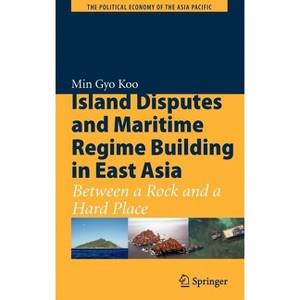
Island Disputes and Maritime Regime Building in East Asia - (Political Economy of the Asia Pacific) by Min Gyo Koo (Hardcover)
In Stock
Sponsored
About this item
Highlights
- islands has emotional content far beyond any material significance because giving way on the island issue to Japan would be considered as once again compromising the sovereignty over the whole Korean peninsula.
- Author(s): Min Gyo Koo
- 208 Pages
- Political Science, International Relations
- Series Name: Political Economy of the Asia Pacific
Description
About the Book
This book approaches Asian maritime disputes from an interdisciplinary perspective. It explores the three most prominent island disputes in East Asia, and provides a road map for successful management and development of the world's most dynamic sea areas.
Book Synopsis
islands has emotional content far beyond any material significance because giving way on the island issue to Japan would be considered as once again compromising the sovereignty over the whole Korean peninsula. For Japan, the Dokdo issue may lack the same degree of strategic and economic values and emotional appeal as the other two territorial disputes that Japan has had with Russia and the two Chinas - namely the Northern Territories/Southern Kurile Islands and the Senkaku Islands, respectively. Nevertheless, fishing resources and the maritime boundary issues became highly salient with the introduction of UNCLOS. Also, the legal, political, and economic issues surrounding Dokdo are all intertwined with Japan's other territorial disputes to the extent that concessions of sovereignty on any of these island disputes could jeopardize claims or negotiations concerning the rest. South Korea and Japan have forged a deeper diplomatic and economic partn- ship over the past decade. A new spirit of partnership after the landmark joint declaration of 1998 culminated in the successful co-hosting of the World Cup 2002. At the end of 2003 the two neighbors began to negotiate an FTA to further strengthen their already close economic ties. South Korea's decades-long embargo on Japanese cultural products has now been lifted, while a number of South Korean pop stars are currently sweeping across Japan, creating the so-called "Korean Wave" fever. A pragmatic calculation of national interests would thus suggest cooperative behavior.From the Back Cover
This book explores the three most prominent island disputes in East Asia: the Dokdo/Takeshima, the Senkaku/Diaoyu, and the Paracel and Spratly disputes. These island disputes clearly illustrate the puzzling pattern of continuity and mutual restraint in East Asia's territorial conflicts. In dealing with sovereignty issues, East Asian countries have engaged in varied patterns of diplomatic and military behaviors. In some cases, one can find examples of the aggressive use of military force and intransigent bargaining strategies, while in others military inaction and accommodative diplomacy are equally evident. When and why do disputants pursue conflictual policies? Conversely, why do they at other times seek the containment, if not the resolution, of territorial disputes by shelving thorny sovereignty issues?
This book uses a territorial bargaining game framework to analyze various stages of dispute initiation, escalation, and de-escalation in a consistent and systematic manner. It starts from an assumption that territory involves mixed motive games, which can be characterized as having elements of partnership, competition, and conflict. Consistent with conventional wisdom, this book finds that the combination of resource competition, fluid geopolitics, and unstable domestic power dynamics has regularly brought about the initiation and escalation of the three island disputes. More importantly, this book discovers that the pacific influence of economic interdependence has repeatedly prevented the sovereignty disputes from escalating into a full-scale diplomatic and/or military crisis
Shipping details
Return details
Frequently bought together






Trending Non-Fiction