Sponsored
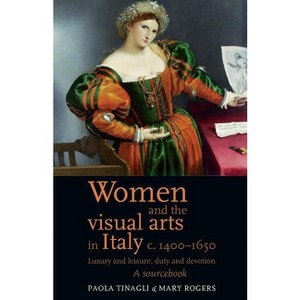
Women and the Visual Arts in Italy c. 1400-1650 - by Mary Rogers & Paola Tinagli (Paperback)
$29.99
In Stock
Eligible for registries and wish lists
Sponsored
About this item
Highlights
- The anthology of original sources from c.1400 to 1650, translated form Italian or Latin, and accompanied by introductions and bibliographies, is concerned with women's varied involvement with the visual arts and material culture of their day.
- About the Author: Mary Rogers has published widely on Italian visual representations of women in relation to the writing of the dayPaola Tinagli is author of Women in Italian Renaissance art (MUP 1997) and live and works in Italy
- 358 Pages
- Performing Arts, General
Description
About the Book
The anthology of original sources from c.1400 to 1650, translated form Italian or Latin, and accompanied by introductions and bibliographies, is concerned with women's varied involvement with the visual arts and material culture of their day. The readers gains a sense of women not only as patrons of architecture, painting, sculpture and the applied arts, but as users of art both on special occasions, like civic festivities or pilgrimages, and in everyday social and devotional life. As they seek to adapt and embellish their persons and their environments, acquire paintings for solace or prestige, or cultivate relationships with artists, women emerge as discerning participants in the consumer culture of their time, and often as lively commentators on it. Their fervent participation in religious life is also seen in their use of art in devotional rituals, or their commissioning of tombs or altarpieces to perpetuate their memory and aid them in the afterlife.Book Synopsis
The anthology of original sources from c.1400 to 1650, translated form Italian or Latin, and accompanied by introductions and bibliographies, is concerned with women's varied involvement with the visual arts and material culture of their day.
The readers gains a sense of women not only as patrons of architecture, painting, sculpture and the applied arts, but as users of art both on special occasions, like civic festivities or pilgrimages, and in everyday social and devotional life. As they seek to adapt and embellish their persons and their environments, acquire paintings for solace or prestige, or cultivate relationships with artists, women emerge as discerning participants in the consumer culture of their time, and often as lively commentators on it. Their fervent participation in religious life is also seen in their use of art in devotional rituals, or their commissioning of tombs or altarpieces to perpetuate their memory and aid them in the afterlife.From the Back Cover
This anthology of original sources from c.1400 to 1650, translated from Italian or Latin, is a companion to the authors Women in Italy, 1340-1650. Ideals and Realities, though it can be read independently. These texts, mostly unfamiliar and often vivid, deal with women's involvement in the visual arts and material culture of their day.
The documents are from inventories, letters, diaries, wills, artists' contracts, and more formal treatises or poetic works. Each section has a general introduction to the broader context and issues. Short introductions precede each text.Advanced undergraduates, postgraduates, and lecturers in art history or Italian studies, will deepen their understanding of the relationship between women, artists and the visual arts in early modern Italy. This book will be an essential aid for a class discussion and further research. Part I deals with the material environments which women inhabited, their living quarters and contents, and women's appearance outside the home, on everyday occasion, and in lavishly orchestrated spectacles. Part II examines women as agents, commissioning, supervising or bequeathing ambitious architectural projects. The commissioning and acquisition of painting and sculptures also show the reader the significance of different types of art for patronesses and intended audiences. Part III looks at women's religious devotion, and the role played in it by buildings, paintings and objects. Part IV enables the reader to enter the working lives of female artists and the little-explored topic of how women authors of the time wrote about real or imaginary artefacts.About the Author
Mary Rogers has published widely on Italian visual representations of women in relation to the writing of the dayPaola Tinagli is author of Women in Italian Renaissance art (MUP 1997) and live and works in ItalyDimensions (Overall): 8.4 Inches (H) x 5.3 Inches (W) x 1.0 Inches (D)
Weight: 1.1 Pounds
Suggested Age: 22 Years and Up
Number of Pages: 358
Genre: Performing Arts
Sub-Genre: General
Publisher: Manchester University Press
Format: Paperback
Author: Mary Rogers & Paola Tinagli
Language: English
Street Date: June 30, 2012
TCIN: 1006243198
UPC: 9780719080999
Item Number (DPCI): 247-18-6369
Origin: Made in the USA or Imported
If the item details aren’t accurate or complete, we want to know about it.
Shipping details
Estimated ship dimensions: 1 inches length x 5.3 inches width x 8.4 inches height
Estimated ship weight: 1.1 pounds
We regret that this item cannot be shipped to PO Boxes.
This item cannot be shipped to the following locations: American Samoa (see also separate entry under AS), Guam (see also separate entry under GU), Northern Mariana Islands, Puerto Rico (see also separate entry under PR), United States Minor Outlying Islands, Virgin Islands, U.S., APO/FPO
Return details
This item can be returned to any Target store or Target.com.
This item must be returned within 90 days of the date it was purchased in store, shipped, delivered by a Shipt shopper, or made ready for pickup.
See the return policy for complete information.
Frequently bought together

$10.40
MSRP $17.95

$71.83
MSRP $90.00

$7.19
was $8.39 New lower price
$18.93
MSRP $32.00
$11.39
MSRP $18.99
Trending Non-Fiction


$19.31
was $20.98 New lower price
4 out of 5 stars with 64 ratings


$4.59
MSRP $7.99
Save $5 when you spend $20 on select books
4.8 out of 5 stars with 123 ratings

$6.20
MSRP $10.95
Save $5 when you spend $20 on select books
4.8 out of 5 stars with 33 ratings

$7.09
MSRP $9.99
Save $5 when you spend $20 on select books
4.9 out of 5 stars with 46 ratings
Discover more options


$22.95
MSRP $29.95