Target New ArrivalsFourth of JulyBack to SchoolCollegeClothing, Shoes & AccessoriesHome & DecorKitchen & DiningOutdoor Living & GardenGroceryHousehold EssentialsBabyBeautyPersonal CareSports & OutdoorsHealthWellnessSchool & Office SuppliesToys & GamesElectronicsVideo GamesMovies, Music & BooksParty SuppliesGift IdeasGift CardsPetsUlta Beauty at TargetShop by CommunityTarget OpticalDealsClearanceNew ArrivalsBack to SchoolCollegeTop DealsTarget Circle DealsWeekly AdShop Order PickupShop Same Day DeliveryRegistryRedCardTarget CircleFind Stores
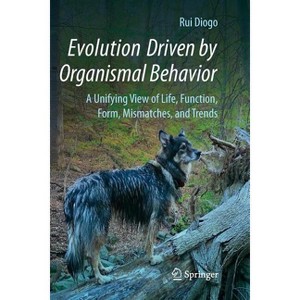
Evolution Driven by Organismal Behavior - by  Rui Diogo (Paperback) - 1 of 1

Evolution Driven by Organismal Behavior - by Rui Diogo (Paperback)

$44.99

In Stock

Free & easy returns
Free & easy returns
Return this item by mail or in store within 90 days for a full refund.
Eligible for registries and wish lists

About this item

Highlights

  • This book proposes a new way to think about evolution.
  • About the Author: Rui Diogo is an Associate Professor at Howard University College of Medicine and a member of the Resource Faculty at the Center for the Advanced Study of Hominid Paleobiology at George Washington University.
  • 252 Pages
  • Science, Life Sciences

Description


Book Synopsis


This book proposes a new way to think about evolution. The author carefully brings together evidence from diverse fields of science. In the process, he bridges the gaps between many different--and usually seen as conflicting--ideas to present one integrative theory named ONCE, which stands for Organic Nonoptimal Constrained Evolution. The author argues that evolution is mainly driven by the behavioral choices and persistence of organisms themselves, in a process in which Darwinian natural selection is mainly a secondary--but still crucial--evolutionary player. Within ONCE, evolution is therefore generally made of mistakes and mismatches and trial-and-error situations, and is not a process where organisms engage in an incessant, suffocating struggle in which they can't thrive if they are not optimally adapted to their habitats and the external environment. Therefore, this unifying view incorporates a more comprehensive view of the diversity and complexity of life by stressing that organisms are not merely passive evolutionary players under the rule of external factors. This insightful and well-reasoned argument is based on numerous fascinating case studies from a wide range of organisms, including bacteria, plants, insects and diverse examples from the evolution of our own species. The book has an appeal to researchers, students, teachers, and those with an interest in the history and philosophy of science, as well as to the broader public, as it brings life back into biology by emphasizing that organisms, including humans, are the key active players in evolution and thus in the future of life on this wonderful planet.


From the Back Cover


This book proposes a new way to think about evolution. The author carefully brings together evidence from diverse fields of science. In the process, he bridges the gaps between many different--and usually seen as conflicting--ideas to present one integrative theory named ONCE, which stands for Organic Nonoptimal Constrained Evolution. The author argues that evolution is mainly driven by the behavioral choices and persistence of organisms themselves, in a process in which Darwinian natural selection is mainly a secondary--but still crucial--evolutionary player. Within ONCE, evolution is therefore generally made of mistakes and mismatches and trial-and-error situations, and is not a process where organisms engage in an incessant, suffocating struggle in which they can't thrive if they are not optimally adapted to their habitats and the external environment. Therefore, this unifying view incorporates a more comprehensive view of the diversity and complexity of life by stressing thatorganisms are not merely passive evolutionary players under the rule of external factors. This insightful and well-reasoned argument is based on numerous fascinating case studies from a wide range of organisms, including bacteria, plants, insects and diverse examples from the evolution of our own species. The book has an appeal to researchers, students, teachers, and those with an interest in the history and philosophy of science, as well as to the broader public, as it brings life back into biology by emphasizing that organisms, including humans, are the key active players in evolution and thus in the future of life on this wonderful planet.


Review Quotes


"Rui Diogo has published a book that goes against the current in being truly large in scope but also single-authored. ... The book is full of vignettes of ideas and of papers and the alternative explanations the author provides to some of the conclusions of those papers." (Marcelo R. Sa´nchez-Villagra, Swiss Journal of Palaeontology, Vol. 137, 2018)


"In this relatively slim, but very ambitious volume, the author lays out his own view of how morphological evolution takes place in the context of the many variables that may influence its path. ... the 415-entry bibliography is very impressive, and reads like a who's who of evolutionary biology. This is an impressive work that is jam-packed with complex concepts and ideas. ... everyone should find it rewarding and thought-provoking." (John G. Fleagle, The Quarterly Review of Biology, Vol. 92 (4), December, 2017)

"The book is a provocative and worthy addition to the field. ... this interesting book is suitablefor all four-year colleges and above. Summing Up: Recommended. Upper-division undergraduates and above; faculty and professionals." (J. Nabe, Choice, Vol. 55 (1), September, 2017)

"The author presents an integrated picture of the origins of evolutionary theory, how it has progressed over time, and provides context for how he has developed ONCE, an integrative and unifying viewpoint about evolution that focuses on behavior of the individual organism, as opposed to a gene-based model, as a driving mechanism to evolution. This book would be useful for graduate students in the biological sciences and history and philosophy of science." (Anne M. Burrows, Frontiers in Ecology and Evolution, July, 2017)

"Rui Diogo's new book is not only a brilliant collection of theoretical and empirical data on biological evolution but also an attempt to provide an empirically based explanation for the two most 'difficult' phenomena in the theory of evolution. ... The book will be interesting and helpful for students, as well as experts in other fields, as it contains a nearly encyclopedic overview of empirical data and theoretical ideas in the scope of biological evolution including the most recent ones." (Varvara Dyakonova, Evolutionary Psychological Science, July, 2017)


About the Author


Rui Diogo is an Associate Professor at Howard University College of Medicine and a member of the Resource Faculty at the Center for the Advanced Study of Hominid Paleobiology at George Washington University. One of the youngest researchers to be nominated as Fellow of the American Association of Anatomists, he won several prestigious awards, being the only researcher to be selected for the first/second place for best article of the year in the top anatomical journal two times in just three years (2013/2015). Author or co-author of more than 100 papers in top journals, such as Nature, and of numerous book chapters, he is the co-editor of three books and the sole or first author of eleven books covering subjects as diverse as fish evolution, chordate development, and human medicine and pathology, including a book adopted at medical schools worldwide, "Learning and understanding human anatomy and pathology: an evolutionary and developmental guide for medical students."

Dimensions (Overall): 9.21 Inches (H) x 6.14 Inches (W) x .57 Inches (D)
Weight: .85 Pounds
Suggested Age: 22 Years and Up
Number of Pages: 252
Genre: Science
Sub-Genre: Life Sciences
Publisher: Springer
Theme: Biology
Format: Paperback
Author: Rui Diogo
Language: English
Street Date: July 20, 2018
TCIN: 1012215670
UPC: 9783319837734
Item Number (DPCI): 247-19-8241
Origin: Made in the USA or Imported
If the item details aren’t accurate or complete, we want to know about it.

Shipping details

Estimated ship dimensions: 0.57 inches length x 6.14 inches width x 9.21 inches height
Estimated ship weight: 0.85 pounds
We regret that this item cannot be shipped to PO Boxes.
This item cannot be shipped to the following locations: American Samoa (see also separate entry under AS), Guam (see also separate entry under GU), Northern Mariana Islands, Puerto Rico (see also separate entry under PR), United States Minor Outlying Islands, Virgin Islands, U.S., APO/FPO, Alaska, Hawaii

Return details

This item can be returned to any Target store or Target.com.
This item must be returned within 90 days of the date it was purchased in store, delivered to the guest, delivered by a Shipt shopper, or picked up by the guest.
See the return policy for complete information.

Q: What is the target audience for this book?

submitted by AI Shopping Assistant - 7 days ago
  • A: The book appeals to researchers, students, teachers, and anyone interested in the history and philosophy of science.

    submitted byAI Shopping Assistant - 7 days ago
    Ai generated

Q: Who is the author of this book?

submitted by AI Shopping Assistant - 7 days ago
  • A: The author is Rui Diogo, an Associate Professor at Howard University College of Medicine.

    submitted byAI Shopping Assistant - 7 days ago
    Ai generated

Q: How does the book view the role of organisms in evolution?

submitted by AI Shopping Assistant - 7 days ago
  • A: It argues that organisms are active players in evolution, influencing their own evolutionary paths through behavior.

    submitted byAI Shopping Assistant - 7 days ago
    Ai generated

Q: What is the main theory proposed in this book?

submitted by AI Shopping Assistant - 7 days ago
  • A: The book presents the ONCE theory, emphasizing that evolution is driven by organismal behavior rather than solely by natural selection.

    submitted byAI Shopping Assistant - 7 days ago
    Ai generated

Q: What types of organisms are discussed in the book?

submitted by AI Shopping Assistant - 7 days ago
  • A: The book includes case studies from bacteria, plants, insects, and examples from human evolution.

    submitted byAI Shopping Assistant - 7 days ago
    Ai generated

Additional product information and recommendations

Discover more options

Best-selling Education Books

Get top deals, latest trends, and more.