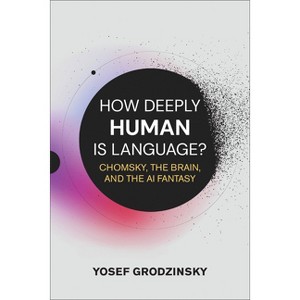
A leading neurolinguist explains linguistic theory and large language models--the top contenders for understanding human language--and evaluates them in the context of the brain.
About the Author: Yosef Grodzinsky is currently Director of the Neurolinguistics Lab at the Edmond and Lily Safra Center for Brain Sciences, and Professor Emeritus at the Hebrew University of Jerusalem.
214 Pages
Language + Art + Disciplines, Linguistics
Description
Book Synopsis
A leading neurolinguist explains linguistic theory and large language models--the top contenders for understanding human language--and evaluates them in the context of the brain. Contemporary linguistics, founded and inspired by Noam Chomsky, seeks to understand the hallmark of our humanity--language. Linguists develop powerful tools to discover how knowledge of language is acquired and how the brain puts it to use. AI experts, using vastly different methods, create remarkable neural networks--large language models (LLMs) such as ChatGPT--said to learn and use language like us. Chomsky called LLMs "a false promise." AI leader Geoffrey Hinton has declared that "neural nets are much better at processing language than anything ever produced by the Chomsky School of Linguistics." Who is right, and how can we tell? Do we learn everything from scratch, or could some knowledge be innate? Is our brain one big network, or is it built out of modules, language being one of them? In How Deeply Human Is Language?, Yosef Grodzinsky explains both approaches and confronts them with the reality as it emerges from the engineering, linguistic, and neurological record. He walks readers through vastly different methods, tools, and findings from all these fields. Aiming to find a common path forward, he describes the conflict, but also locates points of potential contact, and sketches a joint research program that may unite these communities in a common effort to understand knowledge and learning in the brain.
Review Quotes
ENDORSEMENTS "In my lifelong investigations on language, I gradually became convinced that some version of Chomsky's hypothesis about the universal architecture of languages--a small set of combinatory principles--is basically right. Consequently, I also came to believe that large language models, ingenious and useful though they are, unveil precious little of our unique and specific capacity for language. This book provides narratives of these two perspectives in a deep and remarkably engaging way. It helped me get clearer on what I got right and what I got wrong." --Gennaro Chierchia, Haas Foundations Professor of Linguistics and Professor of Philosophy, Harvard University "What if our best predictions and technological achievements are based on little scientific understanding? Grodzinsky pursues this fascinating question as it arises in the case of language and generative AI. This beautifully told story is important for anyone interested in the science of language and its neural encoding, and their relation to the promises of generative AI. More broadly, the lessons are crucial for those who want to think deeply about the complex interconnections between science and technology." --Danny Fox, Anshen-Chomsky Professor of Language & Thought, MIT "The thing about people extolling large language models is that most of them don't actually know all that much about how human language works. Yosef Grodzinsky does. A bracing interdisciplinary analysis of AI's alleged crown jewels, from a bona fide neurolinguist." --Dr. Gary Marcus, author of Taming Silicon Valley "A specter is haunting the world. Are we about to be brutalized by barbarians, or have we have failed to read both our minds and theirs? The ambiguity consumes us throughout the book, until it is made devastatingly poignant, and double edged, in the epilogue--but with a glimmer of hope." --Alessandro Treves, Professor, Scuola Internazionale Superiore di Studi Avanzati, Trieste, Italy
About the Author
Yosef Grodzinsky is currently Director of the Neurolinguistics Lab at the Edmond and Lily Safra Center for Brain Sciences, and Professor Emeritus at the Hebrew University of Jerusalem. He is also a scientific associate at the Institute for Neuroscience and Medicine, Forschungszentrum Jülich, and the Cécile and Oskar Vogt Institute for Brain Research, University Hospital Düsseldorf. He is the recipient of an Alexander von Humboldt Award and was formerly Senior Canada Research Chair in Neurolinguistics at the Departments of Linguistics and Neurology/Neurosurgery at McGill University.
Dimensions (Overall): 8.99 Inches (H) x 5.99 Inches (W) x .64 Inches (D)
Weight: 1.41 Pounds
Suggested Age: 22 Years and Up
Number of Pages: 214
Genre: Language + Art + Disciplines
Sub-Genre: Linguistics
Publisher: MIT Press
Theme: Neurolinguistics, Psycholinguistics
Format: Paperback
Author: Yosef Grodzinsky
Language: English
Street Date: April 21, 2026
TCIN: 1011742374
UPC: 9780262052009
Item Number (DPCI): 247-00-3617
Origin: Made in the USA or Imported
If the item details aren’t accurate or complete, we want to know about it.
Shipping details
Estimated ship dimensions: 0.64 inches length x 5.99 inches width x 8.99 inches height
Estimated ship weight: 1.41 pounds
We regret that this item cannot be shipped to PO Boxes.
This item cannot be shipped to the following locations: American Samoa (see also separate entry under AS), Guam (see also separate entry under GU), Northern Mariana Islands, Puerto Rico (see also separate entry under PR), United States Minor Outlying Islands, Virgin Islands, U.S., APO/FPO, Alaska, Hawaii
Return details
This item can be returned to any Target store or Target.com.
This item must be returned within 90 days of the date it was purchased in store, delivered to the guest, delivered by a Shipt shopper, or picked up by the guest.