Target New ArrivalsGift Ideas for DadClothing, Shoes & AccessoriesHome & DecorKitchen & DiningOutdoor Living & GardenGroceryHousehold EssentialsBabyBeautyPersonal CareSports & OutdoorsHealthWellnessLuggageSchool & Office SuppliesToysElectronicsVideo GamesMovies, Music & BooksParty SuppliesGift IdeasGift CardsPetsUlta Beauty at TargetShop by CommunityTarget OpticalDealsClearanceNew ArrivalsGift Ideas for DadBack to SchoolCollegeTop DealsTarget Circle DealsWeekly AdShop Order PickupShop Same Day DeliveryRegistryRedCardTarget CircleFind Stores
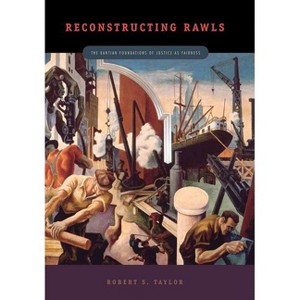
Reconstructing Rawls - by  Robert S Taylor (Paperback) - 1 of 1

Reconstructing Rawls - by Robert S Taylor (Paperback)

$47.95

In Stock

Free & easy returns

Free & easy returns

Return this item by mail or in store within 90 days for a full refund.
Eligible for registries and wish lists

About this item

Highlights

  • Reconstructing Rawls has one overarching goal: to reclaim Rawls for the Enlightenment--more specifically, the Prussian Enlightenment.
  • About the Author: Robert S. Taylor is Associate Professor of Political Science at the University of California, Davis.
  • 360 Pages
  • Philosophy, Political

Description


About the Book


Compares the theories of John Rawls and Immanuel Kant, and offers an internal critique and reconstruction of justice as fairness, reconceiving it as a comprehensive, universalistic Kantian liberalism.


Book Synopsis


Reconstructing Rawls has one overarching goal: to reclaim Rawls for the Enlightenment--more specifically, the Prussian Enlightenment. Rawls's so-called political turn in the 1980s, motivated by a newfound interest in pluralism and the accommodation of difference, has been unhealthy for autonomy-based liberalism and has led liberalism more broadly toward cultural relativism, be it in the guise of liberal multiculturalism or critiques of cosmopolitan distributive-justice theories. Robert Taylor believes that it is time to redeem A Theory of Justice's implicit promise of a universalistic, comprehensive Kantian liberalism. Reconstructing Rawls on Kantian foundations leads to some unorthodox conclusions about justice as fairness, to be sure: for example, it yields a more civic-humanist reading of the priority of political liberty, a more Marxist reading of the priority of fair equality of opportunity, and a more ascetic or antimaterialist reading of the difference principle. It nonetheless leaves us with a theory that is still recognizably Rawlsian and reveals a previously untraveled road out of Theory--a road very different from the one Rawls himself ultimately followed.


Review Quotes


"Reconstructing Rawls provocatively resurrects the issue of Rawls's Kantian ties and finds a unique approach in the well-trodden ground of the literature on Rawls's reliance on Kantian metaphysics. . . . This book is one that calls for attention from those who thought that the issue of Rawls's Kantian conception of the person had been settled. Taylor presents new and challenging reasons to think that we ought to question even Rawls's own claims that he need not rely on Kantian metaphysics, given the importance of that metaphysics to the justification of Rawls's principles of justice."

--Catherine Galko Campbell Ethics


"In this intriguing study, Taylor . . . faults Rawls's liberalism on the grounds that it is insufficiently universal--justice as fairness being at bottom a circumscribed political conception vying for allegiance in a world distinguished by many reasonable, irreconcilable, and comprehensive metaphysical doctrines of the good life. Taylor has an eye toward reconstructing the promising though allegedly impoverished theory along the lines of a global liberalism that derives from a Kantian notion of the morally autonomous person--a notion that Rawls himself partially endorses but ultimately develops in a different, nonuniversal direction. Central to Taylor's project is a correlative reconstruction of Kant. The author aims to provide a practical postulate of freedom at once detranscendentalized yet foundational in yielding a first principle capable of generating, in Rawlsian contours, persuasive arguments on behalf of autonomy and fairness. These arguments may prove efficacious beyond Rawls's preeminent domain of the liberal democratic society. At the same time, Taylor acknowledges the difficulty, if not impossibility, of overcoming the pluralism that, in Rawls's view, decisively militates against universalism. Nevertheless, Taylor maintains that attempts to articulate universalistic liberalisms are well worth the effort."

--H. I. Einsohn Choice


"Taylor's spirited championing of a universalistic form of liberalism . . . is especially intriguing and provocative, as well as particularly relevant to recent discussions of 'American exceptionalism' in its relation to other countries and cultures. . . . [This] book is essential reading for scholars of Kant, Rawls, and liberal theory in general. Taylor's contribution to scholarship in these areas is indeed significant and his arguments extraordinarily challenging."

--S. Adam Seagrave American Political Thought


"This is an ambitious and provocative book that will be of interest to political philosophers who have reservations about the enormous influence that Rawls' defense of political liberalism, in his later writings, has had on much recent political philosophy. . . . The book is a welcome addition to political philosophy and will play a useful role in stimulating discussion about the foundations of contemporary liberalism."

--Colin Macleod Philosophy in Review


"In Reconstructing Rawls, Robert Taylor develops a sophisticated reading of Kant's moral theory and uses it to critically reconstruct Rawls's justice as fairness. In doing so, he generates many original insights and illuminates the work of both authors. His careful and clear discussions of autonomy and self-realization provide a foundation for Rawls's principles, including the frequently neglected principle of fair equality of opportunity, and their strong lexical ordering. This is a powerful call to embrace a comprehensive Kantian foundation for justice as fairness."

--Jon Mandle, University at Albany, SUNY


"Taylor goes against the grain of much Rawls scholarship in arguing that the Rawlsian framework for liberal justice should revert more thoroughly to its Kantian roots. Taylor's critical reinterpretation of liberal theory will challenge those theorists who view Rawls's political turn as a necessary accommodation of pluralism and social difference. Indeed, Taylor argues that Rawls abandoned his Kantianism at his peril. The scholarly and bold line of argument developed here is one with which all theorists currently engaged with the alleged promise or shortcomings of the liberal project will have to grapple."

--John Christman, The Pennsylvania State University


"There has been a lot of debate and discussion among those who work on liberalism and on Rawls in the last decade and a half about the differences between and relative advantages of what Rawls calls comprehensive vs. political liberalism and Galston calls Enlightenment vs. Reformation liberalism. Taylor gives a strong defense of an unabashedly comprehensive, Enlightenment liberalism and shows how fitting Rawls's substantive principles of justice into that framework both sheds light on what they require and, he argues, what they assume about the nature of persons. Taylor's Kantianized Rawls recovers with gusto the spirit of liberalism as a fighting creed against intolerance, injustice, and despotism."

--Anthony Laden, University of Illinois at Chicago


About the Author


Robert S. Taylor is Associate Professor of Political Science at the University of California, Davis.

Dimensions (Overall): 9.0 Inches (H) x 6.0 Inches (W) x .81 Inches (D)
Weight: 1.17 Pounds
Suggested Age: 22 Years and Up
Number of Pages: 360
Genre: Philosophy
Sub-Genre: Political
Publisher: Penn State University Press
Format: Paperback
Author: Robert S Taylor
Language: English
Street Date: November 15, 2012
TCIN: 1011761966
UPC: 9780271037721
Item Number (DPCI): 247-09-9921
Origin: Made in the USA or Imported
If the item details aren’t accurate or complete, we want to know about it.

Shipping details

Estimated ship dimensions: 0.81 inches length x 6 inches width x 9 inches height
Estimated ship weight: 1.17 pounds
We regret that this item cannot be shipped to PO Boxes.
This item cannot be shipped to the following locations: American Samoa (see also separate entry under AS), Guam (see also separate entry under GU), Northern Mariana Islands, Puerto Rico (see also separate entry under PR), United States Minor Outlying Islands, Virgin Islands, U.S., APO/FPO, Alaska, Hawaii

Return details

This item can be returned to any Target store or Target.com.
This item must be returned within 90 days of the date it was purchased in store, delivered to the guest, delivered by a Shipt shopper, or picked up by the guest.
See the return policy for complete information.

Additional product information and recommendations

Discover more options

Get top deals, latest trends, and more.

Privacy policy