Target New ArrivalsChristmasGift IdeasHoliday Kids CatalogHome & DecorKitchen & DiningToys & GamesElectronics & TechVideo GamesGift CardsClothing, Shoes & AccessoriesGroceryBabyBeautyTarget Beauty StudioPersonal CareHousehold EssentialsHealthWellnessBooks, Music & MoviesSports & OutdoorsPetsSchool & Office SuppliesParty SuppliesAutomotiveTarget OpticalClearanceNew ArrivalsChristmasGift IdeasTop DealsTarget Circle DealsWeekly AdShop Order PickupShop Same Day DeliveryRegistryRedCardTarget CircleFind Stores
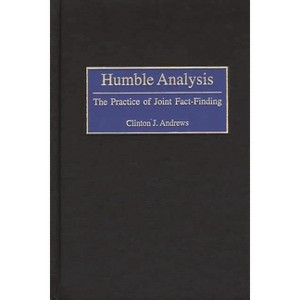
Humble Analysis - by  Clinton Andrews (Hardcover) - 1 of 1

Humble Analysis - by Clinton Andrews (Hardcover)

$68.99

In Stock

Free & easy returns
Free & easy returns
Return this item by mail or in store within 90 days for a full refund.
Eligible for registries and wish lists
Save 5% every day
With Target Circle™ Card (restrictions apply)

About this item

Highlights

  • Joint fact-finding is a cooperative venture and communication among the participants is critical to success.
  • About the Author: CLINTON J. ANDREWS is Assistant Professor at the Edward J. Bloustein School of Planning and Public Policy at Rutgers University.
  • 216 Pages
  • Political Science, Public Policy

Description


About the Book


Joint fact-finding is a cooperative venture and communication among the participants is critical to success. Analysts have begun to recognize this and have started to adjust their craft to reflect the communicative character of their work. Non-analysts usually judge experts' opinions by their value, effectiveness, and legitimacy rather than soundness of the conclusions. Accordingly, experts must recognize the importance of these non-scientific criteria, and learn to communicate better with their non-expert colleagues. Practically, this means explaining the rationale and implications behind their findings in an easily digestible way. Andrews uses real cases to illustrate his argument that analysts should marry process to analysis, spread information, reason inductively, broaden their analytic scope, put analytic results into lay terms, and constantly seek out feedback on their work.

Technical specialists who perform analysis in public settings can turn to Andrews's book for ideas about how to do their jobs more effectively. Scholars interested in the connection between expertise and the process of social learning will find his case study approach useful. Beginning with an analysis of the motivations and concepts at work in the process of joint fact finding, Andrews assesses the challenges analysts face from those who hire them and from their non-expert colleagues. He then illustrates his remarks with case studies of projects that have failed and succeeded. The book concludes by summing up the mistakes learned and elements that make for successful joint fact finding.


Book Synopsis


Joint fact-finding is a cooperative venture and communication among the participants is critical to success. Analysts have begun to recognize this and have started to adjust their craft to reflect the communicative character of their work. Non-analysts usually judge experts' opinions by their value, effectiveness, and legitimacy rather than soundness of the conclusions. Accordingly, experts must recognize the importance of these non-scientific criteria, and learn to communicate better with their non-expert colleagues. Practically, this means explaining the rationale and implications behind their findings in an easily digestible way. Andrews uses real cases to illustrate his argument that analysts should marry process to analysis, spread information, reason inductively, broaden their analytic scope, put analytic results into lay terms, and constantly seek out feedback on their work.

Technical specialists who perform analysis in public settings can turn to Andrews's book for ideas about how to do their jobs more effectively. Scholars interested in the connection between expertise and the process of social learning will find his case study approach useful. Beginning with an analysis of the motivations and concepts at work in the process of joint fact finding, Andrews assesses the challenges analysts face from those who hire them and from their non-expert colleagues. He then illustrates his remarks with case studies of projects that have failed and succeeded. The book concludes by summing up the mistakes learned and elements that make for successful joint fact finding.


Review Quotes


"Clint Andrews argues that analysts must be willing to listen, explain, and tolerate diverse views....His conclusion that the advance of knowledge depends on successful dialogue and a willingness to explore contrary world views rings true. He goes farther, however, and probes a variety of ways to make sure this happens....Relying on convincing in-depth analyses of key cases to assess the adequacy, value, effectiveness and legitimacy of joint fact finding efforts, he concludes that story telling is probably the most important skill of the humble analyst."-Lawrence E. Susskind Ford Professor of Urban and Environmental Planning Massachusetts Institute of Technology

"Humble Analysis is a welcome contribution to the anti-mastery tradition in contemporary thought. Whereas much of policy analysis tries unsuccessfully to overcome disagreement and uncertainty by brute analytic force, Andrews shrewdly follows Lindblom and others in adapting analysis to cope with the realities of political life....Recognizing that policy analysis becomes usable only when adapted to partisans' perceived needs, Andrews is superb in keeping the focus on how analysts can make their technical tasks compatible with the tasks of maintaining legitimacy and communicating effectively with would-be users of the analysis."-Edward J. Woodhouse Associate Professor of Political Science Rensselaer Polytechnic Institute

"The framework for joint fact finding developed in Humble Analysis offers a very useful perspective for viewing these sorts of cooperative efforts as well as the professional practice of policy analysis more generally. Clinton Andrews taps several streams in the policy sciences literature to give Humble Analysis firm intellectual foundations. He then draws on a rich set of economically presented cases of joint fact finding to offer thoughtful advice about when and how it can be effectively used. Andrews thus provides an important contribution to our understanding of policy analysis and the variety of ways it can be organized. Readers at all levels of experience will appreciate his clear presentation. I highly recommend this book to anyone interested in the practice of policy-related professions."-David L. Weimer Professor of Political Science and Public Affairs University of Wisconsin-Madison

"This important work illustrates how to marry technical expertise and policymaking through joint fact finding, as exemplified by the Office of Technology Assessment before it was abolished in 1995. Nonpartisan analysis is exactly what Congress needs but no longer gets."-Representative Rush D. Holt (D-NJ)

"This is a complete guidebook for analysts interested in contributing to public policy. It explains the inherent difficulty of connecting truth to power. It provides a comprehensive guide to the literature on these difficulties and to various approaches for dealing with them. Finally and most importantly, it tells compelling stories of how some analysts have been able to enter into a productive dialogue with policy makers and the public, have helped break stalemates between interest groups, and have identifies new and better policy options."-Frank N. von Hippel Woodrow Wilson School of Public and International Affairs Princeton University

"This is am impressive and much needed book that productively explores the roles of experts and expertise in science intensive decision arenas. Professor Andrews presents theory and practice in language that is accessible to a broad audience. Anyone who serves as an expert, wants to be a expert, or listens to experts will benefit from his ideas."-David M. Hassenzahl Assistant Professor of Environmental StudiesUniversity of Nevada, Los Vegas


About the Author


CLINTON J. ANDREWS is Assistant Professor at the Edward J. Bloustein School of Planning and Public Policy at Rutgers University. His previous works include Regulating Regional Power Systems (Quorum, 1995), and Industrial Ecology and Global Change (Cambridge, 1995).
Dimensions (Overall): 9.54 Inches (H) x 6.42 Inches (W) x .82 Inches (D)
Weight: 1.03 Pounds
Suggested Age: 22 Years and Up
Number of Pages: 216
Genre: Political Science
Sub-Genre: Public Policy
Publisher: Praeger
Theme: General
Format: Hardcover
Author: Clinton Andrews
Language: English
Street Date: May 30, 2002
TCIN: 1015595984
UPC: 9780275975883
Item Number (DPCI): 247-62-5071
Origin: Made in the USA or Imported
If the item details aren’t accurate or complete, we want to know about it.

Shipping details

Estimated ship dimensions: 0.82 inches length x 6.42 inches width x 9.54 inches height
Estimated ship weight: 1.03 pounds
We regret that this item cannot be shipped to PO Boxes.
This item cannot be shipped to the following locations: American Samoa (see also separate entry under AS), Guam (see also separate entry under GU), Northern Mariana Islands, Puerto Rico (see also separate entry under PR), United States Minor Outlying Islands, Virgin Islands, U.S., APO/FPO, Alaska, Hawaii

Return details

This item can be returned to any Target store or Target.com.
This item must be returned within 90 days of the date it was purchased in store, delivered to the guest, delivered by a Shipt shopper, or picked up by the guest.
See the return policy for complete information.

Additional product information and recommendations

Discover more options

Skip to next section

Best-selling Current Affairs & Politics Books

Skip to next section

Get top deals, latest trends, and more.