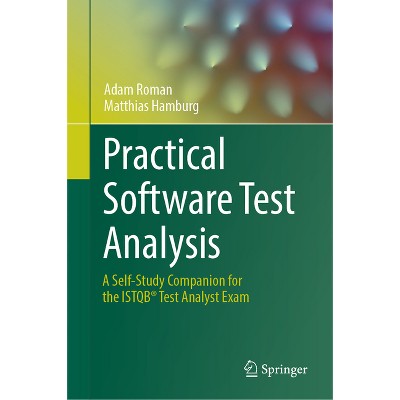
This book focuses on software defect prediction (SDP) in order to avoid threats related to quality, reliability and safety.
About the Author: Zhou Xu was an assistant professor in the School of Big Data and Software Engineering at Chongqing University, China, from 2020 to 2022.
448 Pages
Computers + Internet, Software Development & Engineering
Description
Book Synopsis
This book focuses on software defect prediction (SDP) in order to avoid threats related to quality, reliability and safety. It details advanced machine/deep learning technologies to discuss strategies for identifying and preventing such issues, and introduces innovative approaches to address feature irrelevance and redundancy, data imbalance in defect data, selection of representative module subsets for cross-version defect prediction, and managing data distribution variances in cross-project defect prediction. The book is organized into eight chapters, systematically covering various aspects of software defect prediction. First, chapter 1 "Introduction" explains the socio-economic significance and importance of software defect prediction. Next, chapter 2 "Literature Review" reviews and analyzes current technologies and their applications in defect prediction. Then chapter 3 "Feature Learning" discusses how to extract effective features from software engineering data using machine learning techniques. While chapter 4 "Handling Class Imbalance" introduces strategies to address the class imbalance in software defect data, chapter 5 "Cross-Version Defect Prediction" analyzes the application of historical version data to enhance the accuracy of prediction models. Subsequently, chapter 6 "Cross-Project Defect Prediction" discusses how to mitigate data discrepancies between projects through transfer learning, and chapter 7 "Effort-Aware Defect Prediction" delves into new technologies to rank software modules based on the defect density. Eventually, chapter 8 "Conclusion and Future Trends" summarizes the book and outlines future research directions. The book mainly targets academic researchers and graduate students, particularly those focusing on the intersection of software engineering and machine learning. It is also intended for software engineers and data scientists working on enhancing the quality and safety of software.
From the Back Cover
This book focuses on software defect prediction (SDP) in order to avoid threats related to quality, reliability and safety. It details advanced machine/deep learning technologies to discuss strategies for identifying and preventing such issues, and introduces innovative approaches to address feature irrelevance and redundancy, data imbalance in defect data, selection of representative module subsets for cross-version defect prediction, and managing data distribution variances in cross-project defect prediction.
The book is organized into eight chapters, systematically covering various aspects of software defect prediction. First, chapter 1 "Introduction" explains the socio-economic significance and importance of software defect prediction. Next, chapter 2 "Literature Review" reviews and analyzes current technologies and their applications in defect prediction. Then chapter 3 "Feature Learning" discusses how to extract effective features from software engineering data using machine learning techniques. While chapter 4 "Handling Class Imbalance" introduces strategies to address the class imbalance in software defect data, chapter 5 "Cross-Version Defect Prediction" analyzes the application of historical version data to enhance the accuracy of prediction models. Subsequently, chapter 6 "Cross-Project Defect Prediction" discusses how to mitigate data discrepancies between projects through transfer learning, and chapter 7 "Effort-Aware Defect Prediction" delves into new technologies to rank software modules based on the defect density. Eventually, chapter 8 "Conclusion and Future Trends" summarizes the book and outlines future research directions.
The book mainly targets academic researchers and graduate students, particularly those focusing on the intersection of software engineering and machine learning. It is also intended for software engineers and data scientists working on enhancing the quality and safety of software.
About the Author
Zhou Xu was an assistant professor in the School of Big Data and Software Engineering at Chongqing University, China, from 2020 to 2022. His research interests encompass software defect prediction, empirical software engineering, feature engineering, and data mining. He has published more than 50 papers in international journals and conferences, among them IEEE Transactions on Software Engineering, IEEE Transactions on Reliability, Journal of System and Software, ASE or ISSRE.
Dimensions (Overall): 9.61 Inches (H) x 6.69 Inches (W) x 1.0 Inches (D)
Weight: 2.05 Pounds
Suggested Age: 22 Years and Up
Number of Pages: 448
Genre: Computers + Internet
Sub-Genre: Software Development & Engineering
Publisher: Springer
Theme: General
Format: Hardcover
Author: Zhou Xu
Language: English
Street Date: November 20, 2025
TCIN: 1012305381
UPC: 9783032013354
Item Number (DPCI): 247-12-4000
Origin: Made in the USA or Imported
If the item details aren’t accurate or complete, we want to know about it.
Shipping details
Estimated ship dimensions: 1 inches length x 6.69 inches width x 9.61 inches height
Estimated ship weight: 2.05 pounds
We regret that this item cannot be shipped to PO Boxes.
This item cannot be shipped to the following locations: American Samoa (see also separate entry under AS), Guam (see also separate entry under GU), Northern Mariana Islands, Puerto Rico (see also separate entry under PR), United States Minor Outlying Islands, Virgin Islands, U.S., APO/FPO, Alaska, Hawaii
Return details
This item can be returned to any Target store or Target.com.
This item must be returned within 90 days of the date it was purchased in store, delivered to the guest, delivered by a Shipt shopper, or picked up by the guest.
A: The book targets academic researchers, graduate students, software engineers, and data scientists interested in software engineering and machine learning.
submitted byAI Shopping Assistant - 2 days ago
Ai generated
Q: What advanced technologies does the book discuss?
submitted by AI Shopping Assistant - 2 days ago
A: It details advanced machine and deep learning technologies for identifying and preventing software defects.
submitted byAI Shopping Assistant - 2 days ago
Ai generated
Q: How many chapters are in the book?
submitted by AI Shopping Assistant - 2 days ago
A: The book is organized into eight chapters, each covering different aspects of software defect prediction.
submitted byAI Shopping Assistant - 2 days ago
Ai generated
Q: What is the author's background?
submitted by AI Shopping Assistant - 2 days ago
A: Zhou Xu was an assistant professor at Chongqing University, specializing in software defect prediction and empirical software engineering.
submitted byAI Shopping Assistant - 2 days ago
Ai generated
Q: What is the main focus of this book?
submitted by AI Shopping Assistant - 2 days ago
A: The book focuses on software defect prediction to enhance quality, reliability, and safety in software development.