Target New ArrivalsChristmasGift IdeasHoliday Kids CatalogHome & DecorKitchen & DiningToys & GamesElectronics & TechVideo GamesGift CardsClothing, Shoes & AccessoriesGroceryBabyBeautyTarget Beauty StudioPersonal CareHousehold EssentialsHealthWellnessBooks, Music & MoviesSports & OutdoorsPetsSchool & Office SuppliesParty SuppliesAutomotiveTarget OpticalClearanceNew ArrivalsChristmasGift IdeasTop DealsTarget Circle DealsWeekly AdShop Order PickupShop Same Day DeliveryRegistryRedCardTarget CircleFind Stores
Maximization, Whatever the Cost - by  Maurice T Cunningham (Hardcover) - 1 of 1

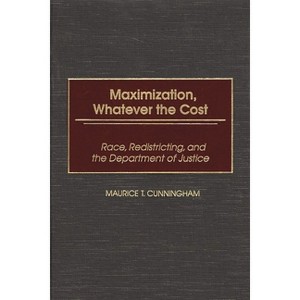
Maximization, Whatever the Cost - by Maurice T Cunningham (Hardcover)

$100.00
 

In Stock

Free & easy returns
Free & easy returns
Return this item by mail or in store within 90 days for a full refund.
Eligible for registries and wish lists
Save 5% every day
With Target Circle™ Card (restrictions apply)

About this item

Highlights

  • During the early 1990s the Department of Justice used its Voting Rights Act power to object to racially unfair redistricting laws to force states to maximize minority congressional districts.
  • About the Author: MAURICE T. CUNNINGHAM is Chairman of the Political Science Department at the University of Massachusetts at Boston.
  • 192 Pages
  • Political Science, American Government

Description


About the Book


During the early 1990s the Department of Justice used its Voting Rights Act power to object to racially unfair redistricting laws to force states to maximize minority congressional districts. The results were dramatic: Congressional Black Caucus membership swelled from 25 to 38 and nine new Hispanic congresspersons were sworn in. Only three years later, the maximization strategy lay in ruins. The courts forced many of the new minority districts to be redrawn and the judiciary reserved especially harsh criticism for the Department.

Cunningham examines and analyzes how the Department came to adopt the maximization strategy. He explores the bureaucratic culture of the Division's Voting Section, its history, and the interaction of its progressive career staff with more conservative political appointees. The Division works amidst a vibrant interest group environment, with civil rights advocates, the state, and political parties eager for influence. Cunningham shows how that influence contest was won by the civil rights groups, how their preferred interpretations of fair redistricting and discriminatory purpose were adopted by the Division, and how their chosen districting models were forced upon states by the Division. He examines the effect the Department has had on federalism, representation, and its own impaired credibility with the judiciary. Finally, he suggests how the Division might resurrect its damaged reputation for balanced enforcement. An important study for scholars, students, and public policy makers involved with civil rights, public administration, and public law.


Book Synopsis


During the early 1990s the Department of Justice used its Voting Rights Act power to object to racially unfair redistricting laws to force states to maximize minority congressional districts. The results were dramatic: Congressional Black Caucus membership swelled from 25 to 38 and nine new Hispanic congresspersons were sworn in. Only three years later, the maximization strategy lay in ruins. The courts forced many of the new minority districts to be redrawn and the judiciary reserved especially harsh criticism for the Department.

Cunningham examines and analyzes how the Department came to adopt the maximization strategy. He explores the bureaucratic culture of the Division's Voting Section, its history, and the interaction of its progressive career staff with more conservative political appointees. The Division works amidst a vibrant interest group environment, with civil rights advocates, the state, and political parties eager for influence. Cunningham shows how that influence contest was won by the civil rights groups, how their preferred interpretations of fair redistricting and discriminatory purpose were adopted by the Division, and how their chosen districting models were forced upon states by the Division. He examines the effect the Department has had on federalism, representation, and its own impaired credibility with the judiciary. Finally, he suggests how the Division might resurrect its damaged reputation for balanced enforcement. An important study for scholars, students, and public policy makers involved with civil rights, public administration, and public law.


Review Quotes


"As someone who served on a congressional redistricting commission in 1991, I encountered the force of the Department of Justice doctrine of maximization' of minority representation. But not until I read Maurice Cunningham's superb account of the administration of Section Five of the Voting Rights Act did I realize just how far political and career professionals could push the envelope of voting rights policy."-Alan Rosenthal Professor of Political Science Eagleton Institute, Rutgers University

.,."a refreshing addition to the VRA literature because it is not a piece of advocacy....a breath of fresh air and a succinct inquiry into the politics and implementation of the Voting Rights Act. It puts the many works of advocacy that characterize the voting rights literature into a thoughtful political science perspective."-American Political Science Review

?...a refreshing addition to the VRA literature because it is not a piece of advocacy....a breath of fresh air and a succinct inquiry into the politics and implementation of the Voting Rights Act. It puts the many works of advocacy that characterize the voting rights literature into a thoughtful political science perspective.?-American Political Science Review

..."a refreshing addition to the VRA literature because it is not a piece of advocacy....a breath of fresh air and a succinct inquiry into the politics and implementation of the Voting Rights Act. It puts the many works of advocacy that characterize the voting rights literature into a thoughtful political science perspective."-American Political Science Review


About the Author


MAURICE T. CUNNINGHAM is Chairman of the Political Science Department at the University of Massachusetts at Boston./e He is a former assistant attorney general in Massachusetts and participated as co-counsel in Voting Rights Act litigation.
Dimensions (Overall): 9.52 Inches (H) x 6.32 Inches (W) x .78 Inches (D)
Weight: 1.06 Pounds
Suggested Age: 22 Years and Up
Number of Pages: 192
Genre: Political Science
Sub-Genre: American Government
Publisher: Praeger
Theme: Legislative Branch
Format: Hardcover
Author: Maurice T Cunningham
Language: English
Street Date: October 30, 2000
TCIN: 1011487951
UPC: 9780275966492
Item Number (DPCI): 247-05-6524
Origin: Made in the USA or Imported
If the item details aren’t accurate or complete, we want to know about it.

Shipping details

Estimated ship dimensions: 0.78 inches length x 6.32 inches width x 9.52 inches height
Estimated ship weight: 1.06 pounds
We regret that this item cannot be shipped to PO Boxes.
This item cannot be shipped to the following locations: American Samoa (see also separate entry under AS), Guam (see also separate entry under GU), Northern Mariana Islands, Puerto Rico (see also separate entry under PR), United States Minor Outlying Islands, Virgin Islands, U.S., APO/FPO, Alaska, Hawaii

Return details

This item can be returned to any Target store or Target.com.
This item must be returned within 90 days of the date it was purchased in store, delivered to the guest, delivered by a Shipt shopper, or picked up by the guest.
See the return policy for complete information.

Additional product information and recommendations

Discover more options

Skip to next section

Best-selling Current Affairs & Politics Books

Skip to next section

Get top deals, latest trends, and more.