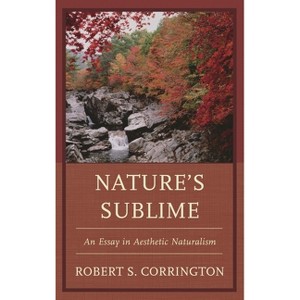
Nature's Sublime uses a radical new form of phenomenology to probe into the deepest traits of the human process in its individual, social, religious, and aesthetic dimensions.
About the Author: Robert S. Corrington is professor of philosophical theology in the graduate division of religion at Drew University, Madison, NJ.
230 Pages
Philosophy, Aesthetics
Description
About the Book
Nature's Sublime provides a radical new vision of infinite nature and its deepest aesthetic dimensions as they are encountered by finite human sign users. Rather than looking to religion for healing and salvation, Nature's Sublime argues that the arts provide a deeper relation...
Book Synopsis
Nature's Sublime uses a radical new form of phenomenology to probe into the deepest traits of the human process in its individual, social, religious, and aesthetic dimensions. Starting with the selving process the essay describes the role of signs and symbols in intra and interpersonal communication. At the heart of the human use of signs is a creative tension between religions symbols and the novel symbols created in the various arts. A contrast is made between natural communities, which flatten out and reject novel forms of semiosis, and communities of interpretation, which welcomes creative and enriched signs and symbols. The normative claim is made that religious sign/symbol systems have a tendency toward tribalism and violence, while the various spheres of the aesthetic are comparatively non-tribal, or even deliberatively anti-tribal. The concept/experience of beauty and the sublime is meant to replace that of religious revelation. The sublime is not merely an internal mode of attunement, contra Kant, but comes from the very depths of nature in the potencies of nature naturing.
Review Quotes
"In order to deliver its central thesis, this book traverses a wide scope of intellectual history--from continental philosophy to classical American to the psychoanalytic theories of Freud, Reich, Kohut, Jung, Rank, and Kristeva. Corrington contrasts communities that actively suppress and reject novel forms of semiosis and artistic creation with those communities of interpretation that welcome creative and enriched signs and symbols. ... the book makes particularly cogent contributions on the topic of religion and violence." --Religious Studies Review
"The regions of self, community, religion, and nature...are present. But each of these themes are radically recast within an aesthetic approach in mind. The aesthetics that Corrington is interpreting here is one which takes the sublime as its key motif. The sublime, we are told, reveals what is most essential about natura naturans ('nature naturing') and its relationship to 'the human process, ' a Buchlerian term designating a 'self' as creative agent in process. The split between nature naturing and nature natured is then taken up with the sublime in mind, and how the human being (or 'human process') relates psychoanalytically and semiotically to the sublime. This is the culminating theme of the book. Overall, those interested in American philosophy and theology, continental philosophy of religion, German idealism and romanticist aesthetics will appreciate this book because it takes on a very unique approach to thinking about religion through art." --Analecta Hermeneutica "[I]n Nature's Sublime, Corrington has crafted ordinal metaphysics, phenomenology, and psychoanalysis with aesthetics into a four-legged stool - remove one leg, and it may wobble but may still support an inquiry into the possibilities of grace in our time.... Moral in its imperative, aesthetic in its ultimacy, Nature's Sublime offers prescriptions for an Art of Life that may redeem our often mundane times." --The Pluralist "Robert Corrington continues to refine, develop, and clarify his vision of religious--or what he now prefers to call aesthetic--naturalism. The book's broad scope includes, among other things, presentation of an ordinal phenomenological metaphysics that contrasts with the phenomenologies of Husserl and Heidegger; analysis of closed and open types of semiotic communities and their respective stultifying and beneficent social effects; description of intrusions of the spirit that supplement the results of biological evolution and stem from the unconscious of nature upwelling into the human unconscious; and defense of the bold thesis that religion can become deeply ethical only when it surpasses itself and becomes sublated into the domain of aesthetic experience, creation, and life--especially to the extent that the aesthetic opens the way to the awesomely disturbing but also healing powers of the sublime. The richly innovative, provocative, and debatable character of Corrington's claims and arguments in relation to these and other topics will stimulate lively thought and discussion." --Donald A. Crosby, Colorado State University "Robert S. Corrington's tenth book, Nature's Sublime: An Essay in Aesthetic Naturalism, marks a major shift in Corringtonian thought to a new, third phase. The major claim of this book is that religion, given its ordinal complexity, is prone to tribalization, moreso than the aesthetic which is its foundation. Expanding upon the Schellingean thesis that art is to crown theology, Corrington links "god-ing" with aesthetic fulfillment, to a sublime that "lives on the other side of all religious revelations with their limiting and limited tribal content." Thus the encounter with art and the sublime is the culminating point of any individuating process - whether personal or communal. This is not to say that religion or theology no longer has any place for Corrington. Instead, within art, Corrington claims, lives the supernatural, understood as the "deeply natural."" --Leon Niemoczynski, Immaculata University "Robert Corrington has sifted his earlier philosophical work of ecstatic naturalism through a new aesthetic sieve with the help of Kant, Reich and Sri Aurobindo among other diverse thinkers. For readers new to Corrington´s work the first chapters of the book will serve as a helpful induction to his unique perspective. Those already familiar with his work will find new and exciting angles from which to ponder his complex system of semiotics, psychoanalysis, naturalism, aesthetics and religious experience from the standpoint of ordinal phenomenology. Nature´s Sublime is a rare treat indeed, an important landmark in Corrington´s intellectual journey." --Sigridur Gudmarsdottir, University of Iceland
About the Author
Robert S. Corrington is professor of philosophical theology in the graduate division of religion at Drew University, Madison, NJ. He has published nine previous books as an ongoing project of creating and expanding the philosophical and theological perspective of his ecstatic naturalism. From the beginning his work has been concerned with bringing classical American philosophy into dialogue with Continental thought. As important is his commitment to Post-Freudian psychoanalysis and its correlation to semiotics and metaphysics. He has served on the Boards of the Semiotic Society of America and the Highlands Institute and as president of the Karl Jaspers Society of North America.
Dimensions (Overall): 8.9 Inches (H) x 6.0 Inches (W) x .9 Inches (D)
Weight: .8 Pounds
Suggested Age: 22 Years and Up
Number of Pages: 230
Genre: Philosophy
Sub-Genre: Aesthetics
Publisher: Lexington Books
Format: Paperback
Author: Robert S Corrington
Language: English
Street Date: March 15, 2015
TCIN: 1012317541
UPC: 9781498510882
Item Number (DPCI): 247-42-5974
Origin: Made in the USA or Imported
If the item details aren’t accurate or complete, we want to know about it.
Shipping details
Estimated ship dimensions: 0.9 inches length x 6 inches width x 8.9 inches height
Estimated ship weight: 0.8 pounds
We regret that this item cannot be shipped to PO Boxes.
This item cannot be shipped to the following locations: American Samoa (see also separate entry under AS), Guam (see also separate entry under GU), Northern Mariana Islands, Puerto Rico (see also separate entry under PR), United States Minor Outlying Islands, Virgin Islands, U.S., APO/FPO, Alaska, Hawaii
Return details
This item can be returned to any Target store or Target.com.
This item must be returned within 90 days of the date it was purchased in store, delivered to the guest, delivered by a Shipt shopper, or picked up by the guest.