Target New ArrivalsHalloweenChristmasGift IdeasClothing, Shoes & AccessoriesHome & DecorKitchen & DiningPatio, Lawn & GardenGroceryHousehold EssentialsBabyBeautyTarget Beauty StudioPersonal CareSports & OutdoorsPetsHealthWellnessSchool & Office SuppliesToys & GamesElectronics & TechVideo GamesBooks, Music & MoviesParty SuppliesGift CardsShop by CommunityTarget OpticalDealsClearanceNew ArrivalsHalloweenChristmasGift IdeasTop DealsTarget Circle DealsWeekly AdShop Order PickupShop Same Day DeliveryRegistryRedCardTarget CircleFind Stores
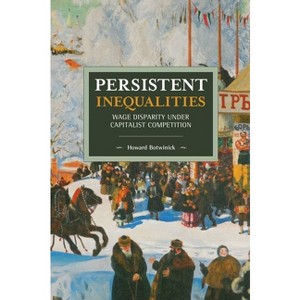
Persistent Inequalities - (Historical Materialism) by  Howard Botwinick (Paperback) - 1 of 1

Persistent Inequalities - (Historical Materialism) by Howard Botwinick (Paperback)

$30.99

In Stock

Free & easy returns
Free & easy returns
Return this item by mail or in store within 90 days for a full refund.
Eligible for registries and wish lists
Save 5% every day
With Target Circle™ Card (restrictions apply)

About this item

Highlights

  • Economists generally assume that wage differentials among similar workers will only endure when competition in the capital and/or labor market is restricted.
  • About the Author: Howard Botwinick, Ph.D. (1985) New School for Social Research, is Associate Professor of Economics at SUNY Cortland.
  • 390 Pages
  • Political Science, Labor & Industrial Relations
  • Series Name: Historical Materialism

Description


About the Book


Botwinick provocatively shows that competition and technical change often militate against wage equalization, and calls for militant union organization that can once again take wages and working conditions out of capitalist competition.


Book Synopsis


Economists generally assume that wage differentials among similar workers will only endure when competition in the capital and/or labor market is restricted. However, using a classical Marxist anaysis of real capitalist competition, Botwinick shows that substantial patterns of wage disparity can persist despite high levels of competition. Indeed, the author provocatively argues that competition and technical change often militate against wage equalization. In addition to providing the basis for a more unified analysis of race and gender inequality within labor markets, Botwinick's work has important implications for contemporary union strategies. Going against mainstream proponents of labor-management cooperation, the author calls for militant union organization that can once again take wages and working conditions out of capitalist competition.

This revised edition was originally published under the same title in 1993 by Princeton University Press.


Review Quotes


"Persistent Inequalities makes a major contribution to economic theory, bringing together a number of existing analytical elements and forging them into a coherent, logical analysis. Further, it includes important innovations. The analytical strength of the book lies in its use of competition as the explanatory mechanism for wage differential [...] It offers an exciting and stimulating explanation of a real-world phenomenon and its social implications."
--John Weeks, University of London, Center for Development Studies, School of Oriental and African Studies

"Today employers cite 'competitiveness' as the reason for cutting wages and benefits and imposing new forms of speed-up. Good jobs are replaced by technology, on the one hand, and subcontracted, substandard jobs, on the other, as capital rushes to cut labor costs. The result is both a general decline in U.S. real wages, now below their 1973 level, and greater inequalities among workers. Persistent Inequalities gives us a contemporary Marxist analysis of wage and income differentials in the labor force - one that is based on the actual dynamics of capitalist competition. Because of this, economist Howard Botwinick, particularly in his conception of the 'regulating capital, ' has given us a prism through which to craft strategies to end the very decline and inequality he explains."
--Kim Moody, author of An Injury to All: The Decline of American Unionism and US Labor in Trouble and Transition

"Botwinick's scholarship is first-rate. His main objective is to reconstruct the explanation for interindustry and intraindustry wage differentials on the basis of the perspective of classical political economy and classical Marxism, rather than orthodox (neoclassical) economics. An important thrust of the book is the argument that the orthodox perspective, particularly in its human capital variant, fails to explain not only differences in earnings across occupations but also differences between persons who may differ ascriptively by race or by gender. The failure is due to the orthodox theory's invalid characterization of competition. The author demonstrates that the classical perspective can be utilized to provide a much richer and persuasive theory of wage differences [...] This work is certainly a significant contribution both to the theory of income distribution and to the theory of industrial organization in economics. In addition, the author explains difficult technical issues in an accessible fashion."
--William, Darity, Jr, University of North Carolina

"Labor organizer turned economist, Howard Botwinick, has written a seminal book in labor economics. Drawing upon the theoretical work of his teacher, Anwar Shaikh of the New School for Social Research, Botwinick in Persistent Inequalities has built what has eluded radical economists, namely, a fully determinate model of labor markets [...] The beauty of Botwinick's analysis is that, while class struggle enters into wage determination, wage rates are not completely indeterminate. There are concrete limits to wage increases [...] Botwinick's work has important implications for the labor movement. At any given time, there will be excellent organizing opportunities. Many of our service industries today are likely to be regulating capitals, and, therefore, good targets for unionization [...] So are low-wage workers in highly capitalized industries [...]"
--Michael Yates, author of Why Unions Matter, in Monthly Review, February 1996


"Botwinick's book is not simply aimed at radical and Marxian academics. Though often complex, it is clearly written and accessible to activists in the labor and social movements interested in the determinants of wages and working conditions."
--Charles Post, Critical Sociology


About the Author


Howard Botwinick, Ph.D. (1985) New School for Social Research, is Associate Professor of Economics at SUNY Cortland. He has been active in several unions and was a founding member of the U.S. Labor Party in the 1990s.

Dimensions (Overall): 8.8 Inches (H) x 6.0 Inches (W) x .9 Inches (D)
Weight: 1.1 Pounds
Suggested Age: 22 Years and Up
Number of Pages: 390
Genre: Political Science
Sub-Genre: Labor & Industrial Relations
Series Title: Historical Materialism
Publisher: Haymarket Books
Format: Paperback
Author: Howard Botwinick
Language: English
Street Date: December 11, 2018
TCIN: 1014889709
UPC: 9781608460199
Item Number (DPCI): 247-66-1770
Origin: Made in the USA or Imported
If the item details aren’t accurate or complete, we want to know about it.

Shipping details

Estimated ship dimensions: 0.9 inches length x 6 inches width x 8.8 inches height
Estimated ship weight: 1.1 pounds
We regret that this item cannot be shipped to PO Boxes.
This item cannot be shipped to the following locations: American Samoa (see also separate entry under AS), Guam (see also separate entry under GU), Northern Mariana Islands, Puerto Rico (see also separate entry under PR), United States Minor Outlying Islands, Virgin Islands, U.S., APO/FPO, Alaska, Hawaii

Return details

This item can be returned to any Target store or Target.com.
This item must be returned within 90 days of the date it was purchased in store, delivered to the guest, delivered by a Shipt shopper, or picked up by the guest.
See the return policy for complete information.

Additional product information and recommendations

Discover more options

Skip to next section

Best-selling Current Affairs & Politics Books

Skip to next section

Get top deals, latest trends, and more.