Target New ArrivalsHalloweenClothing, Shoes & AccessoriesHome & DecorKitchen & DiningPatio, Lawn & GardenGroceryHousehold EssentialsBabyBeautyTarget Beauty StudioPersonal CareSports & OutdoorsPetsHealthWellnessSchool & Office SuppliesToys & GamesElectronics & TechVideo GamesBooks, Music & MoviesParty SuppliesGift IdeasGift CardsShop by CommunityTarget OpticalDealsClearanceNew ArrivalsBack to SchoolCollegeTop DealsTarget Circle DealsWeekly AdShop Order PickupShop Same Day DeliveryRegistryRedCardTarget CircleFind Stores
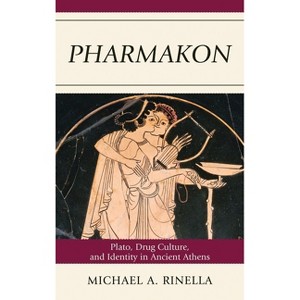
Pharmakon - by  Michael A Rinella (Paperback) - 1 of 1

Pharmakon - by Michael A Rinella (Paperback)

$60.95

In Stock

Free & easy returns
Free & easy returns
Return this item by mail or in store within 90 days for a full refund.
Eligible for registries and wish lists
Save 5% every day
With Target Circle™ Card (restrictions apply)

About this item

Highlights

  • Pharmakon: Plato, Drug Culture, and Identity in Ancient Athens examines the emerging concern for controlling states of psychological ecstasy in the history of western thought, focusing on ancient Greece (c. 750 - 146 BCE), particularly the Classical Period (c. 500 - 336 BCE) and especially the dialogues of the Athenian philosopher Plato (427 - 347 BCE).
  • About the Author: Michael A. Rinella holds a Ph.D. in political science from the Rockefeller College of Public Affairs and Policy, University at Albany, SUNY, and he is currently an instructor of political theory at Empire State College.
  • 358 Pages
  • Literary Criticism, Semiotics & Theory

Description


About the Book


Pharmakon traces the emergence of an ethical discourse in ancient Greece, one centered on states of psychological ecstasy. In the dialogues of Plato, philosophy is itself characterized as a pharmakon, one superior to a large number of rival occupations, each of which laid clai...


Book Synopsis


Pharmakon: Plato, Drug Culture, and Identity in Ancient Athens examines the emerging concern for controlling states of psychological ecstasy in the history of western thought, focusing on ancient Greece (c. 750 - 146 BCE), particularly the Classical Period (c. 500 - 336 BCE) and especially the dialogues of the Athenian philosopher Plato (427 - 347 BCE).

Employing a diverse array of materials ranging from literature, philosophy, medicine, botany, pharmacology, religion, magic, and law, Pharmakon fundamentally reframes the conceptual context of how we read and interpret Plato's dialogues. Michael A. Rinella demonstrates how the power and truth claims of philosophy, repeatedly likened to a pharmakon, opposes itself to the cultural authority of a host of other occupations in ancient Greek society who derived their powers from, or likened their authority to, some pharmakon. These included Dionysian and Eleusinian religion, physicians and other healers, magicians and other magic workers, poets, sophists, rhetoricians, as well as others.

Accessible to the general reader, yet challenging to the specialist, Pharmakon is a comprehensive examination of the place of drugs in ancient thought that will compel the reader to understand Plato in a new way.


Review Quotes


"Beginning from the most thorough review of classical intoxicants, Rinella applies his findings in detail to many Platonic texts. His results certainly have great significance for students of Plato, but also for the history of medicine and of classical civilization generally. It is a truly impressive accomplishment." --Anthony Preus, Binghamton University

"Rinella's discussion of the nature and prevalence of drugs in the Classical Age of Athens is an essential context for a major theme in the Platonic dialogues and provides a valuable background for any student of the great philosopher's works. As Rinella astutely demonstrates, Plato appears to have been the first to address the problem of drug induced ecstasy as dangerous to the well-ordered functioning of society, leading to potentially criminal behavior and non-rational modes of thought, and the philosopher's solution to the problem as the 'noble lie' still survives in our current drug policy." --Carl A. P. Ruck, Boston University

"There is serious scholarship across a range of disciplines, which demands that this be considered a contribution both to history and to studies of society. There is of course a political agenda, an agenda supported with reference to such figures as Derrida and Foucault, but it is muted and mostly kept well in the background. Certain features of Athenian society make this contribution especially welcome. The Greek symposium is currently receiving considerable attention, an institution where wine, itself rich in other intoxicating impurities, was employed to the point of loss of control...He helps us to look at Plato in a fresh new way, even though such perspectives can only capture part of the picture. Few will think that the pleas for a more relaxed attitude to recreational drug use depend on the clarity of his case on every point along his journey. And here too some will feel more relaxed about his conclusions than others. But as with Plato, the text is supposed to be a catalyst to debate, not the final word." --The Social History of Alcohol and Drugs

"[T]his is a vitally important pharmacography. Not only does it shed light on today's 'drugs problem' via the very roots of Western literary and philosophic thought, it does not do the disservice of assumption to the ancient Greeks, and boldy addresses them on their own terms. It is a treasure trove of investigations that, no doubt, will help cast new light on an a multitude of concerns surrounding the human use of that great ambiguity - the drug/pharmakon." --Psychedelic Press UK

"Michael Rinella's Pharmakon: Plato, Drug Culture, and Identity in Ancient Athens . . . .draws upon an impressively diverse array of sources, from literary and historical texts to pottery and other fragments of material culture to recent studies in molecular archaeology. . . .Overall [the book] advances a provocative set of claims [providing] a helpful introduction to the core sources that represent early drug culture. Rinella's treatment of these sources shows how very different discourses were afoot than those so prevalent today." --New Political Science


About the Author


Michael A. Rinella holds a Ph.D. in political science from the Rockefeller College of Public Affairs and Policy, University at Albany, SUNY, and he is currently an instructor of political theory at Empire State College.
Dimensions (Overall): 8.92 Inches (H) x 6.01 Inches (W) x 1.03 Inches (D)
Weight: 1.17 Pounds
Suggested Age: 22 Years and Up
Number of Pages: 358
Genre: Literary Criticism
Sub-Genre: Semiotics & Theory
Publisher: Lexington Books
Format: Paperback
Author: Michael A Rinella
Language: English
Street Date: November 23, 2011
TCIN: 1013514954
UPC: 9780739146873
Item Number (DPCI): 247-29-1530
Origin: Made in the USA or Imported
If the item details aren’t accurate or complete, we want to know about it.

Shipping details

Estimated ship dimensions: 1.03 inches length x 6.01 inches width x 8.92 inches height
Estimated ship weight: 1.17 pounds
We regret that this item cannot be shipped to PO Boxes.
This item cannot be shipped to the following locations: American Samoa (see also separate entry under AS), Guam (see also separate entry under GU), Northern Mariana Islands, Puerto Rico (see also separate entry under PR), United States Minor Outlying Islands, Virgin Islands, U.S., APO/FPO, Alaska, Hawaii

Return details

This item can be returned to any Target store or Target.com.
This item must be returned within 90 days of the date it was purchased in store, delivered to the guest, delivered by a Shipt shopper, or picked up by the guest.
See the return policy for complete information.

Additional product information and recommendations

Discover more options

Skip to next section

Best-selling Adult Non-Fiction Books

Skip to next section

Get top deals, latest trends, and more.