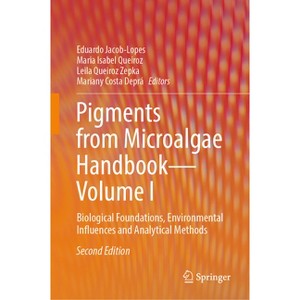
Based on the success of the first edition, Pigments from Microalgae Handbook - Second Edition, Volume I: Biological Foundations, Environmental Influences and Analytical Methods is the first of a comprehensive three-volume series offering an authoritative and up-to-date reference on the science, technology, and applications of microalgal pigments.
About the Author: Prof. Eduardo Jacob-Lopes is currently an Associate Professor at the Department of Food Technology and Science, Federal University of Santa Maria, Brazil.
494 Pages
Science, Chemistry
Description
Book Synopsis
Based on the success of the first edition, Pigments from Microalgae Handbook - Second Edition, Volume I: Biological Foundations, Environmental Influences and Analytical Methods is the first of a comprehensive three-volume series offering an authoritative and up-to-date reference on the science, technology, and applications of microalgal pigments. Carefully updated and expanded, this new edition consolidates the most pressing guidelines and cutting-edge developments in scientific research, technological innovation, and practical applications related to microalgal pigments. Each chapter in this fully revised volume reflects the latest scientific advances in microalgal pigment research, integrating fundamental concepts such as occurrence, distribution, and biosynthesis with emerging insights into environmental modulation, including the impacts of climate change on pigment production and photosynthesis. The handbook also features state-of-the-art analytical methodologies for the identification, quantification, and bioavailability of key pigment classes -- chlorophylls, carotenoids, and phycobiliproteins -- alongside sustainable extraction strategies and green chemistry approaches designed to optimize recovery and support advanced biotechnological applications. Presented in an accessible and well-organized format, this handbook is an indispensable resource for researchers, academics, and professionals in biochemistry, food chemistry, industrial microbiology, and biotechnology industries seeking to deepen their expertise or drive innovation in microalgal pigment applications.
From the Back Cover
Based on the success of the first edition, Pigments from Microalgae Handbook - Second Edition, Volume I: Biological Foundations, Environmental Influences and Analytical Methods is the first of a comprehensive three-volume series offering an authoritative and up-to-date reference on the science, technology, and applications of microalgal pigments. Carefully updated and expanded, this new edition consolidates the most pressing guidelines and cutting-edge developments in scientific research, technological innovation, and practical applications related to microalgal pigments.
Each chapter in this fully revised volume reflects the latest scientific advances in microalgal pigment research, integrating fundamental concepts such as occurrence, distribution, and biosynthesis with emerging insights into environmental modulation, including the impacts of climate change on pigment production and photosynthesis. The handbook also features state-of-the-art analytical methodologies for the identification, quantification, and bioavailability of key pigment classes -- chlorophylls, carotenoids, and phycobiliproteins -- alongside sustainable extraction strategies and green chemistry approaches designed to optimize recovery and support advanced biotechnological applications.
Presented in an accessible and well-organized format, this handbook is an indispensable resource for researchers, academics, and professionals in biochemistry, food chemistry, industrial microbiology, and biotechnology industries seeking to deepen their expertise or drive innovation in microalgal pigment applications.
About the Author
Prof. Eduardo Jacob-Lopes is currently an Associate Professor at the Department of Food Technology and Science, Federal University of Santa Maria, Brazil. He has more than 15 years of teaching and research experience. He has coordinated/coordinates more than 50 research projects and/or technological developments financed by public funding agencies and private initiatives. He has published more than 800 scientific publications/communications, including books, book chapters, original research papers, research communications in conferences, and innovation patents. He is a member of the editorial boards of 10 journals and acts as a reviewer for several national and international journals. His research interests focus on a multidisciplinary approach to applied phycology and its intersection with bioprocess engineering and sustainable engineering Prof. Maria Isabel Queiroz is a former full professor at the School of Chemistry and Food, Federal University of Rio Grande, Brazil. She has more than 500 publications/communications to her credit, including books, book chapters, original research papers, and research communications in conferences. Her main research interest is in microalgal biotechnology with an emphasis on bioprocesses. Prof. Leila Queiroz Zepka is currently an Associate Professor at the Department of Food Technology and Science, Federal University of Santa Maria, Brazil. She has more than 15 years of teaching and research experience. She has published more than 700 scientific publications/communications, including books, book chapters, original research papers, research communications in conferences, and innovation patents. She is member of the editorial boards of 5 journals and acts as a reviewer for several national and international journals. Her research interests include microalgae biotechnology, with an emphasis on biomolecules and natural pigments. Dr. Mariany Costa Deprá is currently a Researcher at the Department of Food Technology and Science, Federal University of Santa Maria, Brazil. She has published more than 150 scientific publications/communications, which include book chapters, original research papers, research communications in conferences, and innovation patents. She acts as a technical and scientific consultant for companies and international scientific journals. Her research interests include sustainability metrics and indicators, with an emphasis on bioprocess engineering.
Dimensions (Overall): 9.21 Inches (H) x 6.14 Inches (W) x 1.13 Inches (D)
Weight: 1.94 Pounds
Suggested Age: 22 Years and Up
Number of Pages: 494
Genre: Science
Sub-Genre: Chemistry
Publisher: Springer
Theme: Industrial & Technical
Format: Hardcover
Author: Eduardo Jacob-Lopes & Maria Isabel Queiroz & Leila Queiroz Zepka & Mariany Costa Deprá
Language: English
Street Date: January 31, 2026
TCIN: 1010996431
UPC: 9783031939440
Item Number (DPCI): 247-34-7638
Origin: Made in the USA or Imported
If the item details aren’t accurate or complete, we want to know about it.
Shipping details
Estimated ship dimensions: 1.13 inches length x 6.14 inches width x 9.21 inches height
Estimated ship weight: 1.94 pounds
We regret that this item cannot be shipped to PO Boxes.
This item cannot be shipped to the following locations: American Samoa (see also separate entry under AS), Guam (see also separate entry under GU), Northern Mariana Islands, Puerto Rico (see also separate entry under PR), United States Minor Outlying Islands, Virgin Islands, U.S., APO/FPO, Alaska, Hawaii
Return details
This item can be returned to any Target store or Target.com.
This item must be returned within 90 days of the date it was purchased in store, delivered to the guest, delivered by a Shipt shopper, or picked up by the guest.