Target New ArrivalsFourth of JulyGift Ideas for DadClothing, Shoes & AccessoriesHome & DecorKitchen & DiningOutdoor Living & GardenGroceryHousehold EssentialsBabyBeautyPersonal CareSports & OutdoorsHealthWellnessLuggageSchool & Office SuppliesToys & GamesElectronicsVideo GamesMovies, Music & BooksParty SuppliesGift IdeasGift CardsPetsUlta Beauty at TargetShop by CommunityTarget OpticalDealsClearanceNew ArrivalsGift Ideas for DadBack to SchoolCollegeTop DealsTarget Circle DealsWeekly AdShop Order PickupShop Same Day DeliveryRegistryRedCardTarget CircleFind Stores
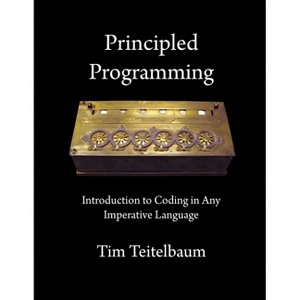
Principled Programming - by  Tim Teitelbaum (Paperback) - 1 of 1

Principled Programming - by Tim Teitelbaum (Paperback)

In Stock

Free & easy returns
Free & easy returns
Return this item by mail or in store within 90 days for a full refund.
Eligible for registries and wish lists

About this item

Highlights

  • This book is an introduction to computer programming aimed at the level of a first college course.
  • Author(s): Tim Teitelbaum
  • 432 Pages
  • Computers + Internet, Programming

Description


Book Synopsis


This book is an introduction to computer programming aimed at the level of a first college course. It is also suitable as a monograph for people beyond the introductory level who are unfamiliar with its methodological content.


A typical introductory programming textbook begins with the notions of algorithm, program, computer, program execution, memory, input, and output. The rest of the book presents a programming language. Each language feature is defined by its syntax, i.e., how to punctuate it, and its semantics, i.e., what the feature does during program execution. Small programs or program snippets illustrate each feature and its utility. Because modern programming languages are large, such books are also large. These books are intimidating in their length, but not in their depth.


Where in such language-oriented books are students explicitly instructed in how to program? Guidance and suggestions may be scattered throughout the text, but are usually subordinate to the main chapter structure, which is based on language constructs. Illustrative examples are critical, but are usually presented as completed programs. The text typically explains how code works, but not how it was derived. Programming, the dynamic and synthetic activity of creating a program, often gets short shrift, as if you are supposed to learn how to do it by osmosis while staring at code samples. You can know a programming language thoroughly, but still not know how to program. Confronted with a programming problem, you may have no idea where to begin. Or worse, you may head off in the wrong direction, and soon find yourself mired in a morass from which the best path forward may be to back up and start all over again.


In contrast, this book is a methodology-oriented introduction to computer programming. Its subject is programming principles, not language features. To keep focus and avoid distraction, it is limited to a minimal programming language, one so small that it can be said to be universal. Programming skill is measured by the ease with which you can turn a problem statement into a working program, not by the number of language features you know.


The methodology presented is not specific to a particular language; rather, it applies to programming, in general. The notation used is essentially a small subset of Java, but the book is about programming, not programming in Java. An appendix provides mappings from this core subset of Java to equivalents in Python, C/C++, and JavaScript.


The approach is distinctive in that it presents content to beginners that is often considered advanced, e.g., program state-spaces, specifications written in terms of preconditions and postconditions, loop invariants, data-structure invariants, loop variants, and programming by stepwise refinement. But the book retains an introductory character --- by avoiding formalism, offering intuitive analogies, and providing elementary explanations.

The book's focus is synthesis, not analysis. Thus, no substantial algorithm or application is presented as a fait accompli for interpretation. Rather, the essential content of the book is the stepwise development of solutions rather than the solutions per se.


Language-oriented introductions to programming tend toward being encyclopedic tomes; in contrast, this is a comparatively short, coherent, and digestible book that aspires to tell a compelling story, knitted together by interesting, nontrivial examples that are woven throughout --- a book that invites cover-to-cover reading.

Dimensions (Overall): 11.0 Inches (H) x 8.5 Inches (W) x .88 Inches (D)
Weight: 2.19 Pounds
Suggested Age: 22 Years and Up
Number of Pages: 432
Genre: Computers + Internet
Sub-Genre: Programming
Publisher: Datetree Press
Theme: General
Format: Paperback
Author: Tim Teitelbaum
Language: English
Street Date: June 28, 2023
TCIN: 1006924393
UPC: 9798987744109
Item Number (DPCI): 247-42-3376
Origin: Made in the USA or Imported
If the item details aren’t accurate or complete, we want to know about it.

Shipping details

Estimated ship dimensions: 0.88 inches length x 8.5 inches width x 11 inches height
Estimated ship weight: 2.19 pounds
We regret that this item cannot be shipped to PO Boxes.
This item cannot be shipped to the following locations: American Samoa (see also separate entry under AS), Guam (see also separate entry under GU), Northern Mariana Islands, Puerto Rico (see also separate entry under PR), United States Minor Outlying Islands, Virgin Islands, U.S., APO/FPO, Alaska, Hawaii

Return details

This item can be returned to any Target store or Target.com.
This item must be returned within 90 days of the date it was purchased in store, delivered to the guest, delivered by a Shipt shopper, or picked up by the guest.
See the return policy for complete information.

Q: What is the main focus of this programming book?

submitted by AI Shopping Assistant - 15 days ago
  • A: The book emphasizes programming principles and methodologies rather than specific language features.

    submitted byAI Shopping Assistant - 15 days ago
    Ai generated

Q: How does this book differ from typical programming textbooks?

submitted by AI Shopping Assistant - 15 days ago
  • A: It focuses on the synthesis of programming skills rather than just language syntax and semantics.

    submitted byAI Shopping Assistant - 15 days ago
    Ai generated

Q: What programming languages does the book reference?

submitted by AI Shopping Assistant - 15 days ago
  • A: The book primarily uses a small subset of Java and includes mappings to Python, C/C++, and JavaScript.

    submitted byAI Shopping Assistant - 15 days ago
    Ai generated

Q: Who is the intended audience for this book?

submitted by AI Shopping Assistant - 15 days ago
  • A: It is aimed at beginners, particularly those in their first college programming course.

    submitted byAI Shopping Assistant - 15 days ago
    Ai generated

Q: What unique concepts does the book introduce to beginners?

submitted by AI Shopping Assistant - 15 days ago
  • A: It covers advanced topics like program state-spaces and programming by stepwise refinement in an accessible manner.

    submitted byAI Shopping Assistant - 15 days ago
    Ai generated

Additional product information and recommendations

Discover more options

Best-selling Computers & Technology Books

Get top deals, latest trends, and more.

Privacy policy