Target New ArrivalsFourth of JulyBack to SchoolCollegeClothing, Shoes & AccessoriesHome & DecorKitchen & DiningOutdoor Living & GardenGroceryHousehold EssentialsBabyBeautyPersonal CareSports & OutdoorsHealthWellnessSchool & Office SuppliesToys & GamesElectronicsVideo GamesMovies, Music & BooksParty SuppliesGift IdeasGift CardsPetsUlta Beauty at TargetShop by CommunityTarget OpticalDealsClearanceNew ArrivalsBack to SchoolCollegeTop DealsTarget Circle DealsWeekly AdShop Order PickupShop Same Day DeliveryRegistryRedCardTarget CircleFind Stores
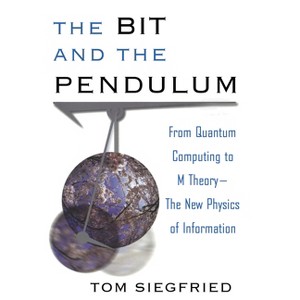
The Bit and the Pendulum - by  Tom Siegfried (Hardcover) - 1 of 1

The Bit and the Pendulum - by Tom Siegfried (Hardcover)

$23.49Save $7.46 (24% off)

In Stock

Free & easy returns
Free & easy returns
Return this item by mail or in store within 90 days for a full refund.
Eligible for registries and wish lists

About this item

Highlights

  • Funny, clear, deep, and right on target.
  • Author(s): Tom Siegfried
  • 288 Pages
  • Science, Philosophy & Social Aspects

Description


Book Synopsis


Funny, clear, deep, and right on target. [Siegfried] lets us get a handle on ideas that are essential for understanding the evolving world.
-K. C. Cole, author of The Universe and the Teacup
"An eager, ambitious book. A stimulating, accessible introduction to scientific theory."
-Dallas Morning News
An award-winning journalist surveys the horizon of a new revolution in science
Everything in the universe, from the molecules in our bodies to the heart of a black hole, is made up of bits of information. This is the radical idea at the center of the new physics of information, and it is leading to exciting breakthroughs in a vast range of science, including the invention of a new kind of quantum computer, millions of times faster than any computer today. Acclaimed science writer Tom Siegfried offers a lively introduction to the leading scientists and ideas responsible for this exciting new scientific paradigm.


Review Quotes


* "Light stopped." So read a number of headlines over recent news articles, about scientists bringing light to a full stop in a laboratory. The more careful writers explained that actually the experiments consisted of capturing all the information about some light rays in a soup of atoms and laser beams; this information could be used to reassemble the rays later and send them on their way. "The Bit and the Pendulum" explores the possibility that everything, heaven and earth and all that is in them, is, like that light, but a manifestation of information. Physical scientists are likely to meet this idea with a dismissive shrug; they are quite happy with energy as the foundation of everything. On the other hand, information scientists are likely to find the idea quite natural and exciting. Tom Siegfried, the science editor of The Dallas Morning News, invites the general reader to come to a personal conclusion. Siegfried posits that science, particularly physics, and by extension the rational view of the universe, have been driven by a succession of metaphorical worldviews - "superparadigms." In turn, these are motivated by the dominant machines of the era. The first: The universe as clockwork (the pendulum of the title) is manifested in Newtonian mechanics. Here force is a key concept, and energy, kinetic and potential, first appears as a conserved quantity. The second, some centuries later: The universe as a large heat engine Is manifested in the theory of thermodynamics, motivated by the steam engine. Energy, the key concept, is conserved, but entropy, or useless heat energy, increases, so the universe is running down. The third, motivated by the computer, the dominant machine of today, sees the universe as a large information processor. Entropy is information.

Information has a precise definition as the state of a system. The simplest bit of information is an either-or state, a zero or one, up or down, yes or no, or a protein either active or inactive (this last connects biology and information). Any system - an atom, a human, the universe - can be completely described by the answers to a few tens of yes-no questions (20 questions, anyone?); that is, a few tens of bits. An information processor, a computer, is a system that transforms its state, according to rules, into a new state. Do not underestimate the import of all this. The thesis developed in the book is that information is not a formal way of analyzing systems and their behavior. "Information is real. Information is physical," Siegfried writes. And later: "Information is more than a metaphor -it is a new reality." And the progression of events through time is computation, so the universe is essentially a huge. If mysterious, computer.

To illustrate, Siegfried begins with the idea of teleportation: "Beam me up, Scotty." If teleportation really exists - and Siegfried shows it does in some sense - it would consist of transporting not matter but the complete information about the structure of an object, every molecule of Captain Kirk, in such a way that the information in the previous location is destroyed. In this view of reality, Siegfried says, "information is the ultimate 'substance' from which all things are made"; witness the light of the recent headlines.

This concept, at most a few decades old in this form, is controversial. Learned opinions vary from complete acceptance to laughing rejection. This book is personal journalism. The author has met with many of the principal movers and shakers. He lets them speak for themselves and recounts his own intellectual journey. He has attended the scientific meetings and read the scientific papers. His primary mentors seem to have been the physicist John Wheeler, a professor of his at the University of Texas, Austin, and the late Rolf Landauer of I.B.M., a primary figure in the physical theory of information (and a deep skeptic about some of the newer directions of exploration).

The book is not about

Dimensions (Overall): 9.21 Inches (H) x 6.14 Inches (W) x .69 Inches (D)
Weight: 1.28 Pounds
Suggested Age: 22 Years and Up
Number of Pages: 288
Genre: Science
Sub-Genre: Philosophy & Social Aspects
Publisher: Trade Paper Press
Format: Hardcover
Author: Tom Siegfried
Language: English
Street Date: December 1, 2000
TCIN: 1011334598
UPC: 9781630261887
Item Number (DPCI): 247-12-8117
Origin: Made in the USA or Imported
If the item details aren’t accurate or complete, we want to know about it.

Shipping details

Estimated ship dimensions: 0.69 inches length x 6.14 inches width x 9.21 inches height
Estimated ship weight: 1.28 pounds
We regret that this item cannot be shipped to PO Boxes.
This item cannot be shipped to the following locations: American Samoa (see also separate entry under AS), Guam (see also separate entry under GU), Northern Mariana Islands, Puerto Rico (see also separate entry under PR), United States Minor Outlying Islands, Virgin Islands, U.S., APO/FPO, Alaska, Hawaii

Return details

This item can be returned to any Target store or Target.com.
This item must be returned within 90 days of the date it was purchased in store, delivered to the guest, delivered by a Shipt shopper, or picked up by the guest.
See the return policy for complete information.

Q: What is the main theme of the book?

submitted by AI Shopping Assistant - 2 months ago
  • A: The book explores the idea that everything in the universe is fundamentally made of information.

    submitted byAI Shopping Assistant - 2 months ago
    Ai generated

Q: What type of writing style is used in the book?

submitted by AI Shopping Assistant - 2 months ago
  • A: The writing style is described as funny, clear, deep, and engaging for readers.

    submitted byAI Shopping Assistant - 2 months ago
    Ai generated

Q: What genre does this book belong to?

submitted by AI Shopping Assistant - 2 months ago
  • A: This book falls under the genres of Science, Philosophy, and Social Aspects.

    submitted byAI Shopping Assistant - 2 months ago
    Ai generated

Q: Who is the author of this book?

submitted by AI Shopping Assistant - 2 months ago
  • A: The author of the book is Tom Siegfried, an acclaimed science writer.

    submitted byAI Shopping Assistant - 2 months ago
    Ai generated

Q: What significant scientific concept does the book discuss?

submitted by AI Shopping Assistant - 2 months ago
  • A: The book discusses the new physics of information and its implications for understanding the universe.

    submitted byAI Shopping Assistant - 2 months ago
    Ai generated

Additional product information and recommendations

Discover more options

Best-selling Education Books

Get top deals, latest trends, and more.