Target New ArrivalsGift Ideas for DadClothing, Shoes & AccessoriesHome & DecorKitchen & DiningOutdoor Living & GardenGroceryHousehold EssentialsBabyBeautyPersonal CareSports & OutdoorsHealthWellnessLuggageSchool & Office SuppliesToysElectronicsVideo GamesMovies, Music & BooksParty SuppliesGift IdeasGift CardsPetsUlta Beauty at TargetShop by CommunityTarget OpticalDealsClearanceNew ArrivalsGift Ideas for DadBack to SchoolCollegeTop DealsTarget Circle DealsWeekly AdShop Order PickupShop Same Day DeliveryRegistryRedCardTarget CircleFind Stores
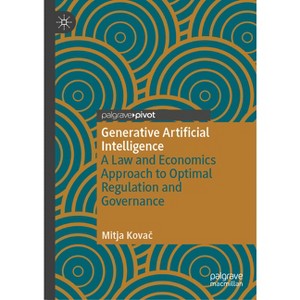
Generative Artificial Intelligence - by  Mitja Kova&#269 (Hardcover) - 1 of 1

Generative Artificial Intelligence - by Mitja Kovač (Hardcover)

$49.99

In Stock

Free & easy returns

Free & easy returns

Return this item by mail or in store within 90 days for a full refund.
Eligible for registries and wish lists

About this item

Highlights

  • This book takes a comparative law and economics approach to explore the role of public and private actors in regulating generative artificial intelligence.
  • About the Author: Mitja Kovač is full time Professor of Civil and Commercial Law at the University of Ljubljana, School of Economics and Business, Ljubljana, Slovenia.
  • 224 Pages
  • Business + Money Management, General

Description


Book Synopsis


This book takes a comparative law and economics approach to explore the role of public and private actors in regulating generative artificial intelligence. The book provides an introduction and context for the creation of new generative AI technologies, now understood to be the chief goal of the leading AI companies. As autonomous 'super-intelligences', these technologies are still an unknown entity which nevertheless have profound implications for liberal democracy, consumer choice mechanisms, mutual trust, and political legitimacy.

This book explores the deep challenges posed for lawmakers and how we can achieve an optimal form of regulation and governance of such unreliable technologies. Chapters investigate possible hybrid modes of regulation, such as a co-regulatory approach between private AI companies and public actors in addressing the issue of misinformation spread. It also explores mixed types of regulation toward research on new forms of AI, arguing that different levels of systemic risk posed by different technologies must be accounted for. Different contemporary and historical contexts for the regulation of unprecedented technical innovation are also considered, and new suggestions for policy are presented. This book is a timely resource which will be of interest to researchers and practitioners in economic governance, law and regulation, artificial intelligence, and comparative law.


From the Back Cover


"AI is guaranteed to change nearly every aspect of our lives, but predicting how it will do so and determining what role law and regulation should play involve huge uncertainty. Kovac gives us an insightful roadmap, using the tools of law and economics, to our bewildering future. In the process, he also provides a comprehensive and necessary guide to understanding the regulatory and legal challenges we will face in the very near future."

--Jonathan Klick, Charles A. Heimbold, Jr. Professor of Law, University of Pennsylvania and Erasmus Chair of Empirical Legal Studies, Erasmus University Rotterdam

This book takes a comparative law and economics approach to explore the role of public and private actors in regulating generative artificial intelligence. The book provides an introduction and context for the creation of new generative AI technologies, now understood to be the chief goal of the leading AI companies. As autonomous 'super-intelligences', these technologies are still an unknown entity which nevertheless have profound implications for liberal democracy, consumer choice mechanisms, mutual trust, and political legitimacy.

This book explores the deep challenges posed for lawmakers and how we can achieve an optimal form of regulation and governance of such unreliable technologies. Chapters investigate possible hybrid modes of regulation, such as a co-regulatory approach between private AI companies and public actors in addressing the issue of misinformation spread. It also explores mixed types of regulation toward research on new forms of AI, arguing that different levels of systemic risk posed by different technologies must be accounted for. Different contemporary and historical contexts for the regulation of unprecedented technical innovation are also considered, and new suggestions for policy are presented. This book is a timely resource which will be of interest to researchers and practitioners in economic governance, law and regulation, artificial intelligence, and comparative law.

Mitja Kovač is full time Professor of Civil and Commercial Law at the University of Ljubljana, School of Economics and Business, Ljubljana, Slovenia. He is also a visiting lecturer at the Erasmus University Rotterdam, The Netherlands, at University of Ghent, Belgium, at the ISM University of Management and Economics in Vilnius, Lithuania, and at University of Vienna, Austria. He publishes in the fields of comparative contract law and economics, new institutional economics, consumer protection, contract theory and competition law and economics.


About the Author


Mitja Kovač is full time Professor of Civil and Commercial Law at the University of Ljubljana, School of Economics and Business, Ljubljana, Slovenia. He is also a visiting lecturer at the Erasmus University Rotterdam, The Netherlands, at University of Ghent, Belgium, at the ISM University of Management and Economics in Vilnius, Lithuania, and at University of Vienna, Austria. He publishes in the fields of comparative contract law and economics, new institutional economics, consumer protection, contract theory and competition law and economics.

Dimensions (Overall): 8.47 Inches (H) x 6.34 Inches (W) x .73 Inches (D)
Weight: .89 Pounds
Suggested Age: 22 Years and Up
Number of Pages: 224
Genre: Business + Money Management
Sub-Genre: General
Publisher: Palgrave MacMillan
Format: Hardcover
Author: Mitja Kova&#269
Language: English
Street Date: January 8, 2025
TCIN: 1010870535
UPC: 9783031655135
Item Number (DPCI): 247-32-0699
Origin: Made in the USA or Imported
If the item details aren’t accurate or complete, we want to know about it.

Shipping details

Estimated ship dimensions: 0.73 inches length x 6.34 inches width x 8.47 inches height
Estimated ship weight: 0.89 pounds
We regret that this item cannot be shipped to PO Boxes.
This item cannot be shipped to the following locations: American Samoa (see also separate entry under AS), Guam (see also separate entry under GU), Northern Mariana Islands, Puerto Rico (see also separate entry under PR), United States Minor Outlying Islands, Virgin Islands, U.S., APO/FPO, Alaska, Hawaii

Return details

This item can be returned to any Target store or Target.com.
This item must be returned within 90 days of the date it was purchased in store, delivered to the guest, delivered by a Shipt shopper, or picked up by the guest.
See the return policy for complete information.

Q: What implications does the book discuss regarding AI technologies?

submitted by AI Shopping Assistant - 2 months ago
  • A: The book highlights profound implications for democracy, consumer choice, trust, and political legitimacy due to AI advancements.

    submitted byAI Shopping Assistant - 2 months ago
    Ai generated

Q: What is the focus of the book's approach?

submitted by AI Shopping Assistant - 2 months ago
  • A: The book employs a comparative law and economics framework to examine regulatory roles in generative artificial intelligence.

    submitted byAI Shopping Assistant - 2 months ago
    Ai generated

Q: Who is the intended audience for this book?

submitted by AI Shopping Assistant - 2 months ago
  • A: This book is aimed at researchers and practitioners in economic governance, law and regulation, and artificial intelligence.

    submitted byAI Shopping Assistant - 2 months ago
    Ai generated

Q: What types of regulation does the book explore?

submitted by AI Shopping Assistant - 2 months ago
  • A: The book covers mixed regulation strategies geared towards AI research and addresses varying systemic risks from different technologies.

    submitted byAI Shopping Assistant - 2 months ago
    Ai generated

Q: How does the book address misinformation spread?

submitted by AI Shopping Assistant - 2 months ago
  • A: It investigates hybrid regulatory modes, particularly co-regulatory approaches between private companies and public actors.

    submitted byAI Shopping Assistant - 2 months ago
    Ai generated

Additional product information and recommendations

Discover more options

Frequently bought together

Get top deals, latest trends, and more.

Privacy policy