Return this item by mail or in store within 90 days for a full refund.
Eligible for registries and wish lists
About this item
Highlights
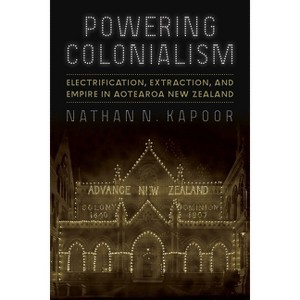
Powering Colonialism explores the history of electrification and its relationship to colonialism in Aotearoa New Zealand.
About the Author: Nathan N. Kapoor is assistant professor of history at Illinois State University.
History, Australia & New Zealand
Series Name: Intersections
Description
Book Synopsis
Powering Colonialism explores the history of electrification and its relationship to colonialism in Aotearoa New Zealand. Exploitative electric infrastructure, Nathan N. Kapoor argues, was not inevitable, and it was not determined by geography or a coincidence of colonization--it was by design. By the twenty-first century, hydropower provided more than half the country's electricity. Although it is now lauded as a renewable energy source, advocates for the earliest hydroelectrification schemes were more concerned with extracting greater profits and highlighting British technological superiority. Settlers, miners, and politicians saw electricity as a tool for achieving modernity, wealth, and self-sufficiency, and Aotearoa New Zealand's vast river system, once a barrier to colonial expansion, was now used to justify it. The electrification projects Kapoor examines in Powering Colonialism--from hydroelectric power for gold mining in the 1880s to Māori-led geothermal energy plants in use today--illustrate how, from the very beginning of Aotearoa New Zealand's transition to electric power, settlers designed and used electric power systems in service to their colonial mission.
Review Quotes
In this thought-provoking book, Nathan N. Kapoor deftly explores the relationship between electrification and settler colonial logics in Aotearoa New Zealand. Through five different electrification projects, Kapoor powerfully demonstrates that modern Aotearoa's electric energy systems were not determined by a path of least resistance, but rather were historically conceived, adapted, and justified in accordance with settler colonial notions of land use and value imported from across the British Empire. Powering Colonialism is a necessary read for anyone seeking to understand settler colonialism's role in shaping global energy systems.--Jessica Urwin, University of Tasmania
Nathan N. Kapoor's lively book fills a welcome gap in scholarship on electrification in Aotearoa New Zealand. It reveals the legacy of colonial development projects in shaping the country's current electricity generation system, and that there was nothing inevitable or natural about the emergence of such infrastructure. His work also points to the losses--environmentally, socially, and to the Māori--of such grandiose projects of modernity and cautions current decision-makers to be cogniscent of avoiding past mistakes.--James Beattie, Sun Yat-sen University
About the Author
Nathan N. Kapoor is assistant professor of history at Illinois State University. He is the editor of Electric Power in Victorian Britain and coeditor of volume 8 of The Correspondence of John Tyndall.
Suggested Age: 22 Years and Up
Genre: History
Sub-Genre: Australia & New Zealand
Series Title: Intersections
Publisher: University of Pittsburgh Press
Theme: General
Format: Paperback
Author: Nathan N Kapoor
Language: English
Street Date: November 17, 2026
TCIN: 1013521262
UPC: 9780822968139
Item Number (DPCI): 247-62-9601
Origin: Made in the USA or Imported
If the item details aren’t accurate or complete, we want to know about it.
Shipping details
Estimated ship dimensions: 1 inches length x 1 inches width x 1 inches height
Estimated ship weight: 1 pounds
We regret that this item cannot be shipped to PO Boxes.
This item cannot be shipped to the following locations: American Samoa (see also separate entry under AS), Guam (see also separate entry under GU), Northern Mariana Islands, Puerto Rico (see also separate entry under PR), United States Minor Outlying Islands, Virgin Islands, U.S., APO/FPO, Alaska, Hawaii
Return details
This item can be returned to any Target store or Target.com.
This item must be returned within 90 days of the date it was purchased in store, delivered to the guest, delivered by a Shipt shopper, or picked up by the guest.