Return this item by mail or in store within 90 days for a full refund.
Eligible for registries and wish lists
About this item
Highlights
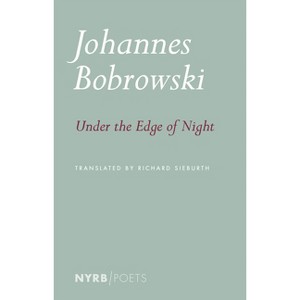
Odes and elegies set in Prussia, Lithuania, and on the killing fields of the Eastern Front during World War II.
About the Author: Johannes Bobrowski (1917-1965) was born in the East Prussian town of Tilsit and spent his boyhood summers on his grandfather's farm in neighboring Lithuania.
496 Pages
Poetry, European
Description
Book Synopsis
Odes and elegies set in Prussia, Lithuania, and on the killing fields of the Eastern Front during World War II. These are war wounds in poetic form, bringing buried history and oppression powerfully into the light. Often compared to the poetry of Paul Celan and Nelly Sachs, the postwar verse of Johannes Bobrowski is set in the East Prussian and Lithuanian landscapes of his childhood, and in the killing fields he witnessed as a young German soldier on the eastern front during World War II. Bobrowski described his poems as his "war wounds," and in these odes and elegies of the mid-fifties and early sixties one can see and hear his belated healing process at work: to bring what has lain buried and forgotten back to the surface, in the hope that Germany's historic oppression of Jewish, Slavic, Baltic, and Roma people might finally be honestly addressed. In this new dual-language and freshly annotated translation, the idiosyncratic rhythms and imagistic urgencies of Bobrowski's verse come to life in Richard Sieburth's English.
Review Quotes
"Reading Johannes Bobrowski, I felt I had entered the shadowlands of history, where landscape bears witness and every name becomes an act of remembrance. Stark, musical, and haunted by beauty, guilt, and longing, these poems restore speech to the silenced places of Eastern Europe. Richard Sieburth has done it again; his extraordinary translations make this indispensable poet thrillingly alive in English." --Peter Gizzi "When Theodor Adorno said that 'to write a poem after Auschwitz is barbaric, ' he was not circumscribing poetry so much as reminding writers that the corrosion of an entire culture enabled the rise of a murderous nationalism. Richard Sieburth's brilliant new translations from three of Johannes Bobrowski's books of poems of the 1960s are a moving testimony to how one poet fought such corrosion. On his return to East Berlin after years as a German soldier and Russian prisoner of war, Bobrowski used his lyric gifts to record a Baltic prehistory of violence and transcendence and to memorialize the world of multi-lingual villages, permeable boundaries, and cultural exchange that the war destroyed. In homage to the poets killed by the Holocaust, these moving lyrics are as clear and fragile as a breeze in 'crow light.' Their pastoral themes celebrate what is sub specie aeternitatis: the beauty of Bach, the landscape of the steppes, the hospitality of strangers traveling roads and rivers, birdsong at dawn and dusk." --Susan Stewart "His poetry is beautifully lyrical, and yet impersonal, oracular in the manner of Hölderlin..... By invoking a river or village he evokes a whole world and a whole tradition. His work is occult, but hardly ever obscure, and his artistry has the 'hiddenness of all perfect things.' Few poets of our time have written as beautifully as Bobrowski." --The Times Literary Supplement
About the Author
Johannes Bobrowski (1917-1965) was born in the East Prussian town of Tilsit and spent his boyhood summers on his grandfather's farm in neighboring Lithuania. He later moved to Königsberg (present-day Kaliningrad), where he received a classical education. After briefly studying art history at the Humboldt University of Berlin, he was conscripted in 1939 as a lance corporal in the Wehrmacht's signal corps. Captured near Riga on the very last day of the war, Bobrowski spent the next four and a half years in Russian POW camps. Released in 1949, he returned to his family's home in the suburbs of East Berlin. Employed as an editor in various sectors of the GDR's publishing industry, he attracted the attention of Peter Huchel, who brought out his first poems in the prestigious East German journal Sinn und Form in 1955. His poetry was later published in three volumes: Sarmatian Time (I961), Shadowland Rivers (I962), and the posthumous Weathersigns (1966). Before his untimely death at age forty-eight, Bobrowski turned increasingly to prose, publishing two novels, Levin's Mill (1964) and Lithuanian Piano (I966), as well as several collections of short stories. Richard Sieburth is an award-winning translator, essayist, and literary scholar. Among the German authors he has translated are Friedrich Hölderlin, Georg Büchner, Walter Benjamin, Gershom Scholem, and Christian Lehnert; among the French are Nostradamus, Maurice Scève, Louise Labé, Gérard de Nerval, Charles Baudelaire, Henri Michaux, Michel Leiris, and Jacques Darras. Sieburth has also edited multiple volumes of Ezra Pound's writings for New Directions and the Library of America.
Dimensions (Overall): 7.0 Inches (H) x 4.5 Inches (W)
Weight: .81 Pounds
Suggested Age: 22 Years and Up
Number of Pages: 496
Genre: Poetry
Sub-Genre: European
Publisher: New York Review of Books
Theme: German
Format: Paperback
Author: Johannes Bobrowski
Language: German
Street Date: October 27, 2026
TCIN: 1008682111
UPC: 9798896230977
Item Number (DPCI): 247-21-9557
Origin: Made in the USA or Imported
If the item details aren’t accurate or complete, we want to know about it.
Shipping details
Estimated ship dimensions: 1 inches length x 4.5 inches width x 7 inches height
Estimated ship weight: 0.812 pounds
We regret that this item cannot be shipped to PO Boxes.
This item cannot be shipped to the following locations: American Samoa (see also separate entry under AS), Guam (see also separate entry under GU), Northern Mariana Islands, Puerto Rico (see also separate entry under PR), United States Minor Outlying Islands, Virgin Islands, U.S., APO/FPO, Alaska, Hawaii
Return details
This item can be returned to any Target store or Target.com.
This item must be returned within 90 days of the date it was purchased in store, delivered to the guest, delivered by a Shipt shopper, or picked up by the guest.