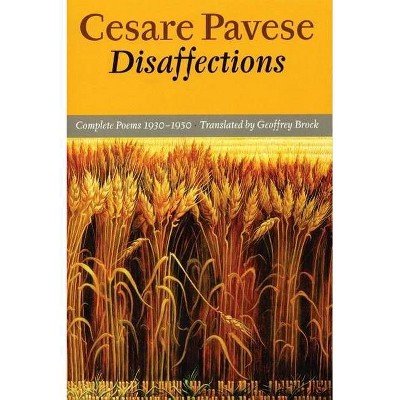
A landmark translation of passionate, fiercely intelligent poetry about coming of age by one of the most influential Italian writers of the twentieth century.
About the Author: Cesare Pavese (1908-1950) was born on his family's vacation farm in the country outside of Turin in northern Italy.
272 Pages
Poetry, European
Description
Book Synopsis
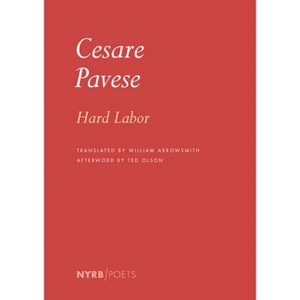
A landmark translation of passionate, fiercely intelligent poetry about coming of age by one of the most influential Italian writers of the twentieth century. In the spring of 1935, the young Cesare Pavese was sentenced, for "antifascist activities," to three years of detention in a small seaside village in Calabria. Far away from his familiar life in the city of Turin and forced to rely on his own resources, he began to write poems of tremendous power, in terse lines and unsentimental language, giving voice to country people and hard country lives untainted by the propaganda of Fascism. "When I found my friends, I found my real home-- / land so worthless a man's got a perfect right / to do absolutely nothing." Though Pavese is now most famous for his fiction, he was a poet first of all, and Hard Labor was the work for which he hoped to be remembered. It is a book, he once said, "that might have saved a generation." William Arrowsmith's translations--with their strong lines and bold American diction--marvelously convey the spirit and complex vitality of the original.
Review Quotes
"This Pavese translation ... is a wonderful piece of work--the final effect of the 'plainness' is brilliancy. This is how writers in our ever-worsening world should write." --Saul Bellow A word about the translations of Pavese's poetry by William Arrowsmith. They are just about as good as could be imagined.... It's hard to analyze how Arrowsmith gets across Pavese's 'still, sad music of humanity, ' but it's there. He even gets the pedal point that underlies the music of Pavese's special melancholy." --Kenneth Rexroth, American Poetry Review
"William Arrowsmith is one of the century's greatest translators. Arrowsmith's introduction is the best essay on the bitter problem of poetic influence that I have encountered for some time. Anyone searching for insight into the war of American poets against their own tradition would benefit by reading Arrowsmith on Pavese." --Harold Bloom, The New Republic
"I think the greatness of this book--and I am not using the word 'greatness' lightly--consists of Pavese's nobility, and of the translator's nobility. This book in English provides one of those strange occasions when the genius of a great man, in disturbing defiance of all arguments, proves its own miracle by rising from the dead in the genius of his translator. In an age which features stylistic adroitness, I hope that Mr. Arrowsmith's translation will be widely read; for it reveals a language beyond adroitness: a noble language in English, appropriate to the great tragic poet whom it embodies." --James Wright "William Arrowsmith, whose work with Greek drama has earned him an enviable reputation for scrupulousness and sensitivity as a translator, has approached Pavese as Pavese himself approached Melville, Joyce and Gertrude Stein with strict fidelity to the sense of the poet's words rather than to the words themselves. He has rendered the poems of Hard Labor in a free‐wheeling colloquial American idiom that approximates the spirit of Pavese's Italian.... There is nothing with quite this passionate intensity and purity in American poetry.... Hard Labor shows us Pavese at the outset of his own ultimately tragic career, writing poetry of courageous originality, intelligence, and power." --Jonathan Galassi, The New York Times "[Hard Labor] was simply too original to be appreciated in its time . . . The poems are quiet and austere. They proceed slowly, without urgency, driven by a succession of simple statements--a rhythm [Pavese] said he discovered as a child, 'murmuring' sentences from novels until they sounded like songs." --Lucy Sillbaugh, TLS
"Cesare Pavese is one of those singular, disruptive poets, like Blake or Lawrence, who go against the grain--or the flow--of their culture, and for whom precedents would be as hard to find as successors.... [H]is marvellously peopled poems not only document the time--what Calvino called 'the Pavese era'--but also bear witness to a unique and restless intelligence." --Jamie McKendric, The Guardian
"Pavese's appeal has on the reader an immediate and emotional hold. To return to these texts today is to confirm the power of an utterance that sends us back to something beyond poetry, but without which poetry could not exist." --Valerio Magrelli "This new NYRB edition--with bilingual texts, Arrowsmith's luminous versions, and Pavese's own reflections--is the fullest yet in English. For newcomers, it is the best way in. For translators, it's both a manual and a warning: the lines of a poet deceptively plain, and therefore infinitely difficult." --Yogesh Patel, Agni
About the Author
Cesare Pavese (1908-1950) was born on his family's vacation farm in the country outside of Turin in northern Italy. He graduated from the University of Turin, where he wrote a thesis on Walt Whitman, beginning a continuing engagement with English-language literature that was to lead to his influential translations of Moby-Dick, A Portrait of the Artist as a Young Man, Three Lives, and Moll Flanders, among other works. Briefly exiled by the Fascist regime to Calabria in 1935, Pavese returned to Turin to work for the new publishing house of Giulio Einaudi, where he eventually became the editorial director. In 1936 he published his first book of poems, Lavorare stanca (Hard Labor), and then turned to writing novels and short stories. Pavese won the Strega Prize for fiction, Italy's most prestigious award, for The Moon and the Bonfires in 1950. Later the same year, after a brief affair with an American actress, he committed suicide. Pavese's posthumous publications include his celebrated diaries, essays on American literature, and a second collection of poems, entitled Verrà la morte e avrà i tuoi occhi (Death Will Come and Will Have Your Eyes). William Arrowsmith (1924-1992) was born in Orange, New Jersey, and raised in Wellesley, Massachusetts. He attended Princeton and Oxford, becoming an accomplished writer, editor, and classicist. He translated ancient works (Aristophanes, Euripides, Petronius) as well as modern ones--most notably Eugenio Montale, Friedrich Nietzsche, and Cesare Pavese. He was awarded the National Book Award for his translation of Hard Labor.Ted Olson is a professor, poet, editor, cultural historian, record producer, musician, and photographer. A nine-time Grammy nominee as a music historian, he has edited volumes of literary work by Sarah Orne Jewett, Sherwood Anderson, and James Still. Olson is also the author of three poetry collections: Breathing in Darkness (2006), Revelations (2012), and Blue Moon (2025).
Dimensions (Overall): 8.2 Inches (H) x 5.7 Inches (W) x .7 Inches (D)
Weight: .7 Pounds
Suggested Age: 22 Years and Up
Number of Pages: 272
Genre: Poetry
Sub-Genre: European
Publisher: New York Review of Books
Theme: Italian
Format: Paperback
Author: Cesare Pavese
Language: Italian
Street Date: June 17, 2025
TCIN: 91306282
UPC: 9781681378787
Item Number (DPCI): 247-31-5784
Origin: Made in the USA or Imported
If the item details aren’t accurate or complete, we want to know about it.
Shipping details
Estimated ship dimensions: 0.7 inches length x 5.7 inches width x 8.2 inches height
Estimated ship weight: 0.7 pounds
We regret that this item cannot be shipped to PO Boxes.
This item cannot be shipped to the following locations: American Samoa (see also separate entry under AS), Guam (see also separate entry under GU), Northern Mariana Islands, Puerto Rico (see also separate entry under PR), United States Minor Outlying Islands, Virgin Islands, U.S., APO/FPO, Alaska, Hawaii
Return details
This item can be returned to any Target store or Target.com.
This item must be returned within 90 days of the date it was purchased in store, delivered to the guest, delivered by a Shipt shopper, or picked up by the guest.