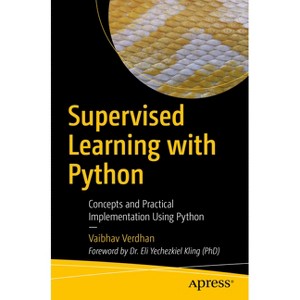
Gain a thorough understanding of supervised learning algorithms by developing use cases with Python.
About the Author: Vaibhav Verdhan has 12+ years of experience in Data Science, Machine Learning and Artificial Intelligence.
372 Pages
Computers, Artificial Intelligence
Description
Book Synopsis
Gain a thorough understanding of supervised learning algorithms by developing use cases with Python. You will study supervised learning concepts, Python code, datasets, best practices, resolution of common issues and pitfalls, and practical knowledge of implementing algorithms for structured as well as text and images datasets.
You'll start with an introduction to machine learning, highlighting the differences between supervised, semi-supervised and unsupervised learning. In the following chapters you'll study regression and classification problems, mathematics behind them, algorithms like Linear Regression, Logistic Regression, Decision Tree, KNN, Naïve Bayes, and advanced algorithms like Random Forest, SVM, Gradient Boosting and Neural Networks. Python implementation is provided for all the algorithms. You'll conclude with an end-to-end model development process including deployment and maintenance of the model.After reading Supervised Learning with Python you'll have a broad understanding of supervised learning and its practical implementation, and be able to run the code and extend it in an innovative manner. What You'll Learn
Review the fundamental building blocks and concepts of supervised learning using Python
Develop supervised learning solutions for structured data as well as text and images
Solve issues around overfitting, feature engineering, data cleansing, and cross-validation for building best fit models
Understand the end-to-end model cycle from business problem definition to model deployment and model maintenance
Avoid the common pitfalls and adhere to best practices while creating a supervised learning model using Python
Who This Book Is For Data scientists or data analysts interested in best practices and standards for supervised learning, and using classification algorithms and regression techniques to develop predictive models.
From the Back Cover
Gain a thorough understanding of supervised learning algorithms by developing use cases with Python. You will study supervised learning concepts, Python code, datasets, best practices, resolution of common issues and pitfalls, and practical knowledge of implementing algorithms for structured as well as text and images datasets.
You'll start with an introduction to machine learning, highlighting the differences between supervised, semi-supervised and unsupervised learning. In the following chapters you'll study regression and classification problems, mathematics behind them, algorithms like Linear Regression, Logistic Regression, Decision Tree, KNN, Naïve Bayes, and advanced algorithms like Random Forest, SVM, Gradient Boosting and Neural Networks. Python implementation is provided for all the algorithms. You'll conclude with an end-to-end model development process including deployment and maintenance of the model.
After reading Supervised Learning with Python you'llhave a broad understanding of supervised learning and its practical implementation, and be able to run the code and extend it in an innovative manner.
You will:
Review the fundamental building blocks and concepts of supervised learning using Python
Develop supervised learning solutions for structured data as well as text and images
Solve issues around overfitting, feature engineering, data cleansing, and cross-validation for building best fit models
Understand the end-to-end model cycle from business problem definition to model deployment and model maintenance
Avoid the common pitfalls and adhere to best practices while creating a supervised learning model using Python
About the Author
Vaibhav Verdhan has 12+ years of experience in Data Science, Machine Learning and Artificial Intelligence. An MBA with engineering background, he is a hands-on technical expert with acumen to assimilate and analyse data. He has led multiple engagements in ML and AI across geographies and across retail, telecom, manufacturing, energy and utilities domains. Currently he resides in Ireland with his family and is working as a Principal Data Scientist.
Dimensions (Overall): 9.21 Inches (H) x 6.14 Inches (W) x .81 Inches (D)
Weight: 1.21 Pounds
Suggested Age: 22 Years and Up
Number of Pages: 372
Genre: Computers
Sub-Genre: Artificial Intelligence
Publisher: Apress
Theme: General
Format: Paperback
Author: Vaibhav Verdhan
Language: English
Street Date: October 8, 2020
TCIN: 1015599142
UPC: 9781484261552
Item Number (DPCI): 247-67-1454
Origin: Made in the USA or Imported
If the item details aren’t accurate or complete, we want to know about it.
Shipping details
Estimated ship dimensions: 0.81 inches length x 6.14 inches width x 9.21 inches height
Estimated ship weight: 1.21 pounds
We regret that this item cannot be shipped to PO Boxes.
This item cannot be shipped to the following locations: American Samoa (see also separate entry under AS), Guam (see also separate entry under GU), Northern Mariana Islands, Puerto Rico (see also separate entry under PR), United States Minor Outlying Islands, Virgin Islands, U.S., APO/FPO, Alaska, Hawaii
Return details
This item can be returned to any Target store or Target.com.
This item must be returned within 90 days of the date it was purchased in store, delivered to the guest, delivered by a Shipt shopper, or picked up by the guest.