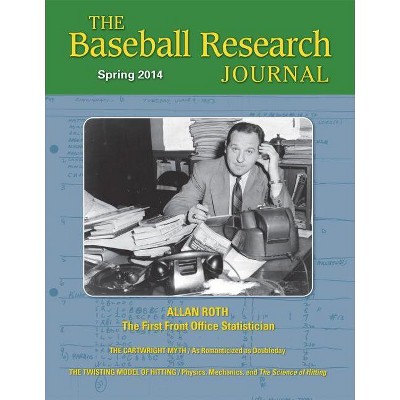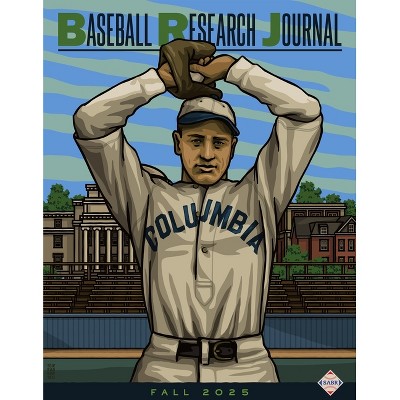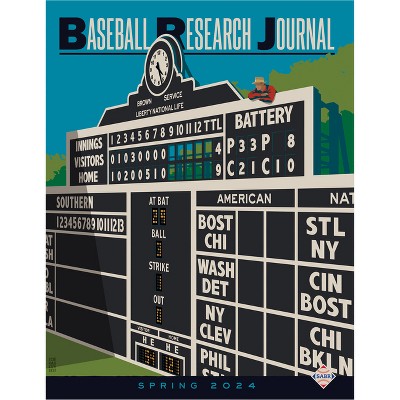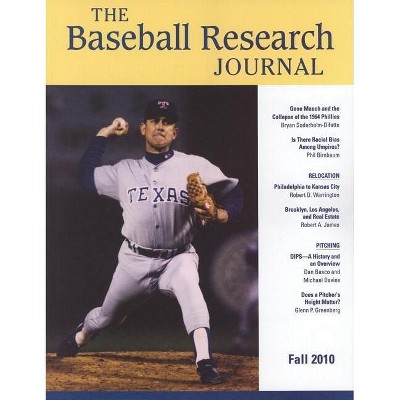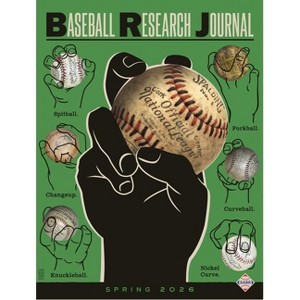
The Spring 2026 issue of SABR's Baseball Research Journal delves into topics ranging from interracial baseball in 1867 to left-handed double-play combinations, from translating the rules of baseball into Mi'kmaq (the indigenous language of Canada's Atlantic Provinces) to professional women players in Banana Ball.
128 Pages
Sports + Recreation, Baseball
Description
About the Book
The Spring 2026 issue of SABR's Baseball Research Journal delves into topics ranging from interracial baseball in 1867 to left-handed double-play combinations, from translating the rules of baseball into Mi'kmaq (the indigenous language of Canada's Atlantic Provinces) to professional women players in Banana Ball.
Book Synopsis
The Spring 2026 issue of SABR's Baseball Research Journal delves into topics ranging from interracial baseball in 1867 to left-handed double-play combinations, from translating the rules of baseball into Mi'kmaq (the indigenous language of Canada's Atlantic Provinces) to professional women players in Banana Ball.
"Did MLB's Clean Ball Policy Fuel the Hitting and Scoring Surge of the 1920s?"
by David J. Gordon
Some baseball analysts have pointed to baseball's adoption of its "Clean Ball Policy" following the August 1920 beaning death of Cleveland SS Ray Chapman as a major catalyst of the surge in hitting and scoring that marked the turning point demarcating the end of baseball's "Deadball Era" and the dawn of the modern game. If this hypothesis is true, this offensive surge should show up mainly in the later innings, when scuffed and dirty balls would have previously remained in play; the new policy would have had little or no impact in the early innings, when fresh baseballs were always in play. But was such a simple solution the real answer? Did replacing those dirty, scuffed-up balls with new ones really lead to the outbreak of offense in the 1920s?
"Babe Ruth's Anomalous 1929 Season: Why Did His Bases on Balls Plummet?"
by Herm Krabbenhoft and Mike Haupert
Babe Ruth was an extraordinary batter with respect to the "three true outcomes" in baseball. In the two positive outcomes--hitting home home runs and receiving bases on balls--the Sultan of Swat topped the American League twelve times and eleven times, respectively. In the negative true outcome--striking out--the Bambino led the AL just five times. From 1926 through 1931, Ruth put together "the finest sustained display of hitting that baseball has ever seen." During those six seasons he averaged 50 home runs, 155 runs batted in, 147 runs scored, and batted .354. Ruth led the AL in homers in each of those six seasons and also drew the most walks in each of those seasons--EXCEPT in 1929, in which he finished tenth with a total of only 72 free passes. For the three previous seasons (1926-28) Ruth had averaged 139 walks per season. And for the three subsequent seasons (1930-32) Ruth averaged 131 walks per season. What happened in 1929?
"A Toast to Sam Payne: The Diminutive Civil War Vet Who Became Phillies Groundskeeper, and One of Their Biggest Personalities"
by Kenny Ayers
Sam Payne, the wily, mustachioed groundskeeper for the Phillies from the early 1900s to 1932, was famous and popular in both baseball circles and with the Philadelphia populace. He was eccentric, pugnacious, entertaining, kind, more than a bit vain and possessed an unwavering devotion to his craft and ball club. Stan Baumgartner, who pitched for the Phillies during that time, recalled that the first time he ran onto the field to warm up with a new ball, Payne stopped him in his tracks. "Just a minute son, you aren't well enough acquainted around here to get a brand-new ball to play with. Wait until you're dry behind the ears," Payne told him, mentioning he had once said the same to Grover Cleveland Alexander and other veterans. "And see that little door back there. That is the way back to the clubhouse when you get knocked out. The hinges are well-greased, so you can sneak out quietly."
"On the Association of Umpire Performance with Age and Experience in MLB"
by Dale Zimmerman, Chenyang Li, and Riley Post
Perhaps no sport relies on the accuracy and consistency of its officials more than baseball, where the home plate umpire calls a ball or strike on every pitch not swung at by the batter. The relatively sedentary nature of the home plate umpire's duties compared to officials in other major sports allows individuals to perform this role to a more advanced age and to accrue relatively greater experience. Here, we investigate the associations of two metrics of home plate umpire performance with umpire age and experience using game-level data from 2015 to 2023 provided by the StatCast pitch-tracking system. Are older, more experienced umpires more desirable to have behind the plate than younger umpires with less experience?
Dimensions (Overall): 10.82 Inches (H) x 8.51 Inches (W) x .26 Inches (D)
Weight: .61 Pounds
Suggested Age: 22 Years and Up
Number of Pages: 128
Genre: Sports + Recreation
Sub-Genre: Baseball
Publisher: Society for American Baseball Research
Theme: History
Format: Paperback
Language: English
Street Date: June 15, 2026
TCIN: 1011769062
UPC: 9781960819550
Item Number (DPCI): 247-26-5798
Origin: Made in the USA or Imported
If the item details aren’t accurate or complete, we want to know about it.
Shipping details
Estimated ship dimensions: 0.26 inches length x 8.51 inches width x 10.82 inches height
Estimated ship weight: 0.61 pounds
We regret that this item cannot be shipped to PO Boxes.
This item cannot be shipped to the following locations: American Samoa (see also separate entry under AS), Guam (see also separate entry under GU), Northern Mariana Islands, Puerto Rico (see also separate entry under PR), United States Minor Outlying Islands, Virgin Islands, U.S., APO/FPO, Alaska, Hawaii
Return details
This item can be returned to any Target store or Target.com.
This item must be returned within 90 days of the date it was purchased in store, delivered to the guest, delivered by a Shipt shopper, or picked up by the guest.