Target New ArrivalsGift Ideas for MomClothing, Shoes & AccessoriesHome & DecorKitchen & DiningOutdoor Living & GardenGroceryHousehold EssentialsBabyBeautyPersonal CareHealthWellnessLuggageSports & OutdoorsToysElectronicsVideo GamesMovies, Music & BooksSchool & Office SuppliesParty SuppliesGift IdeasGift CardsPetsUlta Beauty at TargetShop by CommunityTarget OpticalDealsClearanceTarget New ArrivalsSpring OutfitsGift Ideas for MomWomen’s Festival OutfitsTop DealsTarget Circle DealsWeekly AdShop Order PickupShop Same Day DeliveryRegistryRedCardTarget CircleFind Stores
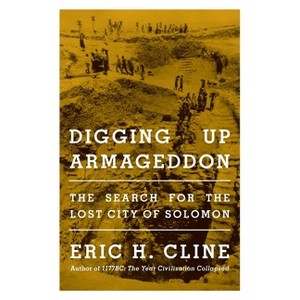
Digging Up Armageddon - (Isms) by  Eric H Cline (Paperback) - 1 of 1

Digging Up Armageddon - (Isms) by Eric H Cline (Paperback)

$14.99Save $7.96 (35% off)

In Stock

Free & easy returns

Free & easy returns

Return this item by mail or in store within 90 days for a full refund.
Eligible for registries and wish lists

About this item

Highlights

  • A vivid portrait of the early years of biblical archaeology from the acclaimed author of 1177 B.C.: The Year Civilization Collapsed In 1925, James Henry Breasted, famed Egyptologist and director of the Oriental Institute at the University of Chicago, sent a team of archaeologists to the Holy Land to excavate the ancient site of Megiddo--Armageddon in the New Testament--which the Bible says was fortified by King Solomon.
  • About the Author: Eric H. Cline is professor of classics and anthropology and director of the Capitol Archaeological Institute at George Washington University.
  • 432 Pages
  • Social Science, Archaeology
  • Series Name: Isms

Description


About the Book


"In 1925 a team of archaeologists was sent by famed archaeologist James Henry Breasted, the Director of the Oriental Institute of the University of Chicago, to search for the city that King Solomon built in the tenth century BCE. These excavations are rightfully famous for the light they shed on one of the most important cities in biblical times: the ancient city of Megiddo, in Israel, the site of Armageddon. The books and articles that the original participants published are still used, and debated, by archaeologists working in the region today. However, these scholarly publications provide only a small window into the daily activities of the team members and the stories behind their amazing discoveries. Using a treasure trove of other writing - including more than three decades' worth of letters, cablegrams, cards, and diaries, archaeologist and historian Eric Cline, who spent twenty years digging at Megiddo himself, brings the Chicago excavators and their discoveries to life situating them against the backdrop of the Great Depression in the United States as well as the growing troubles and tensions in British Mandate Palestine. Their story, as recounted by Cline, often reads more like melodrama than dry archaeological report and provides a unique a glimpse of the internal workings of a dig in the early years of biblical archaeology. In the course of telling their story, Cline gives readers the full picture of an archaeological site from its first discoveries to its most recent excavations placing it all in the larger scheme of the rise and fall of civilizations, from the Neolithic Revolution through the Romans"--


Book Synopsis


A vivid portrait of the early years of biblical archaeology from the acclaimed author of 1177 B.C.: The Year Civilization Collapsed

In 1925, James Henry Breasted, famed Egyptologist and director of the Oriental Institute at the University of Chicago, sent a team of archaeologists to the Holy Land to excavate the ancient site of Megiddo--Armageddon in the New Testament--which the Bible says was fortified by King Solomon. Their excavations made headlines around the world and shed light on one of the most legendary cities of biblical times, yet little has been written about what happened behind the scenes. Digging Up Armageddon brings to life one of the most important archaeological expeditions ever undertaken, describing the site and what was found there, including discoveries of gold and ivory, and providing an up-close look at the internal workings of a dig in the early years of biblical archaeology.

The Chicago team left behind a trove of writings and correspondence spanning more than three decades, from letters and cablegrams to cards, notes, and diaries. Eric Cline draws on these materials to paint a compelling portrait of a bygone age of archaeology. He masterfully sets the expedition against the backdrop of the Great Depression in America and the growing troubles and tensions in British Mandate Palestine. He gives readers an insider's perspective on the debates over what was uncovered at Megiddo, the infighting that roiled the expedition, and the stunning discoveries that transformed our understanding of the ancient world.

Digging Up Armageddon is the enthralling story of an archaeological site in the interwar years and its remarkable place at the crossroads of history.


Review Quotes


"[A] diligent, clear, and engaging guide through the individuals, relationships, and (more or less) serendipitous events that shaped one of the most influential excavations. . . . Part biography and part history, Cline's Digging Up Armageddon is an exemplary work of scholarship and story-telling that will entertain and inform scholars and interested nonexperts alike."---C. A. Strine, Palestine Exploration Quarterly

"[Cline] has placed the project in the context of its times."---Neil Faulkner, Minerva

"[Cline] writes with the deft surety of someone familiar with both the site and its archive . . . . What makes [Digging Up Armageddon] such a smart historical treatment of Megiddo is Cline's nuanced examination of how labor, privilege, politics, and capitalism underscored much of the archaeology done in the United States and Europe in the early to mid-20th century."---Lydia Pyne, Los Angeles Review of Books

"A fascinating read. . . . So detailed is [Cline's] account of those involved that the book reads better than many a modern novel."---Peter Costello, Irish Catholic

"Absolutely fascinating."---Paul Zimansky, Times Literary Supplement

"An original and lively study that skilfully mixes archaeology with personalities, and politics with culture, science and technology."---Andrew Robinson, Nature

"At the time this massive dig was undertaken, it was criticised for high costs and never-ending delays. Cline celebrates the high points, but he also exposes the mission's failures."---Sam Waters, Current World Archaeology

"Cline writes with wry insight into human nature and a saving sense of humour."---Patrick Madigan, Heythrop Journal

"Engaging."-- "Moment Magazine"

"Enjoyable reading . . . riveting."---Amanda Borschel-Dan, Times of Israel

"If it is thrills, spills and devious political machinations of past excavations that take your fancy, why not check out Eric Cline's new book. . . . This is the story about Megiddo that they didn't want you to know."-- "Anglo-Israel Archaeological Society"

"If you love to read about crossroads of history, are fascinated by the years between wards and well beyond, and really just like a good story, this is the book to begin that journey."---Elaine Holden, Monadnock Ledger-Transcript

"It's really quite amazing how he pulls it off--Cline has written a book deeply-imbued with scholarship, an in-depth look at the history and archaeology not just of the expedition at Megiddo, but of the whole Near Eastern region and ancient Israel. . . . So vivid is Cline's telling of the story that readers might be forgiven for finding the personal dimension just as interesting as the archaeology. Anyone who thought that archaeologists were just boring people digging up ancient relics which were of no interest to anyone outside their own field, will be quickly disabused of such a notion."---John Butler, Asian Review of Books

"Like the best tales from the golden age of archaeology, Digging Up Armageddon combines the grandeur of ancient history, the currency of modern fame and the cast of a malarial soap opera."---Dominic Green, The Spectator


About the Author


Eric H. Cline is professor of classics and anthropology and director of the Capitol Archaeological Institute at George Washington University. His many books include Three Stones Make a Wall: The Story of Archaeology and 1177 B.C.: The Year Civilization Collapsed (both Princeton). He lives in Rockville, Maryland. Twitter @digkabri
Dimensions (Overall): 7.95 Inches (H) x 5.28 Inches (W) x 1.57 Inches (D)
Weight: .85 Pounds
Suggested Age: 22 Years and Up
Number of Pages: 432
Genre: Social Science
Sub-Genre: Archaeology
Series Title: Isms
Publisher: Princeton University Press
Format: Paperback
Author: Eric H Cline
Language: English
Street Date: May 17, 2022
TCIN: 1005879778
UPC: 9780691233932
Item Number (DPCI): 247-45-5742
Origin: Made in the USA or Imported
If the item details aren’t accurate or complete, we want to know about it.

Shipping details

Estimated ship dimensions: 1.57 inches length x 5.28 inches width x 7.95 inches height
Estimated ship weight: 0.85 pounds
We regret that this item cannot be shipped to PO Boxes.
This item cannot be shipped to the following locations: American Samoa (see also separate entry under AS), Guam (see also separate entry under GU), Northern Mariana Islands, Puerto Rico (see also separate entry under PR), United States Minor Outlying Islands, Virgin Islands, U.S., APO/FPO, Alaska, Hawaii

Return details

This item can be returned to any Target store or Target.com.
This item must be returned within 90 days of the date it was purchased in store, delivered to the guest, delivered by a Shipt shopper, or picked up by the guest.
See the return policy for complete information.

Q: What archaeological site is central to this book?

submitted by AI Shopping Assistant - 1 month ago
  • A: The central archaeological site discussed in the book is Megiddo, associated with the biblical Armageddon.

    submitted byAI Shopping Assistant - 1 month ago
    Ai generated

Q: What is the main focus of Eric H. Cline's book?

submitted by AI Shopping Assistant - 1 month ago
  • A: The book focuses on the early years of biblical archaeology, specifically the excavation of Megiddo by a team in 1925.

    submitted byAI Shopping Assistant - 1 month ago
    Ai generated

Q: How does Cline convey the team's experiences during the excavation?

submitted by AI Shopping Assistant - 1 month ago
  • A: Cline uses letters, diaries, and other writings from the team to vividly recount their daily activities and discoveries.

    submitted byAI Shopping Assistant - 1 month ago
    Ai generated

Q: What historical context is included in Cline's narrative?

submitted by AI Shopping Assistant - 1 month ago
  • A: Cline situates the excavation amid the Great Depression and the growing tensions in British Mandate Palestine.

    submitted byAI Shopping Assistant - 1 month ago
    Ai generated

Q: Who was James Henry Breasted?

submitted by AI Shopping Assistant - 1 month ago
  • A: James Henry Breasted was a renowned Egyptologist and director of the Oriental Institute at the University of Chicago.

    submitted byAI Shopping Assistant - 1 month ago
    Ai generated

Additional product information and recommendations

Discover more options

Trending Social Science Books

Get top deals, latest trends, and more.

Privacy policy