"The most significant way in which Self's book differs from its predecessor is in its very freedom and frankness. . . .
About the Author: Will Self is the author of many novels and books of nonfiction, including Great Apes; How the Dead Live, which was shortlisted for the Whitbread Novel of the Year; The Butt, winner of the Bollinger Everyman Wodehouse Prize for Comic Fiction; Umbrella, which was shortlisted for the Booker Prize; Shark; Phone; the memoir Will; and the essay collection Why Read.
288 Pages
Fiction, LGBTQ+
Description
About the Book
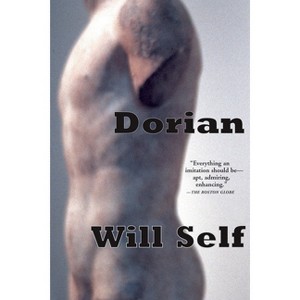
Set against the AIDS epidemic of the eighties and nineties, Self's "Dorian" is a shameless reworking of the most significant myth of shamelessness, brilliantly evoking the decade in which it was fine to stare into the abyss, so long as you were wearing two pairs of Ray-Bans.
Book Synopsis
"The most significant way in which Self's book differs from its predecessor is in its very freedom and frankness. . . . There's no denying Self's novel's cleverness, best displayed in its neatly postmodern ending." --Sophie Harrison, The New York Times Book Review
Set against the AIDS epidemic of the 1980s and '90s, Will Self's Dorian is a shameless reworking of our most significant myth of shamelessness. It is the summer of 1981 and Henry Wotton, uneasily gay, egregiously drug addicted, and queasily snobbish, is at the center of a Chelsea clique dedicated to timeless dissolution. His friend Baz Hallward, a sometime Warhol acolyte and video installation artist, has discovered a most remarkable young man, the very epitome of male beauty, Dorian Gray. Hallward's installation, "Cathode Narcissus," captures all of Dorian's allure, but perhaps it's captured another more integral part of him as well?
Certainly, after a night of debauchery that climaxes in a veritable conga line of buggery, Wotton and Hallward have been snared by a sinister retrovirus that becomes synonymous with the decade. After sixteen years of delirious drug taking and ruthless fornication, their playmates have succumbed to the disease de jour. But what of Wotton and Hallward? How have they fared as the stock market soared and their T-cell counts plummeted? And what of Dorian, a sultan of style in an era of mass superficiality? while all around him shrivel and die, how is it that he remains so unsullied--so vibrantly alive?
By one of our most wildly imaginative novelists--who has been praised by The New York Times Book Review as a "high powered satirical weapon"--Dorian brilliantly evokes the decade in which it was fine to stare into the abyss, so long as you were wearing two pairs of Ray-Bans.
Review Quotes
Selected as one of Time Out's 1,000 Books to Change Your Life
"The most significant way in which Self's book differs from its predecessor is in its very freedom and frankness. . . . There's no denying Self's novel's cleverness, best displayed in its neatly postmodern ending." --Sophie Harrison, The New York Times Book Review
"Dorian is a serial killer, a cross between Casanova and American Psycho. . . . [Self has] eviscerated Wilde's book to create his own bittersweet portrait of gay life in the shadow of AIDS." --J.Y. Yeh, The Village Voice
"Very ambitious. . . . The scope here is panoramic." --Carolyn See, The Washington Post
"Everything an imitation should be--apt, admiring, enhancing." --Barbara Fisher, The Boston Globe
"Self has always been a poet of prurience, and Dorian's belly flop into decadence is scripted with typical gusto. . . . There is, ultimately, a purpose, which is to highlight the way people court their own dark sides." --John Freeman, The Hartford Courant
"[AIDS] is a sort of chilling bonanza for this author, who produces some of the most arresting images of the disease since Adam Mars-Jones's stories in The Darker Proof. . . . Like [Wilde] his precursor, Self has made the nature of wit one of his novel's themes." --Thomas Mallon, The Atlantic Monthly
"Fresh and entertaining. . . . Self's tale offers compassion and hope, ultimately giving Dorian a visceral and emotional conclusion. . . . As if attempting to live up to the excesses of the decade in which it is set, Dorian spares no details regarding sex, drug abuse and more sex. . . . The tamed excess of Self's irreverent and unrelenting voice make Dorian an exceptional read and a thought-provoking examination of the most basic of human vices." --Jay Pawlowski, Rocky Mountain News
"Self admirably succeeds in the most daunting of tasks: re-working a classic. With an unerring eye, Dorian takes on a generation that was not only self-serving and excessive, but also redefining itself through art and breaking with sexual taboos. . . . He lays bare the vanity of a society at once superficial and aesthetically inclined. And like Wilde, he does it with panache." --Boldtype
"More graphic, and more sordid, than the original. . . . Self writes with such wit and intelligence that he gives his story a satiric edge worthy of Wilde himself." --Michael Shelden, The Baltimore Sun
"Self, at his iconoclastic best--here skewering London's art scene, philanthropy as fashion, and, as he says, the 'Royal Fag Hag' herself, Princess Di." --David Bahr, The Advocate
"If you're the type of person who finds Beckett and Kafka as hilarious as they are grim and feels strangely compelled by the best moments of David Cronenberg's nauseous sensuality, [Dorian] must seem like a custom-written gift. . . . Self concentrates on the fetishization of beauty. . . . In Baz, Self creates his most likable character to date--a man palpably torn by the creative impulse of art, the self-destruction of drugs, a deep-seated self-loathing, and a hopeless obsession with Dorian Gray." --Jonathan Dixon, Providence Phoenix
"Certainly Will Self has succeeded in imitating Oscar Wilde's characteristic prose. . . . As for the tale, it is both funnier than the original and more appallingly grotesque. . . . Self's imitation is not just a simple homage; it is an act of literary and cultural criticism, and one suspects Wilde would have approved." --Thomas J. Campbell, The Salem Press
"A daring act of literary homage. . . . Self uses Wilde's plot to examine post-Stonewall gay life, from its drug-fueled hedonistic excesses to the reckoning of the AIDS epidemic. The novel skewers every layer of British society--street hustlers, members of Parliament and the idle rich. . . . The prose is laced with epigrammatic, lightly amusing pseudo-Wildean wit." --Publishers Weekly
"Self has done a masterly job of resetting the story in the era of AIDS, where Dorian's self-indulgent behavior proves to have a particularly devastating effect. . . . A tale that allows Self to indulge his own penchant for word play, black humor, and uncomfortable imagery while continuing to explore the themes of sexual identity and social decadence. . . . [Dorian is] a story well suited to our times." --David W. Henderson, Library Journal (starred review)
"Sweeping and savagely funny, Self's update reads less like an 'imitation' (as it's subtitled) and more like a tripped-out reincarnation." --Michael Martin, Nerve.com
"A book that filled its first reviewers with 'the odor of moral and spiritual putrefaction' just got smellier, darker, and funnier. . . . Brutal, savage, infinitely readable. It will upset people." --The Observer (London)
"Chilling, hysterical, tasteless and haunting. A Gothic thriller complementing and enriching its original." --Independent on Sunday
"Self's reincarnation of Dorian has taken the fag ends of both an English century and an English myth and given them a new, troubling and hugely entertaining life." --Neil Bartlett, The Guardian
"Savage and hilarious [with a] delicious sense of dread. Wilde would have been flattered by Self's brilliant 'imitation' of his tainted love story." --Mark Sanderson, Time Out (London)
"Funny and coolly clever. At once an homage, a parody and a critical commentary. As supremely mannered as the original." --Times Literary Supplement
"[A] witty, biting modern-day retelling of Oscar Wilde's The Picture of Dorian Gray . . . Self's take on the tale is magnificent." --Ottowa Sun
About the Author
Will Self is the author of many novels and books of nonfiction, including Great Apes; How the Dead Live, which was shortlisted for the Whitbread Novel of the Year; The Butt, winner of the Bollinger Everyman Wodehouse Prize for Comic Fiction; Umbrella, which was shortlisted for the Booker Prize; Shark; Phone; the memoir Will; and the essay collection Why Read. He lives in South London.
Dimensions (Overall): 8.26 Inches (H) x 5.53 Inches (W) x .8 Inches (D)
Weight: .79 Pounds
Suggested Age: 22 Years and Up
Number of Pages: 288
Genre: Fiction
Sub-Genre: LGBTQ+
Publisher: Grove Press
Theme: Gay
Format: Paperback
Author: Will Self
Language: English
Street Date: January 20, 2004
TCIN: 1013514099
UPC: 9780802140470
Item Number (DPCI): 247-10-7609
Origin: Made in the USA or Imported
If the item details aren’t accurate or complete, we want to know about it.
Shipping details
Estimated ship dimensions: 0.8 inches length x 5.53 inches width x 8.26 inches height
Estimated ship weight: 0.79 pounds
We regret that this item cannot be shipped to PO Boxes.
This item cannot be shipped to the following locations: American Samoa (see also separate entry under AS), Guam (see also separate entry under GU), Northern Mariana Islands, Puerto Rico (see also separate entry under PR), United States Minor Outlying Islands, Virgin Islands, U.S., APO/FPO, Alaska, Hawaii
Return details
This item can be returned to any Target store or Target.com.
This item must be returned within 90 days of the date it was purchased in store, delivered to the guest, delivered by a Shipt shopper, or picked up by the guest.