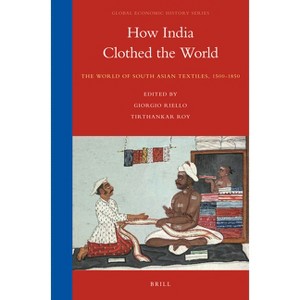
Cloth has always been the most global of all traded commodities.
About the Author: Giorgio Riello, Ph.D. (2002) in History, University College London, is Associate Professor in Global History and Culture at the University of Warwick.
490 Pages

Business & Economics, Economic History
Description
About the Book
Drawing on new research on textile trade and production in the regions that depended on the Indian Ocean, the book contributes to a new understanding of the role that Indian cloth played in the making of the modern world economy.
Book Synopsis
Cloth has always been the most global of all traded commodities. It is an illuminating example of the circulation of goods, skills, knowledge and capital across wide geographic spaces. South Asia has been central to the making of these global exchanges over time. This volume presents innovative research that explores the dynamic ways in which diverse textile production and trade regions generated the 'first globalization'. A series of experts connect this global commodity with the dramatic political and economic transformations that characterised the Indian Ocean in the seventeenth and eighteenth centuries. Collectively, the essays transform our understanding of the contribution of South Asian cloth to the making of the modern world economy.
Review Quotes
"There are few books that can equal [this book] in providing readers with an appreciation of the variety of interconnections between different regions of the world before the nineteenth century. Cloth, it clearly demonstrates, is an invaluable entry point into global economic history." - Douglas Haynes, Dartmouth College, in: H-Net "How India Clothed the World is an ambitious book which takes a comprehensive look at South Asian textiles from the minutiae of technology and procurement to the global movement of products and 'invisible cargoes'." - Anand V. Swamy, William College, in: Journal of Economic History "Until recently, the production and exchange of textiles were understood as purely economic activities in which production technology, weavers, merchants, companies, and markets played a prominent role. This volume, instead, invokes consumer choice, fashion, gender, social hierarchy, aesthetics, and the dissemination of knowledge as playing important roles in determining the consumption and production of textiles in both Asia and Europe." - Ghulam Nadri, Georgia State University, in: Economic History Review
About the Author
Giorgio Riello, Ph.D. (2002) in History, University College London, is Associate Professor in Global History and Culture at the University of Warwick. He has published on early modern textiles, dress and fashion in Europe and Asia.
Tirthankar Roy, Ph.D. (1989) in Economics, Jawaharlal Nehru University, is a Lecturer of Economic History at London School of Economics. He has published extensively on the economic and social history of modern and early modern South Asia, and has contributed to the textile history of the region in particular.
Dimensions (Overall): 9.2 Inches (H) x 6.1 Inches (W) x 1.3 Inches (D)
Weight: 1.7 Pounds
Suggested Age: 22 Years and Up
Number of Pages: 490
Genre: Business & Economics
Sub-Genre: Economic History
Publisher: Brill
Format: Paperback
Language: English
Street Date: August 8, 2013
TCIN: 1013515169
UPC: 9789004255319
Item Number (DPCI): 247-35-0044
Origin: Made in the USA or Imported
If the item details aren’t accurate or complete, we want to know about it.
Shipping details
Estimated ship dimensions: 1.3 inches length x 6.1 inches width x 9.2 inches height
Estimated ship weight: 1.7 pounds
We regret that this item cannot be shipped to PO Boxes.
This item cannot be shipped to the following locations: American Samoa (see also separate entry under AS), Guam (see also separate entry under GU), Northern Mariana Islands, Puerto Rico (see also separate entry under PR), United States Minor Outlying Islands, Virgin Islands, U.S., APO/FPO, Alaska, Hawaii
Return details
This item can be returned to any Target store or Target.com.
This item must be returned within 90 days of the date it was purchased in store, delivered to the guest, delivered by a Shipt shopper, or picked up by the guest.