Target New ArrivalsHalloweenChristmasGift IdeasClothing, Shoes & AccessoriesHome & DecorKitchen & DiningPatio, Lawn & GardenGroceryHousehold EssentialsBabyBeautyTarget Beauty StudioPersonal CareSports & OutdoorsPetsHealthWellnessSchool & Office SuppliesToys & GamesElectronics & TechVideo GamesBooks, Music & MoviesParty SuppliesGift CardsShop by CommunityTarget OpticalDealsClearanceNew ArrivalsHalloweenChristmasGift IdeasTop DealsTarget Circle DealsWeekly AdShop Order PickupShop Same Day DeliveryRegistryRedCardTarget CircleFind Stores
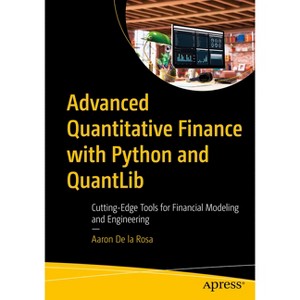
Mastering Quantitative Finance with Python and Quantlib - by  Aaron de la Rosa (Paperback) - 1 of 1

Mastering Quantitative Finance with Python and Quantlib - by Aaron de la Rosa (Paperback)

$69.99
 

Pre-order

Free & easy returns
Free & easy returns
Return this item by mail or in store within 90 days for a full refund.
Eligible for registries and wish lists

About this item

Highlights

  • Advanced Quantitative Finance with Python and QuantLib-Python is a practical, code-driven guide for quantitative analysts, financial engineers, traders, and risk professionals seeking to build modern quantitative finance solutions using Python and QuantLib-Python.
  • About the Author: Aaron De La Rosa is a distinguished fixed-income quantitative researcher and Python Quant developer, renowned for designing and implementing advanced models for derivative pricing and risk management.
  • 386 Pages
  • Computers, Languages

Description


Book Synopsis


Advanced Quantitative Finance with Python and QuantLib-Python is a practical, code-driven guide for quantitative analysts, financial engineers, traders, and risk professionals seeking to build modern quantitative finance solutions using Python and QuantLib-Python. Combining financial theory with hands-on implementation, the book demonstrates how to develop pricing models, risk analytics, stochastic simulations, and portfolio management workflows used in real-world financial markets.

The book begins with quantitative modelling foundations and exploratory data analysis (EDA) techniques for financial datasets before introducing the Black-Scholes framework and its practical implementation. Readers then explore stochastic volatility models, advanced methods for pricing exotic derivatives, and sophisticated interest-rate lattice models. The coverage extends to fixed-income and interest-rate derivative pricing using QuantLib 1.42, including practical applications of modern term-structure and interest-rate modeling techniques. The final chapters focus on portfolio analysis and advanced stochastic models, enabling readers to evaluate risk, model market dynamics, and build data-driven investment strategies. Throughout the book, readers work with Python and QuantLib-Python examples that demonstrate how quantitative models can be implemented, tested, and applied in production environments.

By the end of the book, readers will have the skills to develop robust quantitative finance applications, price complex financial instruments, analyze market data, and implement advanced models for trading, risk management, and portfolio optimization.

What You Will Learn

  • Build quantitative finance applications in Python and QuantLib-Python for pricing and risk analysis.
  • Apply Black-Scholes, stochastic volatility, and exotic option pricing models to real market scenarios.
  • Develop interest-rate and fixed-income valuation models using advanced lattice frameworks and QuantLib.
  • Perform portfolio analysis, risk assessment, and stochastic modelling for investment decision-making.

Who this book is for:

Financial engineers in banks, quant developers, hedge funds, or proprietary trading firms. MSc and PhD quantitative finance students. FinTech CTOs and leaders of algorithmic trading teams.


From the Back Cover


Modern quantitative finance requires more than financial theory--it demands the ability to transform mathematical models into robust computational tools for analyzing markets and pricing complex derivatives.

Mastering Quantitative Finance with Python and QuantLib provides a practical journey through the models, numerical methods, and programming techniques at the heart of modern financial engineering. Combining quantitative theory with hands-on Python implementations, the book demonstrates how sophisticated financial models can be transformed into working computational solutions.

Beginning with quantitative modeling in Python, readers develop essential analytical and numerical skills before exploring financial datasets through professional exploratory data analysis (EDA). The book then progresses from the Black-Scholes framework to stochastic volatility models and advanced methods for pricing exotic and equity derivatives involving barriers, path dependence, early exercise, and nonstandard payoffs.

The final chapters explore fixed-income and interest-rate modeling, including the construction and calibration of Black-Derman-Toy, Hull-White, and Black-Karasinski short-rate lattices. Readers then advance to powerful term-structure frameworks, including Hull-White, G2++, Heath-Jarrow-Morton (HJM), and Brace-Gatarek-Musiela (BGM/LIBOR Market Model).

Throughout, Python and QuantLib serve as a quantitative laboratory for implementing, calibrating, testing, and analyzing financial models.

Designed for students, quantitative developers, financial engineers, analysts, researchers, and practitioners, this book bridges the gap between mathematical finance and computational implementation, providing the tools needed to understand modern derivatives, develop quantitative applications, and build a foundation for advanced financial modeling.

You will learn how to:

. Learn to build and implement quantitative finance models with Python and QuantLib.

- Develop skills to explore, visualize, and analyze financial data using EDA techniques.

- Understand and implement the Black-Scholes framework for option pricing.

- Apply stochastic volatility models to capture dynamic market behavior.

- Price exotic and complex equity derivatives using advanced numerical methods.


About the Author


Aaron De La Rosa is a distinguished fixed-income quantitative researcher and Python Quant developer, renowned for designing and implementing advanced models for derivative pricing and risk management. Specializing in exotic and path-dependent options, Aaron adeptly bridges theoretical finance with high-performance solutions using modern C++, Python, and MATLAB.

Holding an MSc in Finance from Anahuac University, Mexico North, Aaron's academic foundation underpins his expertise. His master's thesis earned the prestigious National Prize: Mexican Stock Exchange (Category: Master's Thesis) for its innovative application of Dynamic Correlation and Extreme Value Theory (EVT). Titled "Dynamic Correlation and Extreme Value Theory (EVT) to Estimate VaR Extreme Conditional and ES Extreme Conditional Using a Fréchet Distribution and a Bivariate Model for Dynamic Conditional Correlation Generalized Asymmetric (AGDCC-LGARCHMLE) for Mexican Stock Index and American Indexes," this work showcased his ability to tackle complex financial challenges.

Aaron leverages QuantLib-Python 1.43, the industry-standard open source library, to deliver scalable, production-ready solutions for fixed-income, structured products and derivative pricing using modern Python 3.14.7 His expertise spans the full spectrum of financial engineering, from modeling stochastic processes and volatility surfaces to developing efficient numerical solvers, including finite difference methods, Monte Carlo (MC) simulations, and lattice-based trees.

Passionate about translating intricate financial mathematics into robust, maintainable Python code, Aaron adheres to modern software engineering principles, emphasizing clean architecture, modular design, and computational efficiency. His solutions are both mathematically rigorous and optimized for performance, reflecting his dual expertise in financial theory and quantitative research.

Dimensions (Overall): 10.0 Inches (H) x 7.01 Inches (W)
Suggested Age: 22 Years and Up
Number of Pages: 386
Genre: Computers
Sub-Genre: Languages
Publisher: Apress
Theme: Python
Format: Paperback
Author: Aaron de la Rosa
Language: English
Street Date: November 10, 2026
TCIN: 1014057410
UPC: 9798868831829
Item Number (DPCI): 247-64-1131
Origin: Made in the USA or Imported
If the item details aren’t accurate or complete, we want to know about it.

Shipping details

Estimated ship dimensions: 1 inches length x 7.01 inches width x 10 inches height
Estimated ship weight: 1 pounds
We regret that this item cannot be shipped to PO Boxes.
This item cannot be shipped to the following locations: American Samoa (see also separate entry under AS), Guam (see also separate entry under GU), Northern Mariana Islands, Puerto Rico (see also separate entry under PR), United States Minor Outlying Islands, Virgin Islands, U.S., APO/FPO, Alaska, Hawaii

Return details

This item can be returned to any Target store or Target.com.
This item must be returned within 90 days of the date it was purchased in store, delivered to the guest, delivered by a Shipt shopper, or picked up by the guest.
See the return policy for complete information.

Additional product information and recommendations

Discover more options

Skip to next section

Best-selling Computers & Technology Books

Skip to next section

Get top deals, latest trends, and more.