Target New ArrivalsHalloweenClothing, Shoes & AccessoriesHome & DecorKitchen & DiningPatio, Lawn & GardenGroceryHousehold EssentialsBabyBeautyTarget Beauty StudioPersonal CareSports & OutdoorsPetsHealthWellnessSchool & Office SuppliesToys & GamesElectronics & TechVideo GamesBooks, Music & MoviesParty SuppliesGift IdeasGift CardsShop by CommunityTarget OpticalDealsClearanceNew ArrivalsBack to SchoolCollegeTop DealsTarget Circle DealsWeekly AdShop Order PickupShop Same Day DeliveryRegistryRedCardTarget CircleFind Stores
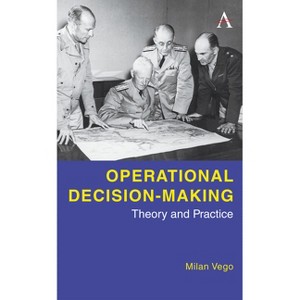
Operational Decision-Making - by  Milan Vego (Hardcover) - 1 of 1

Operational Decision-Making - by Milan Vego (Hardcover)

$70.00

Pre-order

Free & easy returns
Free & easy returns
Return this item by mail or in store within 90 days for a full refund.
Eligible for registries and wish lists

About this item

Highlights

  • Explains how operational-level commanders must make complex, forward-looking decisions based on incomplete information, treating their choices as hypotheses shaped by uncertainty and large-scale military dynamics.
  • About the Author: Dr. Milan Vego is Professor of Operations, Joint Military Operations (JMO) Department, U.S. Naval War College, Newport, RI, USA.
  • 302 Pages
  • Technology & Engineering, History

Description


About the Book


The highest art of operational leadership is that of making timely and sound decisions. The act of exercising command consists of making decisions and ordering their execution.


Book Synopsis


Explains how operational-level commanders must make complex, forward-looking decisions based on incomplete information, treating their choices as hypotheses shaped by uncertainty and large-scale military dynamics.

The number and importance of the decisions vary for each level of war. The higher the level of war, the fewer decisions are made and the larger the time window for making them. Operational commanders make fewer decisions, but the impact of these decisions is much greater than those made at the tactical level. The key for making sound operational decisions is to have an accurate picture of the operational situation. Such a picture cannot be obtained by a simple sum of tactical data or information. In fact, the operational situation should be built as a synthesis of strategic and tactical information pertaining to the operational commander's area of responsibility plus his area of interest. It deals with both military and nonmilitary aspects of the situation. This is especially true for the operational commander and, to a lesser extent, for subordinate tactical commanders. The operational commander must make his decisions by considering trends in the operational situation several weeks or even months into the future. In contrast, the tactical commander is concerned with the developments of the tactical situation, from a few hours to 72 or 96 hours in the future. Information technologies should be considered as aids in making operational decisions, not as the masters of the entire decision-making process. The personality traits, professional education, experience, judgment, and wisdom of the operational commander are the key to making sound operational or strategic decisions.

Psychological and social/cultural factors play a major role in making decisions not only by military commanders, but also political and business leaders, and other parts of society. Many books and articles/essays were published on that subject. Yet the role and importance of psychosocial factors are not adequately highlighted in military/naval doctrine and in the education of future military leaders. The principal categories of psychosocial factors in military decision-making are psychological, social/cultural, and situational. The most important psychological factors are stress, fatigue, self-efficacy, and heuristics.

The main method in making a decision is by using an estimate of a military situation. In military terms, the commander's estimate of the situation is understood as a logical process of reasoning by which a commander considers all the factors affecting a military situation to determine a course of action to accomplish a given mission. The estimate is a reasoned solution to a problem in which each step in the process incrementally leads to a decision that, without these steps, could be arrived at only by an accident. In the estimate, the commander assesses the situation and then tries to embark on a certain course of action aimed at changing the situation for the better or at least taking advantage of the given situation. The ultimate result of the estimate should be a sound decision. The estimate of the situation makes the chances of reaching a sound decision much higher than if an ad hoc method is used. One of the prerequisites for making a quick decision is to grasp the essential points of a given situation quickly and then evaluate them properly. It is in this determination that one's reasoning and imaginative faculties come into play. In conducting the estimate of the situation, the commander should focus his mental efforts on the most important things. The facts of the situation should be clearly differentiated from assumptions or speculation. All the facts should have a proof. The commander should remain calm. He should think quickly but should not act in haste. He should rethink the situation and make the decision independently while receiving reports from his subordinates. The commander should express his decision in short, clear sentences. The estimate of the situation should not be conducted for the purpose of justifying a decision made beforehand.

The analytic method of the commander's estimate is extensively used in all militaries. It is especially valuable in the education and training of inexperienced commanders and staff officers. At the operational level, it is used in making a decision for planning campaigns/major operations as part of war (contingency) planning in peacetime. It is also applied in the case of an imminent outbreak of hostilities for planning a campaign or major operations. Mastery of the analytical method of the estimate is the main prerequisite for making intuitive decisions in combat when the time is short and knowledge of the situation is fragmentary and imprecise.

The greater the certainty the more effective the analytical method is. The analytical method is not very suitable in combat. It is too time-consuming. It contains multiple and varied steps and substeps. By the time the operational commander makes the decision, it is most likely already overtaken by the events. In contrast to the analytic method, intuitive decision making relies on the commander's experience and judgment to determine the best course of action. It is highly suitable when the time for making a decision is very short, information on the situation is insufficient, the staff is small or non-existent, the objectives are variable and ill-defined, and contact between the higher commander and subordinate commanders is missing. Intuitive method has proven superior to analytic method in combat, especially at the tactical level. Some studies show that the intuitive method is used 90 percent of the time. This method of decision-making does not seek to make the ideal solution. It is based on the commander's judgment and experience.


Review Quotes


"Dr. Milan Vego has produced a must read for students, academics, and those who will be called upon to plan and wage war. It has been said that 'Tactics without Strategy is simply noise before defeat'. It is the operational art that is the connecting file between these two critical elements which comprise the framework of war. Our professional military colleges are flush with discussions and readings of singular tactical actions and deep dives into grand strategy. This is a book that belongs on every military planners bookshelf."--Lawrence D. Nicholson, retired U.S. Marine Corps Lieutenant General.

"Milan Vego is America's greatest expert on Operational Art, both theory and practice. This book is a significant contribution in understanding both, which should be of keen interest to military professionals and anyone interested in operational decision making, how it actually works, more importantly, how to get it right." --Michael R. Matheny, Professor Emeritus, U.S. Army War College, and author of Carrying the War to the Enemy, American Operational Art to 1945.

"This book attempts to correct this situation and fills a much-needed void in the theory of military decision-making. Therefore Dr. Vego's book would be a valuable contribution to military curriculum of military senior level service colleges."--COL Dale C. Eikmeier, USA (Ret.), Assistant Professor at the U.S. Army Command and General Staff College, USA.

"An excellent resource for aspiring commanders, this book deepens understanding of command and decision-making beyond doctrine. Vego combines clear context with historical examples to illuminate decisions in complex operations, filling a notable gap in the literature on military command and decision-making." --James Gannon, Professor in the Joint Military Operations Department at the U.S. Naval War College, USA.

"This is a must-read work for those who perform or support decision-making at the operational level of war. Dr. Vego offers detailed insights into the requirements for successful intuitive and analytical decision-making, as well as the common pitfalls encountered by commanders and their planning staffs." --Dr. Patrick Sweeney, Adjunct Professor at The Citadel-The Military College of South Carolina, USA.


About the Author


Dr. Milan Vego is Professor of Operations, Joint Military Operations (JMO) Department, U.S. Naval War College, Newport, RI, USA.

Dimensions (Overall): 9.0 Inches (H) x 6.0 Inches (W) x .81 Inches (D)
Weight: 1.26 Pounds
Suggested Age: 22 Years and Up
Number of Pages: 302
Genre: Technology & Engineering
Sub-Genre: History
Publisher: Anthem Press
Format: Hardcover
Author: Milan Vego
Language: English
Street Date: October 6, 2026
TCIN: 1006415361
UPC: 9781839998829
Item Number (DPCI): 247-34-1245
Origin: Made in the USA or Imported
If the item details aren’t accurate or complete, we want to know about it.

Shipping details

Estimated ship dimensions: 0.81 inches length x 6 inches width x 9 inches height
Estimated ship weight: 1.26 pounds
We regret that this item cannot be shipped to PO Boxes.
This item cannot be shipped to the following locations: American Samoa (see also separate entry under AS), Guam (see also separate entry under GU), Northern Mariana Islands, Puerto Rico (see also separate entry under PR), United States Minor Outlying Islands, Virgin Islands, U.S., APO/FPO, Alaska, Hawaii

Return details

This item can be returned to any Target store or Target.com.
This item must be returned within 90 days of the date it was purchased in store, delivered to the guest, delivered by a Shipt shopper, or picked up by the guest.
See the return policy for complete information.

Additional product information and recommendations

Discover more options

Skip to next section

Get top deals, latest trends, and more.