During the final stages of Prohibition, the US government allowed the consumption and sale of "non-intoxicating" beer, which was at or below 3.2% alcohol-by-weight.
About the Author: Jason E. Taylor is Jerry and Felicia Campbell Professor of Economics at Central Michigan University.
268 Pages
Business & Economics, Economic History
Description
Book Synopsis
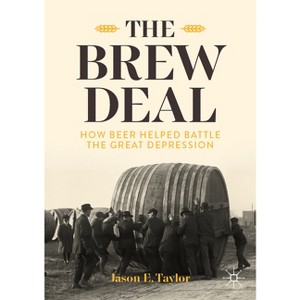
During the final stages of Prohibition, the US government allowed the consumption and sale of "non-intoxicating" beer, which was at or below 3.2% alcohol-by-weight. Beer's return--permitted with an eye toward job creation during the Great Depression--was one of President Franklin D. Roosevelt's earliest New Deal policies. In this book, economist Jason E. Taylor takes readers through the rapid resurgence of American breweries and shows how beer helped spark a sharp recovery in the spring of 1933.
Taylor begins with stories of how the nation's 1,400 breweries were decimated by the onset of Prohibition in 1920. He then turns to the frothy debates that led Congress to declare 3.2 beer "non-intoxicating," and hence allowable under Prohibition. While April 7th is now celebrated as "National Beer Day," the original April 7th--when legal beer returned after more than 13 years away--brought raucous scenes that make today's Mardi Gras festivities seem tame by comparison.
The Brew Deal shares stories of breweries, people, politics, perseverance, and the various roles that 3.2 beer has played--and continues to play--in the evolving American beer scene.
From the Back Cover
"Jason Taylor knows how to make economic history sing. While The Brew Deal is about FDR and the beer industry, it also tells a tale of American resilience in battling the Great Depression. If you've got the time, Taylor's got the book."
--Kenneth Elzinga, Professor of Economics, University of Virginia
"It's rare that a book about events from a century ago feels so fresh and timely. This gripping scholarship is a joy for readers. It also provides important insights into the politics and regulation of alcoholic beverages today."
--Bart Watson, VP of Strategy & Chief Economist of the Brewers Association
--Kenneth Elzinga, Professor of Economics, University of Virginia
"It's rare that a book about events from a century ago feels so fresh and timely. This gripping scholarship is a joy for readers. It also provides important insights into the politics and regulation of alcoholic beverages today."
--Bart Watson, VP of Strategy & Chief Economist of the Brewers Association
During the final stages of Prohibition, the US government allowed the consumption and sale of "non-intoxicating" beer, which was at or below 3.2% alcohol-by-weight. Beer's return--permitted with an eye toward job creation during the Great Depression--was one of President Franklin D. Roosevelt's earliest New Deal policies. In this book, economist Jason E. Taylor takes readers through the rapid resurgence of American breweries and shows how beer helped spark a sharp recovery in the spring of 1933.
Taylor begins with stories of how the nation's 1,400 breweries were decimated by the onset of Prohibition in 1920. He then turns to the frothy debates that led Congress to declare 3.2 beer "non-intoxicating," and hence allowable under Prohibition. While April 7th is now celebrated as "National Beer Day," the original April 7th--when legal beer returned after more than 13 years away--brought raucous scenes that make today's Mardi Gras festivities seem tame by comparison.
The Brew Deal shares stories of breweries, people, politics, perseverance, and the various roles that 3.2 beer has played in the evolving American beer scene.
Jason E. Taylor is Jerry and Felicia Campbell Professor of Economics at Central Michigan University. Before joining CMU, he earned a bachelor's degree in journalism from Ohio University and a PhD in economics from the University of Georgia. Taylor served as Editor-in-Chief of Essays in Economic & Business History between 2012 and 2018. His research is focused on US economic history, industrial organization, and public policy. Taylor's work appears in The Wall Street Journal, Forbes, USA Today, The Journal of Economic History, The Journal of Law and Economics, Public Choice, Economica, The Journal of Industrial Economics, and more.
Review Quotes
"Taylor writes exceptionally well and tells a good story--or rather, one good story after another about how beer returned swiftly to the nation's mugs in 1933, after brewers cleared out the mushrooms that thrived in disused facilities. He cheerfully recounts in detail the knock-on effects of legalized beer: demand increased for necessaries like barley and hops, or lumber for cooperage; but also for delectable accompaniments like smoked fish and other salty treats." (Eric Rauchway, EH Net, eh.net, July, 2026)
"Each spring the United States brewing industry celebrates April 7 as National Beer day, making the date in 1933 when relegalized beer slacked the thirst of a grateful American public. ... In The Brew Deal, Central Michigan University economics professor Jason E. Taylor shines a spotlight on that momentous date and its importance for the nation. ... The Brew Deal shows considerable research. It includes 58 pages of references, bibliography and indices, over one-fifth of the entire book!" (Greg Kitsock, Mid-Atlantic Brew News - American Brewer, Vol. 28 (2), May, 2026)
"Jason E. Taylor's The Brew Deal: How Beer Helped Battle the Great Depression tells the story. ... The best thing I can say about this book, really any book, is that I learned a lot. ... and heartily recommend it." (Robert A. Lawson, The Independent Review, Vol. 30 (4), 2026)
"The book is structured into 11 concise chapters with an additional prologue and epilogue that follow a mostly chronological framework alternating between economic analysis of the transitional period and case studies of specific regions, cities, and breweries nationwide ... . His economic examination of Prohibition and the early years of the Great Depression, as viewed through the beer and brewing industry, constitutes a valuable contribution to the historiography of this period." (Malcolm F. Purinton, The Economic History Review, Vol. 79 (1), February, 2026)
"This book by Jason Taylor of Central Michigan University outlines the history of prohibition in the US, beginning with its origins in the restrictions during World War I. ... Covering everything from attempts to make money from "near beer" to the lingering persistence of restrictions in some parts of the US, it's well worth tagging along for this pacy tour through America's failed attempt to go dry." (MoneyWeek, March 14, 2025)
About the Author
Jason E. Taylor is Jerry and Felicia Campbell Professor of Economics at Central Michigan University. Before joining CMU, he earned a bachelor's degree in journalism from Ohio University and a PhD in economics from the University of Georgia. Taylor was Assistant Professor at the University of Virginia from 1998 to 2003. He served as Editor-in-Chief of Essays in Economic & Business History between 2012 and 2018. His research is focused on US economic history, industrial organization, and public policy. Taylor's work appears in The Wall Street Journal, Forbes, USA Today, The Journal of Economic History, The Journal of Law and Economics, Public Choice, Economica, The Journal of Industrial Economics, and more.
Dimensions (Overall): 8.27 Inches (H) x 5.83 Inches (W) x .6 Inches (D)
Weight: .76 Pounds
Suggested Age: 22 Years and Up
Number of Pages: 268
Genre: Business & Economics
Sub-Genre: Economic History
Publisher: Palgrave MacMillan
Format: Paperback
Author: Jason E Taylor
Language: English
Street Date: December 2, 2024
TCIN: 1011993181
UPC: 9783031731327
Item Number (DPCI): 247-33-4275
Origin: Made in the USA or Imported
If the item details aren’t accurate or complete, we want to know about it.
Shipping details
Estimated ship dimensions: 0.6 inches length x 5.83 inches width x 8.27 inches height
Estimated ship weight: 0.76 pounds
We regret that this item cannot be shipped to PO Boxes.
This item cannot be shipped to the following locations: American Samoa (see also separate entry under AS), Guam (see also separate entry under GU), Northern Mariana Islands, Puerto Rico (see also separate entry under PR), United States Minor Outlying Islands, Virgin Islands, U.S., APO/FPO, Alaska, Hawaii
Return details
This item can be returned to any Target store or Target.com.
This item must be returned within 90 days of the date it was purchased in store, delivered to the guest, delivered by a Shipt shopper, or picked up by the guest.