Sponsored
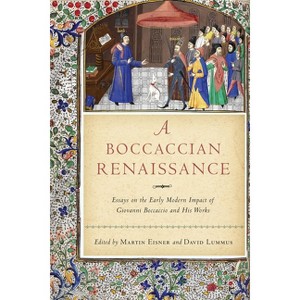
A Boccaccian Renaissance - (William and Katherine Devers Dante and Medieval Italian Literature) by Martin Eisner & David G Lummus (Hardcover)
In Stock
Sponsored
About this item
Highlights
- A Boccaccian Renaissance brings together essays written by internationally recognized scholars in diverse national traditions to respond to the largely unaddressed question of Boccaccio's impact on early modern literature and culture in Italy and Europe.
- About the Author: David Lummus is assistant director of the Center for Italian Studies at the University of Notre Dame and editor of the American Boccaccio Association's Lectura Boccaccii for Day 6 of the Decameron.
- 350 Pages
- Literary Criticism, European
- Series Name: William and Katherine Devers Dante and Medieval Italian Literature
Description
About the Book
A Boccaccian Renaissance brings together internationally recognized scholars to reveal Boccaccio's impact on early modern literature and culture in Italy and Europe.
Book Synopsis
A Boccaccian Renaissance brings together essays written by internationally recognized scholars in diverse national traditions to respond to the largely unaddressed question of Boccaccio's impact on early modern literature and culture in Italy and Europe. Martin Eisner and David Lummus co-edit the first comprehensive examination in English of Boccaccio's impact on the Renaissance.
The essays investigate what it means to follow a Boccaccian model, in tandem with or in place of ancient authors such as Vergil or Cicero, or modern poets such as Dante or Petrarch. The book probes how deeply the Latin and vernacular works of Boccaccio spoke to the Renaissance humanists of the fifteenth century. It treats not only the literary legacy of Boccaccio's works but also their paradoxical importance for the history of the Italian language and reception in theater and books of conduct.
While the geographical focus of many of the essays is on Italy, the volume concludes with three studies that open new inroads to understanding his influence on Spanish, French, and English writers across the sixteenth century. The book will appeal strongly to scholars and students of Boccaccio, the Italian and European Renaissance, and Italian literature.
Contributors: Jonathan Combs-Schilling, Rhiannon Daniels, Martin Eisner, Simon Gilson, James Hankins, Timothy Kircher, Victoria Kirkham, David Lummus, Ronald L. Martinez, Ignacio Navarrete, Brian Richardson, Marc Schachter, Michael Sherberg, and Janet Levarie Smarr
Review Quotes
"A Boccaccian Renaissance opens a window on various aspects of Boccaccio studies and provides insights into literary and cultural trends across centuries, countries, and languages, which will certainly be of great interest to scholars of the early modern period." --Sixteenth Century Journal
"Giovanni Boccaccio's presence as it radiates through time and space is captured and distilled in this elegantly conceived volume. Martin Eisner and David Lummus have gathered and framed twelve distinguished essays on the 'Renaissance Boccaccio'; together they offer a compelling reexamination of the impact of this most generous of Italy's tre corone." --Teodolinda Barolini, Lorenzo Da Ponte Professor of Italian, Columbia University
"This is a collection of strong essays by leading experts in the field that break new ground in our understanding of the diverse reworkings of Boccaccio's works in the Renaissance and beyond, both in Italy and in Europe. These contributions are independently rigorous and original works. The book will be useful to readers in a variety of fields in studies of medieval and Renaissance Italian and European traditions and beyond. I agree wholeheartedly with the editors that the chapters 'leave signs of how much work still needs to be done and from what perspective that work must begin.'" --Kristina M. Olson, George Mason University
"The book enhances in a number of ways our knowledge of Boccaccio's legacy in the Renaissance, particularly in the area of the history of the book, but also Boccaccio's significance as a political thinker, his obsession with the pastoral, his role in the birth of Renaissance comedy, and new aspects of his influence in France, Spain, and England. The scholarship is very sound, as most contributors are acknowledged leaders in their fields." --Martin McLaughlin, University of Oxford
About the Author
David Lummus is assistant director of the Center for Italian Studies at the University of Notre Dame and editor of the American Boccaccio Association's Lectura Boccaccii for Day 6 of the Decameron. His publications on Boccaccio and Petrarch have appeared in Speculum and Renaissance Quarterly.
Shipping details
Return details
Discover more options