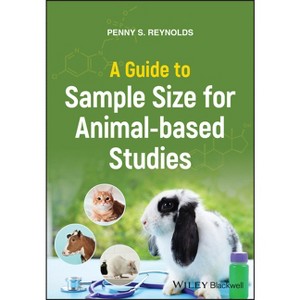
A Guide to Sample Size for Animal-Based Studies - by Penny S Reynolds (Paperback)
About this item
Highlights
- A Guide to Sample Size for Animal-based Studies Understand a foundational area of experimental design with this innovative reference Animal-based research is an essential part of basic and preclinical research, but poses a unique set of experimental design challenges.
- About the Author: Penny S. Reynolds, PhD, is a Research Assistant Professor in the Department of Anesthesiology, College of Medicine, and Department of Small Animal Clinical Sciences, College of Veterinary Medicine, University of Florida, USA.
- 288 Pages
- Medical, Biostatistics
Description
About the Book
"How large a sample size do I need for my study"? Although one of the most commonly-asked questions in statistics, the importance of proper sample size estimation seems to be overlooked by many preclinical researchers. Over the past two decades, numerous reviews of the published literature indicate many studies are too small to answer the research question and results are too unreliable to be trusted. Few published studies present adequate justification of their chosen sample sizes, or even report the total number of animals used. On the other hand, it is not unusual for protocols (usually those involving mouse models) to request preposterous numbers of animals, sometimes in the tens or even hundreds of thousands, "because this is an exploratory study, so it is unknown how many animals we will require"--Book Synopsis
A Guide to Sample Size for Animal-based StudiesUnderstand a foundational area of experimental design with this innovative reference
Animal-based research is an essential part of basic and preclinical research, but poses a unique set of experimental design challenges. The most important of these are the 3Rs - Replacement, Reduction and Refinement - the principles comprising the ethical framework for humane animal-based studies. However, many researchers have difficulty navigating the design trade-offs necessary to simultaneously minimize animal use, and produce scientific information that is both rigorous and reliable.
A Guide to Sample Size for Animal-based Studies meets this need with a thorough, accessible reference work to the subject. This book provides a straightforward systematic approach to "rightsizing" animal-based experiments, with sample size estimates based on the fundamentals of statistical thinking: structured research questions, variation control and appropriate design of experiments. The result is a much-needed guide to planning animal-based experiments to ensure scientifically valid and reliable results.
This book offers:
- Step-by-step guidance in diverse methods for approximating and refining sample size
- Detailed treatment of research topics specific to animal-based research, including pilot, feasibility and proof-of-concept studies
- Sample size approximation methods for different types of data - binary, continuous, ordinal, time to event - and different study types - description, comparison, nested designs, reference interval construction and dose-response studies
- Numerous worked examples, using real data from published papers, together with SAS and R code
A Guide to Sample Size for Animal-based Studies is a must-have reference for preclinical and veterinary researchers, as well as ethical oversight committees and policymakers.
From the Back Cover
Understand a foundational area of experimental design with this innovative reference
Animal-based research is an essential part of basic and preclinical research, but poses a unique set of experimental design challenges. The most important of these are the 3Rs - Replacement, Reduction and Refinement - the principles comprising the ethical framework for humane animal-based studies. However, many researchers have difficulty navigating the design trade-offs necessary to simultaneously minimize animal use, and produce scientific information that is both rigorous and reliable.
A Guide to Sample Size for Animal-based Studies meets this need with a thorough, accessible reference work to the subject. This book provides a straightforward systematic approach to "rightsizing" animal-based experiments, with sample size estimates based on the fundamentals of statistical thinking: structured research questions, variation control and appropriate design of experiments. The result is a much-needed guide to planning animal-based experiments to ensure scientifically valid and reliable results.
This book offers:
- Step-by-step guidance in diverse methods for approximating and refining sample size
- Detailed treatment of research topics specific to animal-based research, including pilot, feasibility and proof-of-concept studies
- Sample size approximation methods for different types of data - binary, continuous, ordinal, time to event - and different study types - description, comparison, nested designs, reference interval construction and dose-response studies
- Numerous worked examples, using real data from published papers, together with SAS and R code
A Guide to Sample Size for Animal-based Studies is a must-have reference for preclinical and veterinary researchers, as well as ethical oversight committees and policymakers.
About the Author
Penny S. Reynolds, PhD, is a Research Assistant Professor in the Department of Anesthesiology, College of Medicine, and Department of Small Animal Clinical Sciences, College of Veterinary Medicine, University of Florida, USA.
Shipping details
Return details
Trending Diet, Health & Fitness Books






Discover more options