Sponsored
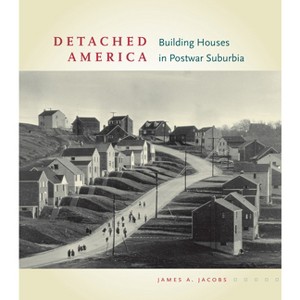
Detached America - (Midcentury) by James A Jacobs (Hardcover)
In Stock
Sponsored
About this item
Highlights
- During the quarter century between 1945 and 1970, Americans crafted a new manner of living that shaped and reshaped how residential builders designed and marketed millions of detached single-family suburban houses.
- About the Author: James A. Jacobs is a historian for the Historic American Buildings Survey and the National Historic Landmarks Program of the National Park Service.
- 272 Pages
- Architecture, History
- Series Name: Midcentury
Description
About the Book
This vast and long-lived collaboration between government and business--fueled by millions of homeowners--established the financial mechanisms, consumer framework, domestic ideologies, and architectural precedents that permanently altered the geographic and demographic landscape of the nation.Book Synopsis
During the quarter century between 1945 and 1970, Americans crafted a new manner of living that shaped and reshaped how residential builders designed and marketed millions of detached single-family suburban houses. The modest two- and three-bedroom houses built immediately following the war gave way to larger and more sophisticated houses shaped by casual living, which stressed a family's easy sociability and material comfort and were a major element in the cohesion of a greatly expanded middle class. These dwellings became the basic building blocks of explosive suburban growth during the postwar period, luring families to the metropolitan periphery from both crowded urban centers and the rural hinterlands.
Detached America is the first book with a national scope to explore the design and marketing of postwar houses. James A. Jacobs shows how these houses physically document national trends in domestic space and record a remarkably uniform spatial evolution that can be traced throughout the country. Favorable government policies, along with such widely available print media as trade journals, home design magazines, and newspapers, permitted builders to establish a strong national presence and to make a more standardized product available to prospective buyers everywhere. This vast and long-lived collaboration between government and business--fueled by millions of homeowners--established the financial mechanisms, consumer framework, domestic ideologies, and architectural precedents that permanently altered the geographic and demographic landscape of the nation.
Review Quotes
Detached America examines closely the issues of housing that most adults are familiar with--the ranch house, the split level, informal living--but for the first time, these architectural forms are investigated in detail. The author discusses their formal properties, focusing on typical vernacular examples. At the same time, these are placed within a rich social and cultural history concerning room use, women's roles, discrimination, and the like. The author has done a fantastic job mining home builder journals, home design magazines, architectural publications, and local newspapers, and the text is filled with a rich array of quotations from these sources.
--Andrew Dolkart, Columbia University, author of Biography of a Tenement House in New York City: An Architectural History of 97 Orchard StreetDetached America is well organized and written, and will undoubtedly earn a place on the shelf of essential readings concerning postware suburban America.
-- "American Historical Review"Detached Americais well-grounded on an extensive survey of trade and consumer magazines, combined with fieldwork in two subdivisions just outside Washington, DC, and three in Glenshaw, a suburb of Pittsburgh.... [Jacobs] has redrawn plans from these sources in a consistent style, facilitating comparison, and his interpretations of the changed character and meaning of interior space are convincing. His identification of three design phases is a significant addition to our understanding of the postwar suburban dwelling.
-- "Journal of Planning History"[An] excellent resource for anyone interested in a deep dive into suburban planning. In particular, Jacobs offers a comprehensive overview of the politics that promoted and enabled the great suburban shift.
-- "Foreign Affairs"[A] balanced, probing, and insightful history.
-- "New York Review of Books"[A]n insightfully detailed study... Jacobs fruitfully analyzes the evolution of interior dwelling spaces and their functions, elaborating on details such as the size and locations of closets and the master bath and perceptively relating these physical details to changing cultural values.
-- "CHOICE"This book explores the quarter century between 1945 and 1970, when Americans crafted a new manner of living that shaped and reshaped how residential builders designed and marketed millions of detached single-family suburban houses. These dwellings were the basic building blocks and the single most important components of the explosive suburban growth during the postwar period, luring families to the metropolitan periphery from both crowded urban centers and the rural hinterlands. Favorable government policies, and sympathetic and widely available print media such as trade journals, popular shelter magazines, and newspapers, emboldened the residential building industry while informing the public of these new possibilities. A vast and long-lived collaboration involving government and business--and fueled by millions of middle-class homeowners--established the financial mechanisms, consumer frameworks, domestic ideologies informed especially by the notion of "casual living," and the architectural precedents that permanently altered the geographic and demographic landscape of the nation.
This book is a sorely needed contribution to the history of post World War II domestic architecture, which for too long has focused on a few key architects and merchant builders at the expense of a thorough understanding of the most ubiquitous building form of the period: the middle-class American house. Focusing on the house as the principal building block of the postwar American landscape, Jacobs's narrative shows us how it resulted from a complex, yet carefully orchestrated, series of collaborations between the building industry, the federal government, postwar tastemakers, and middle-class consumers. National in scope and ambitious in using a rich body of evidence drawn from builders' records, shelter magazines, and actual houses, this book fills a much-needed gap in suburban studies and American architecture by examining the structural, stylistic, and formal innovations of middle-class houses from the rich and varied perspectives of their designers, builders, and occupants.
--Anna Vemer Andrzejewski, University of Wisconsin-Madison, author of Building Power: Architecture and Surveillance in Victorian AmericaThis is an impressive and well-conceived research program. Jacobs has extracted from these sources a great many house plans, which he has hired a draftsman to repro- duce. The result is a handsome book that is far more informative than most publications about suburban houses after World War II.
-- "Buildings and Landscapes"About the Author
James A. Jacobs is a historian for the Historic American Buildings Survey and the National Historic Landmarks Program of the National Park Service.
Shipping details
Return details
Trending Non-Fiction






Discover more options