Sponsored
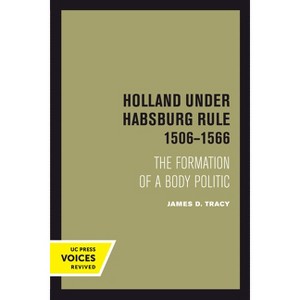
Holland Under Habsburg Rule, 1506-1566 - by James D Tracy (Paperback)
$39.99
In Stock
Eligible for registries and wish lists
Sponsored
About this item
Highlights
- Under what conditions were limited forms of self-government possible in medieval and early modern Europe?
- About the Author: James D. Tracy is Professor Emeritus of History at the University of Minnesota and the author of A Financial Revolution in the Habsburg Netherlands: Renten and Renteniers in the County of Holland, 1515-1565 and two other books.
- 342 Pages
- Political Science, General
Description
Book Synopsis
Under what conditions were limited forms of self-government possible in medieval and early modern Europe? While many historians have sought an answer by investigating the development of parliamentary institutions in emerging national monarchies and the wider autonomy enjoyed by various city-states within their own borders, James D. Tracy concentrates instead on a relatively neglected phenomenon at an intermediate level of political organization--the self-governing province. Focusing on the province of Holland during the reigns of Charles V and Philip II (1506-1566), Tracy argues convincingly that Holland effectively underwent an apprenticeship in self-government. The seven provinces of the Dutch Republic--among which Holland was the richest and most populous--were the first in history to govern themselves by a consensus among their towns and nobles. The foundations for this internal cohesion were put in place long before the Dutch Revolt; first by medieval provincial dynasties, then by the dukes of Burgundy, and finally by the House of Habsburg. At the turn of the sixteenth century, Holland was urbanized to a surprising degree, with over forty percent of its population residing in some thirty small and mid-sized towns. Forced by external threats to rise above their economic rivalries, the towns joined together through the forum of the provincial parliament, or States of Holland, which came to assume a primary role in the management of public finances. While noting that the growing autonomy of Holland did not make the Dutch Revolt inevitable, Tracy points out that the revolt could hardly have succeeded without provinces that already had a tradition of managing their own affairs. In the broader context of European political institutions, the circumstances that permitted the provincial states to assume many of the functions of government illustrate not only the capacity for self-government but also the formation of genuine body politics. This title is part of UC Press's Voices Revived program, which commemorates University of California Press's mission to seek out and cultivate the brightest minds and give them voice, reach, and impact. Drawing on a backlist dating to 1893, Voices Revived makes high-quality, peer-reviewed scholarship accessible once again using print-on-demand technology. This title was originally published in 1990.From the Back Cover
"Very little work has been done on tracing the development of the form of government that was to become characteristic of the Dutch Republic during its 'Golden Age.' The discussion of the development of representative institutions in the Low Countries within a European-wide comparative framework is valuable. . . . [Holland's] structure of representation came to differ significantly from its neighbors. It was not supposed to work, according to political theory of the time, and yet it did. Learning how it came about helps to understand how it managed to stand as the only viable form of political organization outside of increasing royal absolutism in early modern times."--William H. TeBrake, University of Maine at OronoAbout the Author
James D. Tracy is Professor Emeritus of History at the University of Minnesota and the author of A Financial Revolution in the Habsburg Netherlands: Renten and Renteniers in the County of Holland, 1515-1565 and two other books.Dimensions (Overall): 9.0 Inches (H) x 6.0 Inches (W) x .76 Inches (D)
Weight: 1.11 Pounds
Suggested Age: 22 Years and Up
Number of Pages: 342
Genre: Political Science
Sub-Genre: General
Publisher: University of California Press
Format: Paperback
Author: James D Tracy
Language: English
Street Date: October 23, 2018
TCIN: 1007770687
UPC: 9780520304031
Item Number (DPCI): 247-17-4304
Origin: Made in the USA or Imported
If the item details aren’t accurate or complete, we want to know about it.
Shipping details
Estimated ship dimensions: 0.76 inches length x 6 inches width x 9 inches height
Estimated ship weight: 1.11 pounds
We regret that this item cannot be shipped to PO Boxes.
This item cannot be shipped to the following locations: American Samoa (see also separate entry under AS), Guam (see also separate entry under GU), Northern Mariana Islands, Puerto Rico (see also separate entry under PR), United States Minor Outlying Islands, Virgin Islands, U.S., APO/FPO
Return details
This item can be returned to any Target store or Target.com.
This item must be returned within 90 days of the date it was purchased in store, shipped, delivered by a Shipt shopper, or made ready for pickup.
See the return policy for complete information.
Trending Non-Fiction

$15.68
Buy 1, get 1 50% off select books
4.8 out of 5 stars with 204 ratings

Highly rated
$19.31
was $20.98 New lower price
Buy 1, get 1 50% off select books
4 out of 5 stars with 67 ratings
$18.28
was $19.58 New lower price
Buy 1, get 1 50% off select books
4.7 out of 5 stars with 17 ratings

$4.59
MSRP $7.99
Buy 1, get 1 50% off select books
4.8 out of 5 stars with 124 ratings

$6.20
MSRP $10.95
Buy 1, get 1 50% off select books
4.8 out of 5 stars with 33 ratings

$7.09
MSRP $9.99
Buy 1, get 1 50% off select books
4.9 out of 5 stars with 46 ratings
Discover more options
$39.99
Buy 1, get 1 50% off select books
$15.00
Buy 1, get 1 50% off select books

$14.99
MSRP $15.99
Buy 1, get 1 50% off select books

$12.65
MSRP $22.99
Buy 1, get 1 50% off select books

$11.70
MSRP $19.99
Buy 1, get 1 50% off select books
$37.00
Buy 1, get 1 50% off select books