Sponsored
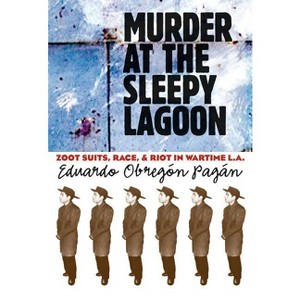
Murder at the Sleepy Lagoon - by Eduardo Obregón Pagán (Paperback)
In Stock
Sponsored
About this item
Highlights
- The notorious 1942 "Sleepy Lagoon" murder trial in Los Angeles concluded with the conviction of seventeen young Mexican American men for the alleged gang slaying of fellow youth Jose Diaz.
- About the Author: Eduardo Obregón Pagán is associate professor and chair of the Department of American Studies at Arizona State University West.
- 328 Pages
- History, United States
Description
About the Book
Murder at the Sleepy Lagoon: Zoot Suits, Race, and Riot in Wartime L.A.Book Synopsis
The notorious 1942 "Sleepy Lagoon" murder trial in Los Angeles concluded with the conviction of seventeen young Mexican American men for the alleged gang slaying of fellow youth Jose Diaz. Just five months later, the so-called Zoot Suit Riot erupted, as white soldiers in the city attacked minority youths and burned their distinctive zoot suits. Eduardo Obregón Pagán here provides the first comprehensive social history of both the trial and the riot and argues that they resulted from a volatile mix of racial and social tensions that had long been simmering.
In reconstructing the lives of the murder victim and those accused of the crime, Pagán contends that neither the convictions (which were based on little hard evidence) nor the ensuing riot arose simply from anti-Mexican sentiment. He demonstrates instead that a variety of pre-existing stresses, including demographic pressures, anxiety about nascent youth culture, and the war effort all contributed to the social tension and the eruption of violence. Moreover, he recovers a multidimensional picture of Los Angeles during World War II that incorporates the complex intersections of music, fashion, violence, race relations, and neighborhood activism.
Drawing upon overlooked evidence, Pagán concludes by reconstructing the murder scene and proposes a compelling theory about what really happened the night of the murder.
Review Quotes
"Murder at Sleepy Lagoon does more than sharpen the edges of a well-worn story. . . . It also serves as a superb case study of the myriad factors that have influenced the course of race relations in the United States. . . . Pagan has constructed an impressive study of modern American race relations that should resonate beyond the fields of Los Angeles and Mexican American history." -- Pacific Historical Review
"[A] masterful volume. . . . One of the most comprehensive and authoritative accounts of both the Sleepy Lagoon murder and the subsequent trials and of the Zoot Suits riots of the early 1940s. . . . Succeeds admirably." -- Latin Americanist
"A brilliant and ultimately persuasive effort to explain the function of music and fashion in shaping how Americans see themselves, then and now. . . . Pagán has made an important and illuminating contribution to [the] body of [Chicano] scholarship." -- Los Angeles Times Book Review
"A fine addition to western and Chicana/o historiography. The varied and unique sources on which this book is based ensure that it will be a standard by which to judge any other studies on this subject." -- Western Historical Quarterly
"Full of flavor. . . . Pagán's book . . . provides insight into a time many overlook. You don't have to be Mexican, or Latino, or even a Californian to care about this story." -- Hispanic
"Pagan does a wonderful job of making the 1940s come alive, while providing the kind of research base that we would expect from any good social history. The book deserves a wide readership." -- American Historical Review
"Smart, insightful and evocative." -- Australasian Journal of American Studies
"This is a vital and pathbreaking book. . . . Obregón Pagán tells a good story, providing perhaps the best extant discussion of the facts underlying the Sleepy Lagoon murder. His scholarship is nuanced and careful." -- Journal of American History
About the Author
Eduardo Obregón Pagán is associate professor and chair of the Department of American Studies at Arizona State University West.Shipping details
Return details
Frequently bought together

Trending Non-Fiction


Discover more options