Target New ArrivalsChristmasGift IdeasHoliday Kids CatalogHome & DecorToys & GamesElectronics & TechVideo GamesGift CardsClothing, Shoes & AccessoriesGroceryBabyBeautyTarget Beauty StudioPersonal CareHousehold EssentialsHealthWellnessBooks, Music & MoviesSports & OutdoorsPetsSchool & Office SuppliesParty SuppliesAutomotiveTarget OpticalClearanceNew ArrivalsChristmasGift IdeasTop DealsTarget Circle DealsWeekly AdShop Order PickupShop Same Day DeliveryRegistryRedCardTarget CircleFind Stores
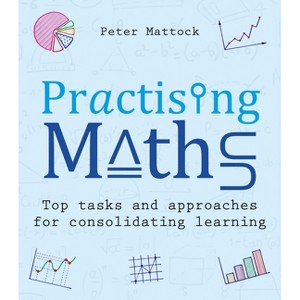
Practising Maths - by  Peter Mattock (Paperback) - 1 of 1

Practising Maths - by Peter Mattock (Paperback)

$24.95

Pre-order

Free & easy returns
Free & easy returns
Return this item by mail or in store within 90 days for a full refund.
Eligible for registries and wish lists

About this item

Highlights

  • The first aim of many maths curricula is for pupils to become fluent in the fundamentals of mathematics, including through varied and frequent practise with increasingly complex problems over time, so that pupils develop conceptual understanding and the ability to recall and apply knowledge rapidly and accurately.
  • About the Author: Peter Mattock has been teaching and leading maths for over 15 years.
  • 200 Pages
  • Education, Teaching

Description


About the Book


A practical guide to sourcing and designing maths practice that goes beyond rote learning and helps students genuinely understand what they're doing.


Book Synopsis


The first aim of many maths curricula is for pupils to become fluent in the fundamentals of mathematics, including through varied and frequent practise with increasingly complex problems over time, so that pupils develop conceptual understanding and the ability to recall and apply knowledge rapidly and accurately. In " Conceptual Maths", Peter Mattock wrote about the importance of pupils learning about mathematical concepts, rather than just " doing" maths. This isn't to say that doing maths is not important, simply that if all pupils learn through a mathematical education is to " do" stuff - carry out calculations and follow procedures - then this isn't much of a mathematical education. To receive a true mathematical education, pupils need to learn both ' about' maths and ' to do' maths. Practice is crucial, however, regardless of whether pupils are learning ' about' or ' to do' maths. There is a widely believed and persistent myth that it takes 10,000 hours of practise to master a particular skill. Of course, what the people quoting the 10,000 hours rule often fail to mention is that, in addition to the time spent practising, the type of practise is just as important. However, this presents several questions for math teachers: what type or types of practise do pupils need in order to master different mathematical ideas? How does the concept that students are learning affect the type of practise that we might offer them? What sort of issues do we need to consider when designing practise activities for pupils? Generally, there are two broad types of practice: - Type 1 involves the rehearsal of core facts, methods and strategies that can be used to complete exercises and solve problems now and in the next stage of education - Type 2 includes explaining, justifying and proving concepts using informal and diagrammatic methods, parsing and derivation of numbers This book concentrates on type 2 practise and provides teachers with opportunities beyond the practise of " methods and strategies that can be used to complete exercises" arguably what the bulk of practise in the maths classroom seems to be focused on. In doing so, teachers will gain the knowledge and confidence to design and choose tasks that will be effective in ensuring pupils' practise leads to the deep understanding of maths that we hope to develop in all learners. Contents include: 1. Conceptual variation. 2. Procedural variation. 3. Deliberate practise. 4. Subordinating practise. 5. Interleaving and interweaving. 6. Guiding practise. 7. Spacing practise. 8. Opportunities for reasoning and problem solving. 9. Rich tasks. 10. Goal-free problems. 11. The role of SLOP (Shed Loads of Practise) and increasingly difficult questions. 12. The role of manipulatives and representation in practise.


Review Quotes


In Practising Maths, Peter Mattock delivers some deep, insightful ideas about how teachers can make sure that the practice they offer their students in developing mathematics concepts and skills is varied and appropriate for different outcomes and stages of learning. Practice comes in different forms, but Peter sets out the theory behind why some practice methods are better than others, based on ideas of conceptual and procedural variation, using practice between and after learning input, and designing practice examples for rich tasks and problem solving. The book explores how practice can be made increasingly difficult and used to diagnose misconceptions in learning. With a wide range of examples taken from all areas of the mathematics curriculum, the book includes many useful diagrams, tables and representations, as well as extensive references for further material to explore. Teaching strategies are also covered, such as using cut-out cards, multiple-choice questions and using game-like scenarios to practise mathematical ideas. Another excellent book in a useful and informative series - following his earlier works Visible Maths, Conceptual Maths and Leading Maths - Practising Maths will be of great benefit to mathematics teachers at all stages of their careers and could form a useful resource for staff development programmes and professional growth.

Ray Huntley


Peter Mattock's Practising Maths: Top Tasks and Approaches for Consolidating Learning does exactly what it says on the tin: it's a working manual for the part of a maths lesson that everyone agrees matters and almost nobody talks about with any precision - practice. Not 'what should I teach', but 'what should learners actually do once I've taught it'.Rather than asserting that conceptual variation matters, Mattock opens the book with a self-reflection exercise for teachers to do. It's a humbling demonstration of how narrow our mental image of a 'typical' example is, and how that narrowness quietly becomes the narrowness of what learners are ever shown. This is the book's best trick and it repeats itself throughout: show the failure mode concretely before naming the principle.The chapter on goal-free problems is the standout for anyone interested in task design. Mattock uses a standard puzzle to vividly make a point around cognitive load: focusing on the goal and solving it teaches us nothing transferable and ignores the structure of the problem. He then takes a real exam question and shows how stripping the explicit goal and instead asking learners to 'work out as much as you can' redirects effort toward the maths itself. This chapter is close to a design pattern, not just a teaching tip.Practising Maths is a practical, well-evidenced, easy-to-navigate handbook rather than a grand theory of practice - and that's its strength. It won't tell you how to build a curriculum, but it will sharpen your eye for what makes a set of practice questions or a task actually get students doing cognitive work, as opposed to just looking busy. For classroom teachers, it's a genuinely useful shelf reference. For anyone designing maths tasks, questions, or game mechanics, several chapters (Conceptual Variation, Goal-Free Problems, and Shed Loads of Practice and Increasingly Difficult Questions, in particular) are worth reading closely even if the rest is skimmed.

Bernie Westacott


Practising Maths explores the art of deepening mathematical thinking in exquisite detail. It provides a clear roadmap for how to build conceptual understanding and shows how to embed mathematical reasoning and problem solving within sequences of lessons. The guidance and the wide-ranging examples will help teachers of maths to direct thinking and craft lessons that meet the needs of the children in their classes.

Gareth Metcalfe


Practising Maths is a great addition to Pete's collection of works and it really complements the understanding and key messages of Visible Maths and Conceptual Maths. It is a synthesisation of all the best approaches to mathematical practice and all the latest thinking and research, all presented in Pete's usual clear and easy-to-understand way. The book makes the case for using a variety of practice tasks in the maths lesson, and groups various approaches to practice into easy-to-access, connected chapters. It is an absolute treasure trove of high-quality examples of practice tasks to suit learners of all ages and abilities - and any teacher of maths is bound to find something they can action in the very next lesson. Practising Maths should be recommended reading for any teacher asking pupils to practise maths.

Lisa Coe


You can argue whether practice makes perfect or makes permanent or makes progress. But you can't argue that there are a range of ways to practise that all need to be utilised by pupils at some stage to create a rich experience of learning mathematics and thisbook shares research and wonderfully explains the rationale and usage of a range of different types of practice. It's one for all maths departments to have to hand to ensure they are offering a more impactful experience and curriculum for their classes.

Tom Manners


About the Author


Peter Mattock has been teaching and leading maths for over 15 years. He is a specialist leader of education (SLE) and an accredited secondary maths professional development lead who regularly presents at conferences across the country. Peter also develops teaching for mastery in the secondary school classroom, having been part of the first cohort of specialists trained in mastery approaches by the National Centre for Excellence in the Teaching of Mathematics (NCETM).
Dimensions (Overall): 9.5 Inches (H) x 8.25 Inches (W)
Suggested Age: 22 Years and Up
Number of Pages: 200
Genre: Education
Sub-Genre: Teaching
Publisher: Crown House Publishing
Theme: Subjects, Mathematics
Format: Paperback
Author: Peter Mattock
Language: English
Street Date: April 30, 2027
TCIN: 1008300575
UPC: 9781785837791
Item Number (DPCI): 247-53-7058
Origin: Made in the USA or Imported
If the item details aren’t accurate or complete, we want to know about it.

Shipping details

Estimated ship dimensions: 1 inches length x 8.25 inches width x 9.5 inches height
Estimated ship weight: 1 pounds
We regret that this item cannot be shipped to PO Boxes.
This item cannot be shipped to the following locations: American Samoa (see also separate entry under AS), Guam (see also separate entry under GU), Northern Mariana Islands, Puerto Rico (see also separate entry under PR), United States Minor Outlying Islands, Virgin Islands, U.S., APO/FPO, Alaska, Hawaii

Return details

This item can be returned to any Target store or Target.com.
This item must be returned within 90 days of the date it was purchased in store, delivered to the guest, delivered by a Shipt shopper, or picked up by the guest.
See the return policy for complete information.

Additional product information and recommendations

Discover more options

Skip to next section

Get top deals, latest trends, and more.