Sponsored
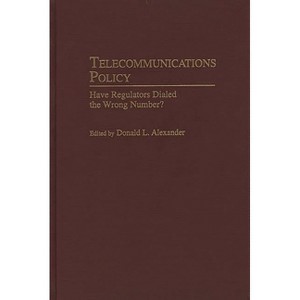
Telecommunications Policy - by Unknown (Hardcover)
In Stock
Sponsored
About this item
Highlights
- In this timely collection of essays, leading economic and communication scholars examine major policy issues confronting federal and state regulators in the telecommunications industry.
- About the Author: DONALD L. ALEXANDER is Associate Professor of Economics at Western Michigan University and adjunct scholar with the Mackinac Center for Public Policy.
- 184 Pages
- Freedom + Security / Law Enforcement, General
Description
About the Book
In this timely collection of essays, leading economic and communication scholars examine major policy issues confronting federal and state regulators in the telecommunications industry. The essays describe how past regulatory decisions have contributed to a growing tension between emerging competition and the preservation of specific social objectives like the continuance of universal service, and thus provide a unique perspective on the current public policy debates. Although each author discusses a different policy issue, the common theme in this volume is the compelling argument that past regulatory decisions, which were often motivated by political compromises rather than sound economic analysis, are the primary source of inefficiency that exists in the telecommunications industry today.
This insight points to potential harm that legislators may create from ignoring economic forces when deregulating an industry. The Telecommunications Act of 1996 is an example in which deregulation has created more, not less, regulatory barriers affecting competitors. The authors challenge policy makers to consider no regulation to insure that competitive forces determine prices, quantities, and quality of service for the vast array of telecommunication services available in today's marketplace.
Book Synopsis
In this timely collection of essays, leading economic and communication scholars examine major policy issues confronting federal and state regulators in the telecommunications industry. The essays describe how past regulatory decisions have contributed to a growing tension between emerging competition and the preservation of specific social objectives like the continuance of universal service, and thus provide a unique perspective on the current public policy debates. Although each author discusses a different policy issue, the common theme in this volume is the compelling argument that past regulatory decisions, which were often motivated by political compromises rather than sound economic analysis, are the primary source of inefficiency that exists in the telecommunications industry today.
This insight points to potential harm that legislators may create from ignoring economic forces when deregulating an industry. The Telecommunications Act of 1996 is an example in which deregulation has created more, not less, regulatory barriers affecting competitors. The authors challenge policy makers to consider no regulation to insure that competitive forces determine prices, quantities, and quality of service for the vast array of telecommunication services available in today's marketplace.About the Author
DONALD L. ALEXANDER is Associate Professor of Economics at Western Michigan University and adjunct scholar with the Mackinac Center for Public Policy. His research and teaching interests are in the areas of industrial organization, antitrust economics, and the economics of regulation. He is the author of several journal articles.Shipping details
Return details
Trending Non-Fiction