Sponsored
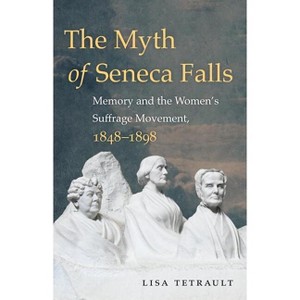
The Myth of Seneca Falls - (Gender and American Culture) by Lisa Tetrault (Paperback)
In Stock
Sponsored
About this item
Highlights
- The story of how the women's rights movement began at the Seneca Falls convention of 1848 is a cherished American myth.
- Author(s): Lisa Tetrault
- 296 Pages
- History, Women
- Series Name: Gender and American Culture
Description
About the Book
Myth of Seneca Falls: Memory and the Women's Suffrage Movement, 1848-1898Book Synopsis
The story of how the women's rights movement began at the Seneca Falls convention of 1848 is a cherished American myth. The standard account credits founders such as Elizabeth Cady Stanton, Susan B. Anthony, and Lucretia Mott with defining and then leading the campaign for women's suffrage. In her provocative new history, Lisa Tetrault demonstrates that Stanton, Anthony, and their peers gradually created and popularized this origins story during the second half of the nineteenth century in response to internal movement dynamics as well as the racial politics of memory after the Civil War. The founding mythology that coalesced in their speeches and writings -- most notably Stanton and Anthony's History of Woman Suffrage -- provided younger activists with the vital resource of a usable past for the ongoing struggle, and it helped consolidate Stanton and Anthony's leadership against challenges from the grassroots and rival suffragists.
As Tetrault shows, while this mythology has narrowed our understanding of the early efforts to champion women's rights, the myth of Seneca Falls itself became an influential factor in the suffrage movement. And along the way, its authors amassed the first archive of feminism and literally invented the modern discipline of women's history.
2015 Mary Jurich Nickliss Prize, Organization of American Historians
Review Quotes
"A clear, well-written, and vivid account. Tetrault's arguments about the ways that any movement-- in this case the woman suffrage movement-- shapes its future course by re-imagining its past will provide substantive grist for discussion. Tetrault's characterization of the battle over memory in the woman suffrage movement will help readers to see the 'founding mothers' of American feminism in a complex and revealing light. Since, as she notes, they have tended to be memorialized in public school curricula and public history sites in the heroic light they themselves framed, this discussion will be revelatory."--Annelise Orleck, author of Common Sense and a Little Fire: Women and Working Class Politics in the United States, 1900-1965
"All historians would benefit from reading Tetrault's study and giving thought to the construction of memory narratives"--American Historical Review
"Greatly expands on current feminist scholarship that interrogates the origin story of Seneca Falls and the inevitability of the triumph of women's suffrage."--CHOICE
"Tetrault examines how the history and memory of women's suffrage was created by Elizabeth Cady Stanton and Susan B. Anthony, as well as their legions of accomplices over time. She makes the convincing case that an archival approach to this 'construction' of a canonized memory will show us how an origins myth rooted in the narrative of Seneca Falls has hovered over the story and reputation of women's suffrage ever since Stanton and Anthony wrote their History. How and why Stanton and Anthony created their own myth of leadership as well as the progress narrative of their movement is a splendid case for how the politics of memory works in history."--David Blight, Yale University
"Tetrault expertly unpacks the myth of Seneca Falls by examining the messy history of the leaders in the post-Civil War women's rights movement."--CHOICE
"This book should be read by anyone interested in women's history as well as the history of memory-making."--Register of the Kentucky Historical Society
"This provocative work challenges the standard narrative of the history of the women's rights movement in the United States. Even more important, however, it aids readers in understanding how collective historical memory is created and shaped. . . . Fascinating. . . . Recommended for scholars in women's history, constitutional history, and late 19th-century American history."--Library Journal
"This wonderful book draws on classics, political science, and sociology to fill a large gap in the history of the U.S. women's movement."--Journal of Interdisciplinary History
"Useful for any historian looking for a detailed study of women's organizing after the Civil War as well as for scholars interested in the relationship between collective memory and social movements."--Journal of American History
Shipping details
Return details
Frequently bought together



Trending Non-Fiction



Discover more options