Sponsored
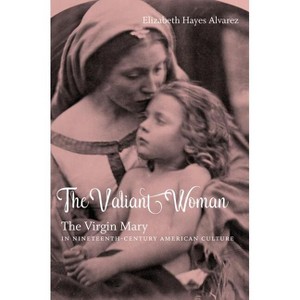
The Valiant Woman - by Elizabeth Hayes Alvarez (Paperback)
In Stock
Sponsored
About this item
Highlights
- Nineteenth-century America was rife with Protestant-fueled anti-Catholicism.
- Author(s): Elizabeth Hayes Alvarez
- 256 Pages
- Religion + Beliefs, Christianity
Description
Book Synopsis
Nineteenth-century America was rife with Protestant-fueled anti-Catholicism. Elizabeth Hayes Alvarez reveals how Protestants nevertheless became surprisingly and deeply fascinated with the Virgin Mary, even as her role as a devotional figure who united Catholics grew. Documenting the vivid Marian imagery that suffused popular visual and literary culture, Alvarez argues that Mary became a potent, shared exemplar of Christian womanhood around which Christians of all stripes rallied during an era filled with anxiety about the emerging market economy and shifting gender roles.
From a range of diverse sources, including the writings of Anna Jameson, Anna Dorsey, and Alexander Stewart Walsh and magazines such as The Ladies' Repository and Harper's, Alvarez demonstrates that Mary was represented as pure and powerful, compassionate and transcendent, maternal and yet remote. Blending romantic views of motherhood and female purity, the virgin mother's image enamored Protestants as a paragon of the era's cult of true womanhood, and even many Catholics could imagine the Queen of Heaven as the Queen of the Home. Sometimes, Marian imagery unexpectedly seemed to challenge domestic expectations of womanhood. On a broader level, The Valiant Woman contributes to understanding lived religion in America and the ways it borrows across supposedly sharp theological divides.
Review Quotes
"A fascinating account of the Virgin Mary in nineteenth-century American popular culture." -- Reading Religion
"A fascinating history in American culture brought to renewed life" -- -American Historical Review
"A one-of-a-kind book that reconsiders the position of the Virgin Mary in Protestant churches, households, and minds throughout nineteenth-century America. Alvarez's meticulous analysis of books, magazines, and newspapers reveals a popular culture steeped in Marian themes and images that contributed to wider conversations about what it meant to be a woman."--Church History and Religious Culture
"A remarkable new book. . . . Draws on a wide range of historical contexts, literary sources, art criticism and theology." -- National Catholic Reporter
"A well-researched exploration of America's widespread interest in the Virgin Mary between the Immaculate Conception declaration of 1854 and its semicentennial in 1904. . . . Convincingly argues that Americans of the period, Protestant and Catholic alike, understood Mary as an exemplar of both woman- and motherhood." -- Library Journal
"Alvarez argues that during the 19th century, the figure of Mary was significant in US culture: irrespective of her theological and devotional significance, understanding of Mary profoundly shaped ideas of the role[s] of women in society. Recommended." -- CHOICE
"An important contribution to American religious and cultural history, and it reminds us that the history of nineteenth-century Protestant-Catholic relations is more complex than mere rivalry and apathy." -- Journal of American History
"Her command of the sources is impressive. . . . Those interested in art history, American studies, religious studies, sociology, and women's studies will appreciate Alvarez's contribution." -- Magistra
"The Virgin Mary has traditionally been identified with Roman Catholic piety, but Alvarez argues that Protestants also had a deep affection for Mary. In this truly original study, Mary emerges as a powerful symbol of womanhood and motherhood not just for Catholics but for Protestants as well. The Valiant Woman will forever change the way people view the role of the Virgin Mary in nineteenth century American culture." -- Jay P. Dolan, author of The Irish Americans: A History
"This book will be of particular interest to scholars of women's studies, religious studies, and nineteenth-century US history." -- American Literature
Shipping details
Return details
Trending Non-Fiction
Discover more options