Sponsored
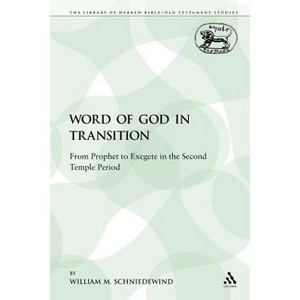
The Word of God in Transition - (Library of Hebrew Bible/Old Testament Studies) by William M Schniedewind (Paperback)
In Stock
Sponsored
About this item
Highlights
- The Chronicler distinguishes between "traditional prophets" and "inspired messengers", and thereby highlights a radical transition in the meaning of the "word of God" which takes place in the post-exilic period.
- About the Author: William Schniedewind is Assistant Professor, Biblical Studies and North-West Semitic Languages, Department of Near Eastern Languages and Cultures, University of California, Los Angeles.
- 275 Pages
- Religion + Beliefs, Biblical Studies
- Series Name: Library of Hebrew Bible/Old Testament Studies
Description
About the Book
The Chronicler distinguishes between "traditional prophets" and "inspired messengers," and thereby highlights a radical transition in the meaning of the "word of God" which takes place in the post-exilic period. The Chronicler summarizes his perspective in 2 Chron. 36.16, saying that Israel rejected "his prophets," "the messengers of God," and "his word" (i.e. Torah). This distinction is reflected in the forms and functions of prophetic speech in the books of Chronicles. Thus, the prophets speak to the king, and the inspired messengers (e.g. priests, levites) speak to the people. The prophets interpret narrative events for the king; they explain how God acts. The inspired messengers exhort the people, admonishing them how they should act. The prophets' speeches usually do not use any kind of inspiration formula, but the inspired messengers' speeches are prefaced with possession formulas. These possession formulas are not typical of classical prophecy and mark the rise of a new kind of prophecy, namely, the inspired interpretation of texts. These inspired messengers are thus forerunners of the inspired interpreters of scripture in Qumran, early Christianity and Judaism.Book Synopsis
The Chronicler distinguishes between "traditional prophets" and "inspired messengers", and thereby highlights a radical transition in the meaning of the "word of God" which takes place in the post-exilic period. The Chronicler summarizes his perspective in 2 Chron. 36.16, saying that Israel rejected "his prophets", "the messengers of God", and "his word" (i.e. Torah). This distinction is reflected in the forms and functions of prophetic speech in the books of Chronicles. Thus, the prophets speak to the king, and the inspired messengers (e.g. priests, levites) speak to the people. The prophets interpret narrative events for the king; they explain how God acts. The inspired messengers exhort the people, admonishing them how they should act. The prophets' speeches usually do not use any kind of inspiration formula, but the inspired messengers' speeches are prefaced with possession formulas. These possession formulas are not typical of classical prophecy and mark the rise of a new kind of prophecy, namely, the inspired interpretation of texts. These inspired messengers are thus forerunners of the inspired interpreters of scripture in Qumran, early Christianity and Judaism.
About the Author
William Schniedewind is Assistant Professor, Biblical Studies and North-West Semitic Languages, Department of Near Eastern Languages and Cultures, University of California, Los Angeles.Shipping details
Return details
Frequently bought together




Trending Non-Fiction






Discover more options