Sponsored
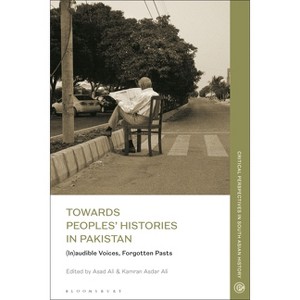
Towards Peoples' Histories in Pakistan - (Critical Perspectives in South Asian History) (Paperback)
In Stock
Sponsored
About this item
Highlights
- After seventy-five years of independence, the history of Pakistan remains centered on the state, its ideology and the two-nation theory.
- About the Author: Kamran Asdar Ali is Professor of Anthropology at the University of Texas, Austin.
- 296 Pages
- History, Asia
- Series Name: Critical Perspectives in South Asian History
Description
Book Synopsis
After seventy-five years of independence, the history of Pakistan remains centered on the state, its ideology and the two-nation theory. Towards Peoples' Histories in Pakistan seeks to shift that focus away from histories of an imagined nation, to the history of its peoples.
Based on the premise that the historiographical tradition in Pakistan has ignored the existence of people who actually make history, this book brings together historians, anthropologists, sociologists and political scientists to shed light on the diverse histories of the people themselves. Assembling histories of events and peoples missing from grand narratives of national history, the essays in this collection incorporate a diversity of approaches to the past as it opens the possibilities of multiple histories, the archives through which they are registered, and the various temporalities in which they persist. The volume highlights and recuperates the entangled nature of history and memory within Pakistan's social and cultural life. By critically examining both leftist and nationalist thought, Towards People's Histories in Pakistan explores competing visions of what is meant by 'the people', and charts new ground in developing the promise of people's histories both within Pakistan and beyond.Review Quotes
"Histories can legitimize political power, just as they can be used to challenge power, sometimes in revolutionary ways. In Pakistan, state power has long been deployed to control national narratives, even amidst territorial fragmentation and deep inequality. The agenda of this exciting collection of essays is to show us the multiplicity and vitality of other popular narratives of the past, whether engaged with the nation and its temporalities or not." --David Gilmartin, Professor of modern South Asian history, NC State University, USA
"Comprising 14 essays divided into four parts, the book makes for a taste-arousing read, touching upon multiple historical facets while taking into account peoples' experiences ... An anthology of academic essays seeks to shift the focus away from the history of an imagined and unitary Pakistan, to the diverse and sometimes conflicting histories of its peoples" --DawnAbout the Author
Kamran Asdar Ali is Professor of Anthropology at the University of Texas, Austin. He is the author of Planning the Family in Egypt: New Bodies, New Selves (UT Press, 2002) and Communism in Pakistan: Politics and Class Activism 1947-1972 (I.B Tauris 2015). Ali has been the President of the American Institute of Pakistan Studies (AIPS: 2011-2017), the Director of the South Asia Institute, UT, Austin (2010-2017) and the Dean of the School of Humanities and Social Sciences at the Lahore University of Management Sciences.
Asad Ali is an independent scholar based in the UK. He is the co-editor of Love, War and Other Longings: Essays on cinema in Pakistan (OUP 2020) and has taught at North American Institutions including New York University, Rutgers and Harvard. He is currently completing a manuscript entitled Languages of the Law: Islam, Liberalism and Moral Community in Pakistan.Shipping details
Return details
Frequently bought together




Trending Non-Fiction




Discover more options