Target New ArrivalsBack to SchoolCollegeClothing, Shoes & AccessoriesHome & DecorKitchen & DiningOutdoor Living & GardenGroceryHousehold EssentialsBabyBeautyPersonal CareSports & OutdoorsHealthWellnessSchool & Office SuppliesToys & GamesElectronics & TechVideo GamesMovies, Music & BooksParty SuppliesGift IdeasGift CardsPetsUlta Beauty at TargetShop by CommunityTarget OpticalDealsClearanceNew ArrivalsBack to SchoolCollegeTop DealsTarget Circle DealsWeekly AdShop Order PickupShop Same Day DeliveryRegistryRedCardTarget CircleFind Stores
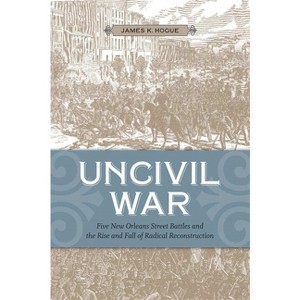
Uncivil War - by  James K Hogue (Paperback) - 1 of 1

Uncivil War - by James K Hogue (Paperback)

$33.00

In Stock

Free & easy returns
Free & easy returns
Return this item by mail or in store within 90 days for a full refund.
Eligible for registries and wish lists

About this item

Highlights

  • No other Reconstruction state government was as chaotic or violent as Louisiana's, located in New Orleans, the largest southern city at the time.
  • About the Author: James K. Hogue is an associate professor of history at the University of North Carolina at Charlotte.
  • 248 Pages
  • History, United States

Description


About the Book


The violent power struggle in the Louisiana state government between the end of the Civil War in 1865 and the demise of Reconstruction in 1877 sets the stage for James K. Hogues Uncivil War. The Unions victory left vague both the reintegration of ex-Confederate states and the status of freed slaves in postwar societysparking internal violence and resulting in Federal military intervention. According to Hogue, by a unique confluence of demographics, geography, and wartime events, New Orleans became a political epicenter and a critical battleground. Setting himself apart from other historians, Hogue contends that Reconstruction-era violence in the postwar South, particularly in Louisiana, evolved into a new civil war rather than intermittent massacres or race riots. In reality, clashing forces were increasingly well-organized, well-armed, and focused on winning or defending control over internal governmentsfitting, as Hogue points out, the classic definition of civil war.


Book Synopsis


No other Reconstruction state government was as chaotic or violent as Louisiana's, located in New Orleans, the largest southern city at the time. James K. Hogue explains the unique confluence of demographics, geography, and wartime events that made New Orleans an epicenter in the upheaval of Reconstruction politics and a critical battleground in the struggle for the future of southern society. No other Reconstruction state government was as chaotic or violent as Louisiana's, located in New Orleans, the largest southern city at the time. James K. Hogue explains the unique confluence of demographics, geography, and wartime events that made New Orleans an epicenter in the upheaval of Reconstruction politics and a critical battleground in the struggle for the future of southern society.
Hogue characterizes Reconstruction in Louisiana as a continuation of civil war, waged between well-organized and well-armed forces vying to control the state's government. He details five key New Orleans street battles, in which elite Confederate veterans played central roles, and gives an in-depth account of how the Republican state government raised militias and a state police force to defend against the violence. In response, a white supremacist movement arose in the mid-1870s and finally overthrew the Republicans. The occupation of Louisiana by federal troops from 1862 to 1877 was the longest of its kind in American history. Not coincidentally, Hogue argues, one of the longest unbroken periods of one-race, one-party dominance in American history followed, lasting until 1972.
Uncivil War reveals that the long-term military impact of the South's occupation included twenty-five years of crippled War Department budgets inflicted by southern congressmen who feared another Reconstruction. Within Louisiana, the biracial Republican militias were dismantled, leaving blacks largely unarmed against future atrocities; at the same time, the nucleus of the state's White Leagues became the Louisiana National Guard, which defended the "Redeemer" government's repressive labor policies. White supremacist victory cast its shadow over American race relations for almost a century.
Moving between national, state, and local realms, Uncivil War demystifies the interplay of force and politics during a complex period of American history.


From the Back Cover


"In his astute, well-written analysis of five street battles between 1866 and 1877, Hogue makes a persuasive case that the conflict in the Crescent City represented a continuation of the Civil War by other means." -- Journal of American History

"James Hogue has produced a well-written and fully documented account of Louisiana during the tumultuous Reconstruction period." -- Journal of African American History

The violent power struggle in the Louisiana state government between the end of the Civil War in 1865 and the demise of Reconstruction in 1877 sets the stage for James K. Hogue's Uncivil War. The Union's victory left vague both the reintegration of ex-Confederate states and the status of freed slaves in postwar society -- sparking internal violence and resulting in Federal military intervention. According to Hogue, by a unique confluence of demographics, geography, and wartime events, New Orleans became a political epicenter and a critical battleground.

Setting himself apart from other historians, Hogue contends that Reconstruction-era violence in the postwar South, particularly in Louisiana, evolved into a new civil war rather than intermittent massacres or race riots. In reality, clashing forces were increasingly well-organized, well-armed, and focused on winning control over or defending internal governments -- fitting, as Hogue points out, the classic definition of civil war.

James K. Hogue is an associate professor of history at the University of North Carolina, Charlotte, and co-author, with James M. McPherson, of Ordeal by Fire: The Civil War and Reconstruction, fourth edition.


About the Author


James K. Hogue is an associate professor of history at the University of North Carolina at Charlotte.

Dimensions (Overall): 8.9 Inches (H) x 5.9 Inches (W) x .6 Inches (D)
Weight: .85 Pounds
Suggested Age: 22 Years and Up
Number of Pages: 248
Genre: History
Sub-Genre: United States
Publisher: LSU Press
Theme: State & Local, South (AL, AR, FL, GA, KY, LA, MS, NC, SC, TN, VA, WV)
Format: Paperback
Author: James K Hogue
Language: English
Street Date: November 15, 2011
TCIN: 1012521799
UPC: 9780807143612
Item Number (DPCI): 247-52-6809
Origin: Made in the USA or Imported
If the item details aren’t accurate or complete, we want to know about it.

Shipping details

Estimated ship dimensions: 0.6 inches length x 5.9 inches width x 8.9 inches height
Estimated ship weight: 0.85 pounds
We regret that this item cannot be shipped to PO Boxes.
This item cannot be shipped to the following locations: American Samoa (see also separate entry under AS), Guam (see also separate entry under GU), Northern Mariana Islands, Puerto Rico (see also separate entry under PR), United States Minor Outlying Islands, Virgin Islands, U.S., APO/FPO, Alaska, Hawaii

Return details

This item can be returned to any Target store or Target.com.
This item must be returned within 90 days of the date it was purchased in store, delivered to the guest, delivered by a Shipt shopper, or picked up by the guest.
See the return policy for complete information.

Additional product information and recommendations

Discover more options

Skip to next section

Best-selling All Book Genres

Skip to next section

Get top deals, latest trends, and more.