Sponsored
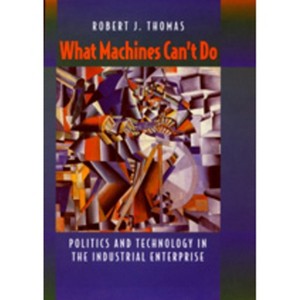
What Machines Can't Do - by Robert J Thomas (Paperback)
$33.99
In Stock
Eligible for registries and wish lists
Sponsored
About this item
Highlights
- Virtually every manufacturing company has plans for an automated "factory of the future.
- About the Author: Robert J. Thomas is Professor of Organizational Studies at the Massachusetts Institute of Technology.
- 336 Pages
- Political Science, General
Description
About the Book
"Anyone who journeys through "What Machines Can't Do" is going to [become] much more sophisticated about the sociology of introducing new technologies into existing organizations."--Lester C. Thurow, Massachusetts Institute of Technology"A compelling case for rethinking why and how new technologies are introduced into organizations. With its graphic accounts and insider detail, he shows that when it comes to technology and politics, one cannot be understood apart from the other. "What Machines Can't Do" is one of those special books that fundamentally alters how one looks at the engines of corporate change."--Michael Useem, University of Pennsylvania
"An extraordinary achievement. Robert J. Thomas not only provides intimately detailed studies of the introduction of new technologies in large companies in four major industries. In the power-process framework, he provides us with a new theoretical approach that seems to me superior to other frameworks for the study of technological changes. For practitioners in industry, this book suggests ways of reorganizing the new technology introduction process so that workers and managers in manufacturing play more creative roles than is possible when they are considered as simply implementors of what others have designed for them."--William F. Whyte, Research Director, Programs for Employment and Workplace Systems, Cornell University
"This is one of the few books I have seen in reent years that is a genuine advance in business scholarship. For over ten years now, American business has been trying to achieve greater 'integration' across the separate components of the internal organization and between the organization and suppliers, customer, and clients outside. The results of these efforts have been disappointing. Here is a book that, for the first time, explains why. It may not be the last work on the subject, but all subsequent work will build upon these results and will have to come to terms with its argument."--Michael J. Piore, MIT
"These are the best cases I know of for giving students a feel for the complex dynamics of technological change and organizational power in industry. The cases are especially credible because of the clear writing and the unobtrusive theoretical guidance. It is not news that technology is socially shaped, but this presentation is more dramatic, more subtle, and more satisfying than the conventional literature."--Charles Perrow, Yale University
"This sophisticated, readable book . . . combines terrific original field research with a grand feat of theoretical synthesis."--Paul DiMaggio, Princeton University
Book Synopsis
Virtually every manufacturing company has plans for an automated "factory of the future." But Robert J. Thomas argues that smart machines may not hold the key to an industrial renaissance. In this provocative and enlightening book, he takes us inside four successful manufacturing enterprises to reveal the social and political dynamics that are an integral part of new production technology. His interviews with nearly 300 individuals, from top corporate executives to engineers to workers and union representatives, give his study particular credibility and offer surprising insights into the organizational power struggles that determine the form and performance of new technologies.Thomas urges managers not to put blind hopes into smarter machines but to find smarter ways to organize people. As U.S. companies battle for survival in an era of growing global competition, What Machines Can't Do is an invaluable treatise on the ways we organize work. While its call for change is likely to be controversial, it will also attract anyone who wishes to understand the full impact of new technology on jobs, organizations, and the future of the industrial enterprise.
From the Back Cover
"Anyone who journeys through What Machines Can't Do is going to [become] much more sophisticated about the sociology of introducing new technologies into existing organizations."--Lester C. Thurow, Massachusetts Institute of Technology"A compelling case for rethinking why and how new technologies are introduced into organizations. With its graphic accounts and insider detail, he shows that when it comes to technology and politics, one cannot be understood apart from the other. What Machines Can't Do is one of those special books that fundamentally alters how one looks at the engines of corporate change."--Michael Useem, University of Pennsylvania
"An extraordinary achievement. Robert J. Thomas not only provides intimately detailed studies of the introduction of new technologies in large companies in four major industries. In the power-process framework, he provides us with a new theoretical approach that seems to me superior to other frameworks for the study of technological changes. For practitioners in industry, this book suggests ways of reorganizing the new technology introduction process so that workers and managers in manufacturing play more creative roles than is possible when they are considered as simply implementors of what others have designed for them."--William F. Whyte, Research Director, Programs for Employment and Workplace Systems, Cornell University
"This is one of the few books I have seen in reent years that is a genuine advance in business scholarship. For over ten years now, American business has been trying to achieve greater 'integration' across the separate components of the internal organization and between the organization and suppliers, customer, and clients outside. The results of these efforts have been disappointing. Here is a book that, for the first time, explains why. It may not be the last work on the subject, but all subsequent work will build upon these results and will have to come to terms with its argument."--Michael J. Piore, MIT
"These are the best cases I know of for giving students a feel for the complex dynamics of technological change and organizational power in industry. The cases are especially credible because of the clear writing and the unobtrusive theoretical guidance. It is not news that technology is socially shaped, but this presentation is more dramatic, more subtle, and more satisfying than the conventional literature."--Charles Perrow, Yale University
"This sophisticated, readable book . . . combines terrific original field research with a grand feat of theoretical synthesis."--Paul DiMaggio, Princeton University
About the Author
Robert J. Thomas is Professor of Organizational Studies at the Massachusetts Institute of Technology. He is the author of Citizenship, Gender, and Work: Social Organization of Industrial Agriculture (California, 1985).Dimensions (Overall): 9.02 Inches (H) x 6.44 Inches (W) x .72 Inches (D)
Weight: 1.0 Pounds
Suggested Age: 22 Years and Up
Number of Pages: 336
Genre: Political Science
Sub-Genre: General
Publisher: University of California Press
Format: Paperback
Author: Robert J Thomas
Language: English
Street Date: March 25, 1994
TCIN: 1007031540
UPC: 9780520087019
Item Number (DPCI): 247-03-9265
Origin: Made in the USA or Imported
If the item details aren’t accurate or complete, we want to know about it.
Shipping details
Estimated ship dimensions: 0.72 inches length x 6.44 inches width x 9.02 inches height
Estimated ship weight: 1 pounds
We regret that this item cannot be shipped to PO Boxes.
This item cannot be shipped to the following locations: American Samoa (see also separate entry under AS), Guam (see also separate entry under GU), Northern Mariana Islands, Puerto Rico (see also separate entry under PR), United States Minor Outlying Islands, Virgin Islands, U.S., APO/FPO
Return details
This item can be returned to any Target store or Target.com.
This item must be returned within 90 days of the date it was purchased in store, shipped, delivered by a Shipt shopper, or made ready for pickup.
See the return policy for complete information.
Frequently bought together

$18.93
MSRP $32.00


$13.00
MSRP $20.00


$11.37 - $16.50
MSRP $18.99 - $30.00
4.4 out of 5 stars with 23 ratings

Trending Non-Fiction



$18.28
was $19.58 New lower price
4.7 out of 5 stars with 18 ratings



Discover more options

$12.64
MSRP $22.00

$17.48
MSRP $25.00

$9.99 - $16.56
MSRP $9.99 - $18.99

$15.95 - $24.95
$31.95 - $130.99
MSRP $34.95 - $145.00
$19.59 - $20.12
MSRP $22.00 - $32.00