Sponsored
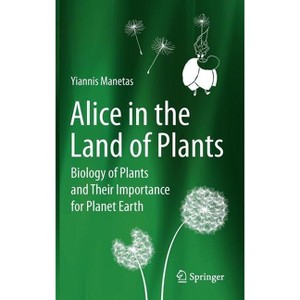
Alice in the Land of Plants - by Yiannis Manetas (Hardcover)
In Stock
Sponsored
About this item
Highlights
- Why is it that plants do not need to move?
- About the Author: Yiannis Manetas was born in Athens, Greece (1947), studied natural sciences and geography at the University of Athens (1970), and received his doctorate in biological sciences from the University of Patras, Greece (1976).
- 374 Pages
- Science, Life Sciences
Description
About the Book
In this book, the author invites readers to explore the World of plants by raising interesting questions. It presents a world so very different from ours, much like the one Alice experiences in the white rabbit's warren.Book Synopsis
Why is it that plants do not need to move? How does a nonmotile organism have sex or defend itself? Why are some plants virtually immortal? What is the mechanism that allows plants to exploit a practically inexhaustible extraterrestrial energy source? How do plants regulate the composition of our planet's atmosphere? Why have there not been mass extinctions among plants as there have been among animals? How do plants communicate with one another? In the end, are plants intelligent organisms?
These are some of the questions the author discusses to demonstrate that plants are wrongly considered to be simple organisms lacking specific behaviour and intelligence. This book promises to be as pleasant a surprise as Alice's experience in the white rabbit's warren, in which she encountered a world very different from ours.
The author explains the biology of plants following Einstein's maxim that everything should be made as simple as possible, but not simpler.
From the Back Cover
Why is it that plants do not need to move? How does a nonmotile organism have sex or defend itself? Why are plants asymmetric and not of a fixed size? Why are some plants virtually immortal? Why is cloning a routine matter in the plant kingdom? What is the mechanism that allows plants to exploit a practically inexhaustible extraterrestrial energy source? How do plants regulate the composition of our planet's atmosphere, its water cycle, the cycle of matter and energy, and ultimately our climate? Why have there not been mass extinctions among plants as there have been among animals? How do plants perceive the animate and inanimate worlds? How do they communicate with one another? In the end, are plants intelligent organisms?
These are some of the questions this book addresses in an attempt to convince readers that contrary to popular - and wrong - belief, plants are not simple organisms lacking specific behaviour and intelligence and thus are unworthy of our interest. In fact, this book promises to be as pleasant a surprise as Alice's experience in the white rabbit's warren, in which she encountered a world very different from ours.
Review Quotes
From the reviews:
"In this new book, experienced plant physiologist Manetas (Univ. of Patras, Greece) draws attention to the fascinating and complex world of plant biology. In an effort to reach a wide audience, the author writes in a more general style, with minimal specialized jargon. ... Summing Up: Highly recommended. Lower-division undergraduates and general readers." (R. B. Pratt, Choice, Vol. 50 (5), January, 2013)
About the Author
Yiannis Manetas was born in Athens, Greece (1947), studied natural sciences and geography at the University of Athens (1970), and received his doctorate in biological sciences from the University of Patras, Greece (1976). Since 1978, he has held several different research and teaching positions at the University of Patras, where he currently is Professor of Plant Physiology in the Department of Biology. He also has participated in research at the Universities of Goteborg (Sweden), Stirling (Scotland), and Essen and Karlsruhe (Germany), as well as at the Abisko Research Station (Swedish Lapland). His publication list includes more than 120 research papers and review articles in international journals. His current research interests concern the ecophysiology of Mediterranean plants, the role of foliar anthocyanins, and the function of nonfoliar chloroplasts.
Shipping details
Return details
Frequently bought together





Trending Non-Fiction





Discover more options