Sponsored
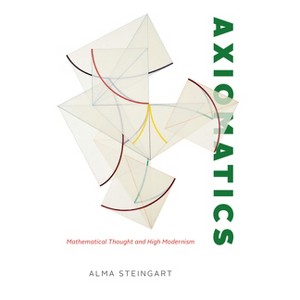
Axiomatics - by Alma Steingart (Paperback)
$35.00
In Stock
Eligible for registries and wish lists
Sponsored
About this item
Highlights
- The first history of postwar mathematics, offering a new interpretation of the rise of abstraction and axiomatics in the twentieth century.
- About the Author: Alma Steingart is assistant professor of history at Columbia University.
- 272 Pages
- Mathematics, History & Philosophy
Description
About the Book
"The first history of postwar mathematics, offering a new interpretation of the rise of abstraction and axiomatics in the twentieth century. Why did abstraction dominate American art, social science, and natural science in the mid-twentieth century? Why, despite opposition, did abstraction and theoretical knowledge flourish across a diverse set of intellectual pursuits during the Cold War? In recovering the centrality of abstraction across a range of modernist projects in the United States, Alma Steingart brings mathematics back into the conversation about midcentury American intellectual thought. The expansion of mathematics in the aftermath of World War II, she demonstrates, was characterized by two opposing tendencies: research in pure mathematics became increasingly abstract and rarified, while research in applied mathematics and mathematical applications grew in prominence as new fields like operations research and game theory brought mathematical knowledge to bear on more domains of knowledge. Both were predicated on the same abstractionist conception of mathematics and were rooted in the same approach: modern axiomatics. For American mathematicians, the humanities and the sciences did not compete with one another, but instead were two complementary sides of the same epistemological commitment. Steingart further reveals how this mathematical epistemology influenced the sciences and humanities, particularly the postwar social sciences. As mathematics changed, so did the meaning of mathematization. Axiomatics focuses on American mathematicians during a transformative time, following a series of controversies among mathematicians about the nature of mathematics as a field of study and as a body of knowledge. The ensuing debates offer a window onto the postwar development of mathematics band Cold War epistemology writ large. As Steingart's history ably demonstrates, mathematics is the social activity in which styles of truth-here, abstraction-become synonymous with ways of knowing. "--Book Synopsis
The first history of postwar mathematics, offering a new interpretation of the rise of abstraction and axiomatics in the twentieth century. Why did abstraction dominate American art, social science, and natural science in the mid-twentieth century? Why, despite opposition, did abstraction and theoretical knowledge flourish across a diverse set of intellectual pursuits during the Cold War? In recovering the centrality of abstraction across a range of modernist projects in the United States, Alma Steingart brings mathematics back into the conversation about midcentury American intellectual thought. The expansion of mathematics in the aftermath of World War II, she demonstrates, was characterized by two opposing tendencies: research in pure mathematics became increasingly abstract and rarified, while research in applied mathematics and mathematical applications grew in prominence as new fields like operations research and game theory brought mathematical knowledge to bear on more domains of knowledge. Both were predicated on the same abstractionist conception of mathematics and were rooted in the same approach: modern axiomatics. For American mathematicians, the humanities and the sciences did not compete with one another, but instead were two complementary sides of the same epistemological commitment. Steingart further reveals how this mathematical epistemology influenced the sciences and humanities, particularly the postwar social sciences. As mathematics changed, so did the meaning of mathematization. Axiomatics focuses on American mathematicians during a transformative time, following a series of controversies among mathematicians about the nature of mathematics as a field of study and as a body of knowledge. The ensuing debates offer a window onto the postwar development of mathematics band Cold War epistemology writ large. As Steingart's history ably demonstrates, mathematics is the social activity in which styles of truth--here, abstraction--become synonymous with ways of knowing.Review Quotes
"The book offers many thought-provoking questions about the role of mathematics, the relation between mathematics and art, and about the border between pure and applied mathematics. . . . recommended to all historians of modern science, as well as to working mathematicians who enjoy thinking about the nature of their subject."-- "zbMATH Open"
"The book is well written, and employs many articles, speeches, memoranda, and national reports in which mathematicians were addressing the public at large, especially by those in charge of science policy decisions. This adds greatly to the value of the work. The discussion is kept accessible for a relatively large readership, avoiding any kind of technical details. Readers will come away with an enriched picture of the world of mathematics."-- "Notices of the American Mathematical Society"
"The mathematicians of the later period explored here (approximately 1945-70) were shaped by their wartime experiences, the postwar growth of the military-industrial complex, and anticommunism. For chapter themes, Steingart divides abstraction in mathematical research into six dimensions: pure, applied, human, creative, unreasonable, and historical. The last chapter provides a clear, thorough survey of the notorious1970s debates over mathematics historiography. Most of the discussion of mathematics is conceptual rather than technical, so the book is broadly accessible to an academic audience."-- "Choice"
"Alma Steingart's Axiomatics: Mathematical Thought and High Modernism is an attempt to combine the story of abstraction with developments outside of mathematics. . . . she presents this material from a very interesting and well-informed perspective."-- "American Mathematical Monthly"
"Steingart provides a history of mathematical thinking over the twentieth century: a compelling review of the increased abstraction of mathematical thought as well as its embrace of deep exploration of alternative axiomatic systems."-- "Public Books"
"Mathematics has undergone tremendous changes, especially during the twentieth century, when it pushed ever deeper into the realm of abstraction. This upheaval even involved a redefinition of the definition itself, as Steingart explains in Axiomatics. A historian of science, Steingart sees this revolution as central to the modernist movements that dominated the mid-twentieth century in the arts and social sciences, particularly in the United States."-- "Nature"
"Steingart takes a wide-angle view on mid-twentieth-century mathematics, connecting the axiomatic movement with high abstraction in modern art, structuralism in the social sciences, the New Criticism in literary criticism, and the deep unease felt by many scientists and mathematicians in the wake of World War II as their research became ever more entangled with military applications. Unfailingly lucid and alert to sympathetic resonances between apparently disparate realms, Steingart positions modern mathematics squarely in the center of high modernism."--Lorraine Daston, author of Rules: A Short History of What We Live By
"The push for axiomatic reasoning, so central to twentieth-century mathematics, extended by 1950 to elite social science. But the power of this abstract logic, never absolute, was in retreat by the 1990s. Although the most familiar of these challenges took form as a new cult of data, Steingart's most engaging arguments explore a new fascination with mathematical historicism."--Theodore M. Porter, author of Trust in Numbers: The Pursuit of Objectivity in Science and Public Life
"American mathematics was in the midst of a puzzling contradiction at midcentury: applied mathematics appeared triumphant even as many mathematicians promoted abstraction and rejected the idea that utility was important. Steingart's brilliant book has finally resolved this puzzle. Far from standing in opposition, mathematics' utility and idealism, its calculations and foundations, were historically intertwined with the concept of axiomatics. By masterfully weaving together the work of artists and mathematicians, mundane academic conference proceedings and philosophical treatises, Steingart has written an essential guide to the transformation of postwar mathematics."--Christopher J. Phillips, author of The New Math: A Political History
"This sophisticated and wide-ranging book examines mid-century American mathematics as a species of high modernism, both in its pure form and in applied mathematics. It looks at how it was supported, why it was advocated, how and why it was compared to contemporary abstract art, how the evolving ideas of abstraction played out in the Cold War, and how this even affected the writing of the history of mathematics. It is a major addition to and critique of the literature that presents modern mathematics as a species of modernism, and it should be read by every historian of modern science and indeed by anyone interested in how abstract ideas have shaped the modern world."--Jeremy Gray, author of Plato's Ghost: The Modernist Transformation of Mathematics
About the Author
Alma Steingart is assistant professor of history at Columbia University. Her work has appeared in the Los Angeles Review of Books, Grey Room, Representations, and Social Studies of Science.Dimensions (Overall): 9.0 Inches (H) x 6.0 Inches (W) x .67 Inches (D)
Weight: .97 Pounds
Suggested Age: 22 Years and Up
Number of Pages: 272
Genre: Mathematics
Sub-Genre: History & Philosophy
Publisher: University of Chicago Press
Format: Paperback
Author: Alma Steingart
Language: English
Street Date: January 17, 2023
TCIN: 1006098944
UPC: 9780226824208
Item Number (DPCI): 247-46-2692
Origin: Made in the USA or Imported
If the item details aren’t accurate or complete, we want to know about it.
Shipping details
Estimated ship dimensions: 0.67 inches length x 6 inches width x 9 inches height
Estimated ship weight: 0.97 pounds
We regret that this item cannot be shipped to PO Boxes.
This item cannot be shipped to the following locations: American Samoa (see also separate entry under AS), Guam (see also separate entry under GU), Northern Mariana Islands, Puerto Rico (see also separate entry under PR), United States Minor Outlying Islands, Virgin Islands, U.S., APO/FPO
Return details
This item can be returned to any Target store or Target.com.
This item must be returned within 90 days of the date it was purchased in store, shipped, delivered by a Shipt shopper, or made ready for pickup.
See the return policy for complete information.
Frequently bought together


$68.44
MSRP $75.00

$11.39
MSRP $18.99


$7.19
was $8.39 New lower price

Trending Non-Fiction

$4.59
MSRP $7.99
Save $5 when you spend $20 on select books
4.8 out of 5 stars with 123 ratings

$6.20
MSRP $10.95
Save $5 when you spend $20 on select books
4.8 out of 5 stars with 33 ratings

$7.09
MSRP $9.99
Save $5 when you spend $20 on select books
4.9 out of 5 stars with 46 ratings
Discover more options

$11.49 - $13.19
MSRP $12.99 - $19.99


$8.79
MSRP $14.99