Sponsored
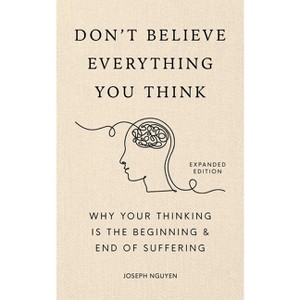
Don't Believe Everything You Think (Expanded Edition) - by Joseph Nguyen (Hardcover)
$12.54Save $9.46 (43% off)
In Stock
Eligible for registries and wish lists
Sponsored
About this item
Highlights
- Learn how to overcome anxiety, self-doubt, and self-sabotage without needing to rely on motivation or willpower - now updated with expanded guidance and contemplative exercises to help change the way you think.
- About the Author: Joseph Nguyen is the author of the #1 international bestselling book, Don't Believe Everything You Think, which has been translated into 31+ languages.
- 208 Pages
- Self Improvement, Motivational & Inspirational
Description
Book Synopsis
Learn how to overcome anxiety, self-doubt, and self-sabotage without needing to rely on motivation or willpower - now updated with expanded guidance and contemplative exercises to help change the way you think. In this book, you'll discover the root cause of all psychological and emotional suffering and how to achieve freedom of mind to effortlessly create the life you've always wanted to live. Although pain is inevitable, suffering is optional. This book offers a completely new paradigm and understanding of where our human experience comes from, allowing us to end our own suffering and create how we want to feel at any moment. In This Book, You'll Discover:- The root cause of all psychological and emotional suffering and how to end it How to become unaffected by negative thoughts and feelings How to experience unconditional love, peace, and joy in the present, no matter what our external circumstances look like How to instantly create a new experience of life if you don't like the one you're in right now How to break free from a negative thought loop when we inevitably get caught in one How to let go of anxiety, self-doubt, self-sabotage, and any self-destructive habits How to effortlessly create from a state of abundance, flow, and ease How to develop the superpower of being okay with not knowing and uncertainty How to access your intuition and inner wisdom that goes beyond the limitations of thinking
About the Author
Joseph Nguyen is the author of the #1 international bestselling book, Don't Believe Everything You Think, which has been translated into 31+ languages. He is a writer who helps others realize who they truly are beyond their own thinking and conditioning to live an abundant life free from psychological and emotional suffering. When he's not busy petting his three cats that he's allergic to, he spends the rest of his time writing, teaching, speaking, and sharing timeless wisdom to help people discover their own divinity from within and how they are the answer they've been looking for their entire lives. You may visit his website at www.josephnguyen.org for more books, resources, and videos to help you on your journey.Dimensions (Overall): 8 Inches (H) x 5 Inches (W)
Weight: .63
Suggested Age: 22 Years and Up
Sub-Genre: Motivational & Inspirational
Genre: Self Improvement
Number of Pages: 208
Publisher: Authors Equity
Format: Hardcover
Author: Joseph Nguyen
Language: English
Street Date: October 29, 2024
TCIN: 92512050
UPC: 9798893310153
Item Number (DPCI): 059-01-6624
Origin: Made in the USA
If the item details aren’t accurate or complete, we want to know about it.
Shipping details
Estimated ship dimensions: 1 inches length x 5 inches width x 8 inches height
Estimated ship weight: 0.628 pounds
We regret that this item cannot be shipped to PO Boxes.
This item cannot be shipped to the following locations: American Samoa (see also separate entry under AS), Guam (see also separate entry under GU), Northern Mariana Islands, Puerto Rico (see also separate entry under PR), United States Minor Outlying Islands, Virgin Islands, U.S., APO/FPO
Return details
This item can be returned to any Target store or Target.com.
This item must be returned within 30 days of the date it was purchased in store, shipped, delivered by a Shipt shopper, or made ready for pickup.
See the return policy for complete information.



Discover more options

$15.99
MSRP $21.95


$12.21
MSRP $20.00
Related Categories
4.7 out of 5 stars with 26 reviews
60% would recommend
5 recommendations
5 out of 5 stars
Thumbs up graphic, would recommend
23 October, 2025
Best book ive ever read
One of the best books I’ve ever read! Such a short read but also the most influential to your life if you really care about changing your mindset and changing your life.
5 out of 5 stars
Thumbs up graphic, would recommend
23 July, 2025
My summary
Below is my summary from Littler Books. I hope you find it helpful! 1. Psychological suffering is produced by our internal reaction to external events. a. "Buddhists say that anytime we experience a negative event in our lives, two arrows fly our way. Being physically struck by an arrow is painful. Being struck by a second emotional arrow is even more painful (suffering). The Buddha explained, 'In life, we can't always control the first arrow. However, the second arrow is our reaction to the first. The second arrow is optional.'" 2. We don't experience objective reality. We experience our personal thinking about reality, and the meaning we assign to events determines our feelings. 3. 100 people can interpret the same job, president, or cup of coffee 100 different ways. 4. Since feelings arise from thought, the true source of psychological suffering is our own thinking. 5. The human mind's primary function evolved for survival, not happiness. Its job is to constantly scan for potential threats based on past experiences and hypothetical futures. Relying solely on this outdated survival mechanism in the modern world leads to chronic negative emotions. 6. Thoughts are effortless, neutral ideas that pop into our minds. Thinking is the deliberate act of judging and analyzing those thoughts. Thinking is the root of psychological suffering, as it's the process where we apply our limiting beliefs to a neutral thought. 7. Positive emotions like joy and love are our natural state of being (babies are not self-conscious). 8. Negative emotions are caused by the act of thinking itself. The intensity of our suffering is directly proportional to the intensity of thinking we do. a. "We do not have to try to 'think positive' to experience love, joy, bliss, and any positive emotions we want because it is our natural state to feel those emotions. The only times we don't naturally feel these emotions is when we begin to think about the thoughts we're having." 9. The human experience is created by the combination of three principles: Universal Mind (the intelligent energy behind all life, some call this God), Consciousness (the awareness that makes experience possible), and Thought (the creative power to form our reality). 10. Do not actively fight or stop thoughts, but simply become aware that you are engaged in thinking. This awareness creates detachment and allows the mind to settle on its own, similar to how murky water becomes clear when left undisturbed. 11. Our highest level of performance occurs in a flow state where there's little conscious thought and actions arise automatically from training and intuition. Overthinking leads to anxiety, hesitation, and ego-driven limits. 12. Not overthinking does not mean abandoning ambitions. Rather, it allows you to distinguish between goals created from desperation versus those from inspiration. Goals from desperation are driven by fear and scarcity. These lead to stress and emptiness. Goals from inspiration arise naturally and lead to joy. 13. Fulfillment comes from unconditional love and creation. Unconditional love arises when we stop attaching reasons to our affection. It comes from within, untied to traits or reciprocity. Unconditional creation is when we create for the sheer joy of creating, not as a means to an end. 14. Acknowledge that negative feelings like doubt and anxiety will naturally return as the ego tries to regain control. Squash them by remembering that your thinking is their only cause. 15. Events, decisions, and political views are inherently neutral. It is our thinking that applies labels like "good" or "bad." This judgment is the source of our negative emotions. Instead of judging, seek universal truth from within. a. “If it is 'true' for one person, but not for another, then it is not universal truth.” [Character limit reached, please see rest on Littler Books]
3 out of 5 stars
Thumbs down graphic, would not recommend
13 May, 2025Verified purchase
Gonna disagree with you there
I loved the title of the book and that's about all I loved. It's also not what I expected. All the talk about "thoughts" vs "thinking" gets my muddied as if one is always good and one is always bad. That if you're an author, the goal of wanting to get on a bestsellers list and feeling validated by that is a sign you don't feel good about yourself and your ability to write but writing just for fun and not concerning yourself with a goal or the natural sense of accomplishment that comes from meeting or exceeding a goal is, uh, not wholly accurate. It appears that for the author it's black and white rather than two things existing simultaneously. Being a best seller will likely feel good for an author and validate their abilities. To say that if you feel that way or want to reach that goal so you can, misses the point in my opinion. I found myself underlining a food good lines but for me personally, the pages flew by and I felt I'd made no progress nor learned anything new.
5 out of 5 stars
Thumbs up graphic, would recommend
2 April, 2025Verified purchase
Good read!
I would definitely reccommend this book to anyone who has a tendancy to overthink or ruminate. This book has been very helpful and insightful.
1 out of 5 stars
Thumbs down graphic, would not recommend
14 December, 2024Verified purchase
Disappointed
Total let down... I truly wonder how many of these reviews on various sites and platforms are incentivized. The entire book is just repetitive and less than helpful.