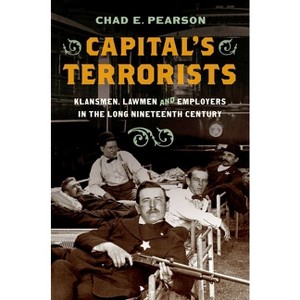
Through the late nineteenth and early twentieth centuries, employers and powerful individuals deployed a variety of tactics to control ordinary people as they sought to secure power in and out of workplaces.
Author(s): Chad E Pearson
324 Pages
Political Science, Labor & Industrial Relations
Description
About the Book
"Through the late nineteenth and early twentieth centuries, employers and powerful individuals deployed a variety of tactics to control ordinary people as they sought to secure power in and out of workplaces. This book suggests that the birth of law and order politics as we know it can be found in nineteenth-century campaigns of organized terror against an assortment of ordinary people across racial lines conducted by Klansmen, lawmen, vigilantes, and union busters"--
Book Synopsis
Through the late nineteenth and early twentieth centuries, employers and powerful individuals deployed a variety of tactics to control ordinary people as they sought to secure power in and out of workplaces. In the face of worker resistance, employers and their allies collaborated to use a variety of extralegal repressive techniques, including whippings, kidnappings, drive-out campaigns, incarcerations, arsons, hangings, and shootings, as well as less overtly illegal tactics such as shutting down meetings, barring speakers from lecturing through blacklists, and book burning. This book draws together the groups engaged in this kind of violence, reimagining the original Ku Klux Klan, various Law and Order Leagues, Stockgrowers' organizations, and Citizens' Alliances as employers' associations driven by unambiguous economic and managerial interests. Though usually discussed separately, all of these groups used similar language to tar their lower-class challengers--former slaves, rustlers, homesteaders of modest means, populists, political radicals, and striking workers--as menacing villains and deployed comparable tactics to suppress them. And perhaps most notably, spokespersons for these respective organizations justified their actions by insisting that they were committed to upholding "law and order."
Ultimately, this book suggests that the birth of law and order politics as we know it can be found in nineteenth-century campaigns of organized terror against an assortment of ordinary people across racial lines conducted by Klansmen, lawmen, vigilantes, and union busters.
Review Quotes
"Capital's Terrorists adds a critical layer to our understanding of mass violence . . . [and] presents a series of fascinating case studies to make his point. . . . This is an outstanding and important book."--Arkansas Historical Quarterly
"[Capital's Terrorists] is a history of antilabor activism in the United States during the long nineteenth century, but it is, perhaps more crucially, a series of categorical provocations. Pearson invites readers to reconsider the definition of such terms as 'terrorist' and to think about 'labor-management conflicts' in a more expansive way. . . . By focusing on tactics, or practical ways that ideology shaped the behaviors of actors on the ground, Pearson gives readers an opportunity to see the cultural dimensions of violence from new angles."--Journal of the Civil War Era
"[Pearson's] extensive research supports a convincing argument that these vigilante groups shared common antilabor biases which influenced their work across regions and moments and suggests that the popular view of this period--romanticized in novels and films, particularly those set in the mythical West--needs significant reexamination."--Journal of American History
"A comprehensive and wide-ranging study. Pearson's arguments are skillfully presented with abundant supporting documentation. . . . It is a timely and thought-provoking book."--Southwestern Historical Quarterly
"A well-documented and -crafted narrative, Capital's Terrorists powerfully points us to the origins of anti-labor violence and terrorism rooted in racial supremacy ideologies, anti-immigrant xenophobia, and a pathological obsession with violence to uphold the existing capitalist order."--Journal of Labor and Society
"Even if labor historians have delved into some of these cases before, the new light in which they are presented here and the wealth of detail accompanying them are important contributions. . . . The book's core argument will surely provoke discussion."--Journal of the Gilded Age and Progressive Era
"Not only is Capitalist's Terrorists an important history, but it is also essential to understanding the brutal truth of US capitalism and its meaning in today's hypercapitalist reality."--CounterPunch
"Pearson's book is not only a remarkable achievement of the historian's craft, but it also marks a major contribution to the history of American capitalism and the current revitalization of labor and working-class history in the United States."--American Historical Review
"Scholars of business and labor history will enjoy this work, given the broad sweep of material that the author brings together. But it will also interest political historians of the mid to late twentieth century who are interested in the origins of 'Law and Order' politics, as well as cultural historians interested in the relationship between language and violence in the creation of a hegemonic bloc."--H-Socialisms
Dimensions (Overall): 9.21 Inches (H) x 6.14 Inches (W) x .73 Inches (D)
Weight: 1.11 Pounds
Suggested Age: 22 Years and Up
Number of Pages: 324
Genre: Political Science
Sub-Genre: Labor & Industrial Relations
Publisher: University of North Carolina Press
Format: Paperback
Author: Chad E Pearson
Language: English
Street Date: November 8, 2022
TCIN: 88953944
UPC: 9781469671734
Item Number (DPCI): 247-00-7582
Origin: Made in the USA or Imported
If the item details aren’t accurate or complete, we want to know about it.
Shipping details
Estimated ship dimensions: 0.73 inches length x 6.14 inches width x 9.21 inches height
Estimated ship weight: 1.11 pounds
We regret that this item cannot be shipped to PO Boxes.
This item cannot be shipped to the following locations: American Samoa (see also separate entry under AS), Guam (see also separate entry under GU), Northern Mariana Islands, Puerto Rico (see also separate entry under PR), United States Minor Outlying Islands, Virgin Islands, U.S., APO/FPO, Alaska, Hawaii
Return details
This item can be returned to any Target store or Target.com.
This item must be returned within 90 days of the date it was purchased in store, delivered to the guest, delivered by a Shipt shopper, or picked up by the guest.