Sponsored
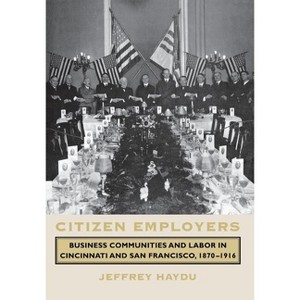
Citizen Employers - by Jeffrey Haydu (Hardcover)
In Stock
Sponsored
About this item
Highlights
- The exceptional weakness of the American labor movement has often been attributed to the successful resistance of American employers to unionization and collective bargaining.
- About the Author: Jeffrey Haydu is Professor of Sociology at the University of California, San Diego.
- 280 Pages
- Political Science, Labor & Industrial Relations
Description
About the Book
Haydu compares the very different employer attitudes and experiences that guided labor-capital relations in two American cities: Cincinnati and San Francisco.
Book Synopsis
The exceptional weakness of the American labor movement has often been attributed to the successful resistance of American employers to unionization and collective bargaining. However, the ideology deployed against labor's efforts to organize at the grassroots level has received less attention. In Citizen Employers, Jeffrey Haydu compares the very different employer attitudes and experiences that guided labor-capital relations in two American cities, Cincinnati and San Francisco, in the period between the Civil War and World War I. His account puts these attitudes and experiences into the larger framework of capitalist class formation and businessmen's collective identities.
Cincinnati and San Francisco saw dramatically different developments in businessmen's class alignments, civic identities, and approach to unions. In Cincinnati, manufacturing and commercial interests joined together in a variety of civic organizations and business clubs. These organizations helped members overcome their conflicts and identify their interests with the good of the municipal community. That pervasive ideology of "business citizenship" provided much of the rationale for opposing unions. In sharp contrast, San Francisco's businessmen remained divided among themselves, opted to side with white labor against the Chinese, and advocated treating both unions and business organizations as legitimate units of economic and municipal governance.
Citizen Employers closely examines the reasons why these two bourgeoisies, located in comparable cities in the same country at the same time, differed so radically in their degree of unity and in their attitudes toward labor unions, and how their views would ultimately converge and harden against labor by the 1920s. With its nuanced depiction of civic ideology and class formation and its application of social movement theory to economic elites, this book offers a new way to look at employer attitudes toward unions and collective bargaining. That new approach, Haydu argues, is equally applicable to understanding challenges facing the American labor movement today.
Review Quotes
In this book Jeffrey Haydu provides an in-depth examination of manufacturing and merchant proprietors in two comparably sized American cities and finds very different patterns in class alignments, ideology, and labor relations between the Civil War and World War II.... Haydu cleverly mines an impressive number of newspaper articles, Chamber of Commerce records, and manuscript collections focused on organizations and individual businessmen. Also impressive is the degree to which this book is fundamentally and thoroughly comparative--even within the chapters focused on a specific city.... Haydu's well-researched and detailed study of businessmen and class formation is important reading for historians of business and labor. Among this book's enduring contributions will surely be a new inability to take capitalists' consciousness for granted.
-- "American Historical Review"Jeffrey Haydu has written a well-researched and thought-provoking study of class formation, labor relations, and upper-class civic life in Cincinnati and San Francisco during the Gilded Age and Progressive Era.... It is a noteworthy book that deserves a wide readership and will stimulate further interest in the history of organized employers.
-- "Enterprise and Society"About the Author
Jeffrey Haydu is Professor of Sociology at the University of California, San Diego. He is the author of Between Craft and Class and Making American Industry Safe for Democracy.
Shipping details
Return details
Trending Non-Fiction





Discover more options