Sponsored
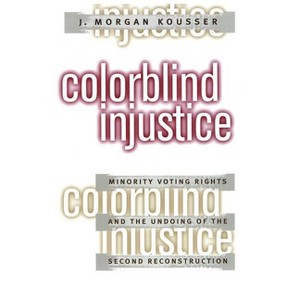
Colorblind Injustice - Abridged by J Morgan Kousser (Paperback)
In Stock
Sponsored
About this item
Highlights
- Challenging recent trends both in historical scholarship and in Supreme Court decisions on civil rights, J. Morgan Kousser criticizes the Court's "postmodern equal protection" and demonstrates that legislative and judicial history still matter for public policy.Offering an original interpretation of the failure of the First Reconstruction (after the Civil War) by comparing it with the relative success of the Second (after World War II), Kousser argues that institutions and institutional rules -- not customs, ideas, attitudes, culture, or individual behavior -- have been the primary forces shaping American race relations throughout the country's history.
- About the Author: J. Morgan Kousser is professor of history and social science at the California Institute of Technology and author of The Shaping of Southern Politics: Suffrage Restriction and the Establishment of the One-Party South, 1880-1910.
- 608 Pages
- Political Science, Civil Rights
Description
About the Book
Colorblind Injustice: Minority Voting Rights and the Undoing of the Second ReconstructionBook Synopsis
Challenging recent trends both in historical scholarship and in Supreme Court decisions on civil rights, J. Morgan Kousser criticizes the Court's "postmodern equal protection" and demonstrates that legislative and judicial history still matter for public policy.
Offering an original interpretation of the failure of the First Reconstruction (after the Civil War) by comparing it with the relative success of the Second (after World War II), Kousser argues that institutions and institutional rules -- not customs, ideas, attitudes, culture, or individual behavior -- have been the primary forces shaping American race relations throughout the country's history. Using detailed case studies of redistricting decisions and the tailoring of electoral laws from Los Angeles to the Deep South, he documents how such rules were designed to discriminate against African Americans and Latinos.
Kousser contends that far from being colorblind, Shaw v. Reno (1993) and subsequent "racial gerrymandering" decisions of the Supreme Court are intensely color-conscious. Far from being conservative, he argues, the five majority justices and their academic supporters are unreconstructed radicals who twist history and ignore current realities. A more balanced view of that history, he insists, dictates a reversal of Shaw and a return to the promise of both Reconstructions.
Review Quotes
"Colorblind Injustice connects meticulous details of politics with the largest, most significant themes in the nation's history. Fulfilling the role of the public intellectual to speak truth to power, Kousser presents original explanations and observations on topics ranging from the First Reconstruction to the most recent Supreme Court cases on voting rights. He challenges both the 'colorblind' school of academics and the 'conservative' majority on the Supreme Court, which he demonstrates is really quite radical. This stunning achievement of scholarship is as deeply researched as it is deeply felt and will change the way historians think about American race relations and public policy." -- Vernon Burton, University of Illinois at Urbana-Champaign
"Colorblind Injustice is an indispensable guide to the uses of discrimination and fraud against racial and ethnic minorities in American politics, especially since the Second Reconstruction." -- C. Vann Woodward, Yale University
"Colorblind Injustice should be required reading for anyone -- scholar, lawyer, or judge -- working in the field of voting rights. It combines meticulous historical case studies of race and the political system with penetrating analysis of contemporary legal doctrine regarding vote dilution and race-conscious redistricting. Colorblind Injustice is an absolute model of what interdisciplinary scholarship should be: informative, thought-provoking, and open-minded." -- Pamela S. Karlan, Stanford University Law School
"A thoroughly researched and well-argued book. . . . This is a book that is valuable for attorneys, judges, policymakers, and academics in helping to understand the nation's tortuous path toward racial justice." -- Law and History Review
"A thoroughly researched, exhaustively documented, and, ultimately, very convincing indictment of the role of the Supreme Court in the battle over equal voting rights. . . . [Kousser's] cogent analysis of constitutional law and voting rights policy speaks to a number of disciplines." -- Law and Politics Review
"Engaging, provocative, and insightful." -- Michigan Law Review
"Kousser has written a very important book about a crucial public issue and made a powerful case for the significance and reliability of history in the public sphere. . . . Historians, lawyers, legislators, and activists will have to read his work with close and respectful attention." -- North Carolina Historical Review
"Kousser presents his case, and his case studies, persuasively. Like any good historian, he is attentive to nuance and complexity, and when he concludes that the evidence lies conclusively on one side, his judgment carries real weight." -- American Historical Review
"There is much to like about this book. . . . Readers will not find the history of voting rights and gerrymandering told any more effectively, and there is great stuff in here for classroom use. . . . This is a fine book for many reasons, not the least because it addresses political issues that have fundamentally abridged the democratic process in this country. One should not ignore this important history, nor can one ignore Kousser's challenge to our profession." -- Journal of American History
About the Author
J. Morgan Kousser is professor of history and social science at the California Institute of Technology and author of The Shaping of Southern Politics: Suffrage Restriction and the Establishment of the One-Party South, 1880-1910. He has served as an expert witness in nineteen federal voting rights cases.
Shipping details
Return details
Frequently bought together
Trending Non-Fiction






Discover more options