Sponsored
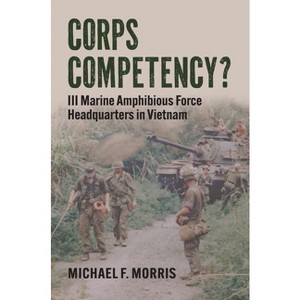
Corps Competency? - (Modern War Studies) by Michael F Morris (Hardcover)
In Stock
Sponsored
About this item
Highlights
- The Vietnam War ended nearly fifty years ago but the central paradox of the struggle endures: how did the world's strongest nation fail to secure freedom for the Republic of Vietnam?
- Author(s): Michael F Morris
- 348 Pages
- History, Military
- Series Name: Modern War Studies
Description
About the Book
"The Vietnam War ended nearly fifty years ago, but it continues to engage, divide, and haunt the American public. The central paradox of the struggle endures: how did the world's strongest nation fail to secure the Republic of Vietnam's freedom? In Corps Competency?, Michael Morris addresses that vexing question by focusing on the senior Marine headquarters in the conflict's most dangerous region. The Vietnamese designated it I (or "Eye" in Marine parlance) Corps, a zone covering the northern five provinces of South Vietnam. This area featured the bloodiest fighting with the North Vietnamese Army, the Viet Cong's strongest infrastructure, the disputed border with North Vietnam, key portions of the Ho Chi Minh Trail, and the important political and economic prizes of Hue and Da Nang. This sector was also the site of the first major American military operation (Operation STARLITE), the battles of Hue City and Khe Sanh during the 1968 Tet Offensive, and a key military innovation known as the Combined Action Platoon (CAP), which was later cited as a counterinsurgency technique that could have won the war if applied more widely. Despite the region's importance, our understanding of the conflict in I Corps remains patchy. The contest there has been broken up into largely unconnected categories of analysis: the "grunt's eye" view, individual battles, specific units, debates over competing military strategies, and the influence of policymaking in Washington and Saigon. The result is that a half-century later, historians know comparatively little about the overall gestalt of the war in this pivotal locale. By approaching the regional conflict through the lens of the Third Marine Amphibious Force (III MAF)-the primary U.S. tactical command in I Corps from 1965-1970-Morris provides the first composite analysis of the critical role of the senior Marine headquarters and offers a coherence missing in piecemeal accounts of particular actions"--Book Synopsis
The Vietnam War ended nearly fifty years ago but the central paradox of the struggle endures: how did the world's strongest nation fail to secure freedom for the Republic of Vietnam? Michael F. Morris addresses this vexing question by focusing on the senior Marine headquarters in the conflict's most dangerous region.
Known as I Corps, the northern five provinces of South Vietnam witnessed the bloodiest fighting of the entire war. I Corps also contained the Viet Cong's strongest infrastructure, key portions of the Ho Chi Minh Trail, and the important political and economic prizes of Hue and Da Nang. For Americans, it was the site of the first major military operation (Operation STARLITE); the Battles of Hue City and Khe Sanh during the 1968 Tet Offensive; and a military innovation known as the Combined Action Platoon (CAP), a counterinsurgency technique designed to secure the region's villages. The Marine zone served as Saigon's "canary in the coal mine"--if the war was to be won, allied action must succeed in its most contested region. With such deep significance, I Corps holds many answers to the lasting questions of the Vietnam War.
Following the Marine Amphibious Force (III MAF)--the primary US tactical command in I Corps from 1965 to 1970--Corps Competency? provides the first composite analysis of the critical role of the senior Marine headquarters and offers a coherence missing in piecemeal accounts. Despite the critical importance of I Corps, relatively little is known about its overall impact on the war due to disconnected and patchy historical study of the region.
In this comprehensive and newly insightful study of the Vietnam War, Michael Morris tells a story that illustrates what can happen when a corps headquarters is not ready for the conflict it encounters and then fights the war it wants to rather than the one it must.
The views expressed in this work are those of the author and not the official position of the United States government, Department of Defense, Department of the Navy, United States Marine Corps, or Marine Corps University.
Review Quotes
"In this groundbreaking book, Michael F. Morris delves deeply into Marine operations in Vietnam to refute widely held beliefs and assumptions about America's most controversial war. It is essential reading for anyone who wants a full understanding of what really happened."--Mark Moyar, author of Triumph Regained: The Vietnam War, 1965-1968
"There have been thousands of books on the Vietnam War, covering a wide range of perspectives and topics, but there have never been any studies of operational headquarters at the corps level during the war. In Corps Competency, Michael Morris provides a much-needed and long-overdue corrective to that missing part of the historiography. Focusing on the Marine Corps, he analyzes the critical role of Headquarters, III Marine Amphibious Force, in the conduct of operations in I Corps Tactical Zone, arguably the most dangerous region in South Vietnam. Morris discusses how III MAF understood its enemy, how it managed the war in its assigned area of responsibility, why it made the decisions it did, and what outcomes resulted from those decisions. The author, a retired Marine colonel, is unflinching in his assessment of III MAF--both its strengths and its weaknesses. Morris closes the book with a consideration of the implications of his study for today's Marine Corps. Meticulously researched and effectively argued, this book is, as the author concludes, 'a piece of Marine Corps history too long untold.'"--James H. Willbanks, author of Abandoning Vietnam: How America Left and South Vietnam Lost Its War and A Raid Too Far: Operation Lam Son 719 and Vietnamization in Laos
"Finally, a no-holds-barred study of one of the most important, and contested, regions of the long and destructive American war in Vietnam. Morris has written, by far, one of the very best and most comprehensive command-level accounts of the US Marine experience in a conflict that continues to resonate among veterans, scholars, and policymakers to this day. A superb work of history."--Gregory A. Daddis, author of Pulp Vietnam: War and Gender in Cold War Men's Adventure Magazines
"Colonel (Ret) Mike Morris has written a superb account of the performance of the senior Marine command headquarters during the Vietnam War. It is exceptionally insightful and thoroughly researched. He has drawn valuable lessons from that experience that are applicable today. This is a must read for military leaders and those interested in that period of our history."--General Anthony Zinni, USMC (Retired), Commander, US Central Command (1997-2000), Commanding General, I Marine Expeditionary Force (1994-1996)
"As a former III MEF Commander, (2015-2018), I am confident that our current MEF headquarters have learned the hard lessons of the past and are manned, trained, and equipped for corps-level expeditionary assignments. Corps Competency? highlights the challenges, then and now, that MEF/corps commanders and their staffs must overcome to fight well at that level."--Lieutenant General Lawrence Nicholson, USMC (Retired), Commanding General, III Marine Expeditionary Force (2015-2018)
"I've known Mike Morris for many years going back to our time together on active duty. His incisive intellect and unflinching look at the challenges III MAF faced in I Corps during the Vietnam War are right in his wheelhouse--no nonsense and brutally honest. During my time as a senior Marine commander and in my subsequent role after retiring from the Corps, I came to appreciate that the pitfalls, distractions and biases experienced by highly regarded senior Marine leaders in Vietnam were not just relics of a war most wanted to forget. The formation and training of a three-star level staff for a warfighting MEF is very tough work even today. Doing it for a corps-level staff is not a linear equation; it's exponential. The difficult decisions required to have the right people, the right resources, the right focus at the right time are innumerable. Morris's work should be a primer for all three-star warfighting commanders."--Lieutenant General Robert F. Hedelund, USMC (Retired), Commanding General, II Marine Expeditionary Force (2017-2019)
"In Corps Competency?, Colonel (Ret) Mike Morris shines a light on an overshadowed segment of the Marine Corps' history in Vietnam. While many historians over the past half century have focused on tactical actions at the battalion and regimental levels, Morris has meticulously researched III MAF as an operational headquarters, which fell disappointingly short of the mark across its stated objectives. In this unvarnished work, Morris uncovers the failure to fully grasp the significant requirements and complexities of corps-level command. More directly, he concludes that the Marine Corps simply did not value operations at this level in its training and education that spanned the period between World War II and Vietnam. This, unfortunately, is a lesson that the Marine Corps have been forced to learn time and again in subsequent conflicts. As the lead planner for I Marine Expeditionary Force (MEF) in Operation IRAQI FREEDOM and returning as the Commanding General twenty years later, I wish I had this exceptional work as a primer prior to both assignments. Morris's insightful and balanced assessment of the III MAF headquarters in Vietnam should be required reading for prospective operational planners and MEF commanders alike."--Lieutenant General George W. Smith Jr, USMC (Retired) Commanding General, I Marine Expeditionary Force (2021-2023)
"Morris is addressing not just marine conundrums, but the broader failures in the Vietnam war."--Journal of Military History
"Morris provides an indispensable case study of a corps-level headquarters fighting a sustained hybrid war for modern practitioners."--Small Wars Journal