Sponsored
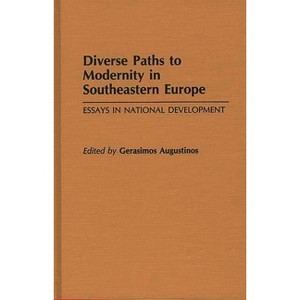
Diverse Paths to Modernity in Southeastern Europe - (Contributions to the Study of World History) by Gerasimos Augustinos (Hardcover)
In Stock
Sponsored
About this item
Highlights
- As the nations in Southeastern Europe confront the changes that are sweeping across the continent, there is much talk of a new beginning for the countries.
- About the Author: GERASIMOS AUGUSTINOS is Associate Professor of History at the University of South Carolina, where he specializes in the history of Southeastern Europe.
- 192 Pages
- Political Science, Political Process
- Series Name: Contributions to the Study of World History
Description
About the Book
As the nations in Southeastern Europe confront the changes that are sweeping across the continent, there is much talk of a new beginning for the countries. But just as surely as they face the enormous task of restructuring, their future development will certainly be influenced to a large extent by their particular experiences in the past. This collection of essays considers the problems and prospects of development from a historical perspective by examining the major Balkan states: Yugoslavia, Romania, Greece, and Bulgaria. These strategic countries are an excellent example of societies with the potential for significant economic growth, but which have developed unevenly because of external and domestic factors. This work provides an integrated overview, geographically and temporally, of each nation's development, reaching back to its emergence.
In his introduction, editor Gerasimos Augustinos characterizes development as the process by which economic and technological change leads to the transformation of the institutions and values of a society. Each contributor then examines each country and its specific historical determinants, identifying the developmental strategies that have been attempted in each state and allowing for the comparison of variations. Essay one focuses on Bulgarian modernization, discussing the possibilities and limits of political and economic development through secularization. The problems of differentiated modernization form the basis of the second essay, which compares the seemingly dissimilar states of Bulgaria and Yugoslavia in the first half of the twentieth century. Essay three addresses the socialist self-management strategy that Yugoslavia adopted in an attempt to promote progress and regime legitimacy. The development of Greece through the market and entrepreneurship is the subject of the fourth essay, while Romania's rapid shift from agriculture to industrialization serves as the focus of the final essay. This comparative study will be an important reference work for courses in contemporary political systems, economic development, and European history, as well as a significant addition to public, college, and university libraries.
Book Synopsis
As the nations in Southeastern Europe confront the changes that are sweeping across the continent, there is much talk of a new beginning for the countries. But just as surely as they face the enormous task of restructuring, their future development will certainly be influenced to a large extent by their particular experiences in the past. This collection of essays considers the problems and prospects of development from a historical perspective by examining the major Balkan states: Yugoslavia, Romania, Greece, and Bulgaria. These strategic countries are an excellent example of societies with the potential for significant economic growth, but which have developed unevenly because of external and domestic factors. This work provides an integrated overview, geographically and temporally, of each nation's development, reaching back to its emergence.
In his introduction, editor Gerasimos Augustinos characterizes development as the process by which economic and technological change leads to the transformation of the institutions and values of a society. Each contributor then examines each country and its specific historical determinants, identifying the developmental strategies that have been attempted in each state and allowing for the comparison of variations. Essay one focuses on Bulgarian modernization, discussing the possibilities and limits of political and economic development through secularization. The problems of differentiated modernization form the basis of the second essay, which compares the seemingly dissimilar states of Bulgaria and Yugoslavia in the first half of the twentieth century. Essay three addresses the socialist self-management strategy that Yugoslavia adopted in an attempt to promote progress and regime legitimacy. The development of Greece through the market and entrepreneurship is the subject of the fourth essay, while Romania's rapid shift from agriculture to industrialization serves as the focus of the final essay. This comparative study will be an important reference work for courses in contemporary political systems, economic development, and European history, as well as a significant addition to public, college, and university libraries.Review Quotes
"The collapse of the Soviet empire and the discrediting of communist models have not only signalled the end of the cold war but have also set the nations of eastern Europe free to find their own paths to social organization and political development. . . . [To] comprehend current and future developments across eastern Europe we must consider how these nations have grappled with problems of development in their recent past. In short, to understand where they are going we need a map showing where they have been. Diverse Paths to Modernity in Southeastern Europe is just such a map for the Balkans. . . . This is scholarship at its best, serving the needs of Balkan specialists as well as those in the more theoretical fields of development and state building. It is also most timely, providing a historical vantage point from which to view the Balkans in the post-cold war era."-John O. Iatrides Professor of Politics Southern Connecticut State University
About the Author
GERASIMOS AUGUSTINOS is Associate Professor of History at the University of South Carolina, where he specializes in the history of Southeastern Europe. He is the author of numerous journal articles as well as the book Conscious of History: Nationalist Critics of Greek Society, 1897-1914.Shipping details
Return details
Trending Non-Fiction