Sponsored
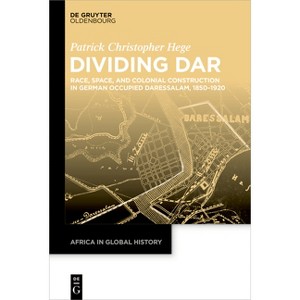
Dividing Dar - (Africa in Global History) by Patrick Christopher Hege (Hardcover)
In Stock
Sponsored
About this item
Highlights
- How did a diversity of intermediaries shape not only the everyday divisions but also the dynamics and growth of the colonial city?
- About the Author: Patrick C. Hege, Humboldt-Universität zu Berlin/Ethnological Museum Berlin, Germany.
- 263 Pages
- History, Africa
- Series Name: Africa in Global History
Description
About the Book
How did a diversity of colonial middlemen and agencies shape not only everyday colonial life, but the dynamics and growth of the colonial city? This is the central question that informs Sights and Sites of Colonial Construction. As a form of globalBook Synopsis
How did a diversity of intermediaries shape not only the everyday divisions but also the dynamics and growth of the colonial city? This is the central question of Dividing Dar. Focusing on South Asian elites, Askari soldiers and police, and a minority of European settlers, the book illustrates how three continents converged to produce the colonial city in East Africa. Dividing Dar shows how negotiations, ranging from contestation to anti-colonial resistance, derailed German colonial plans to transform African "cosmopolitanism" into neatly divided races and city spaces.
Dividing Dar offers a novel approach to colonial urban history. In contrast to the traditional focus on top-down urban planning, knowledge production, and municipal politics, the book builds on a growing body of literature on colonial intermediaries and urbanism "from the middle" to address questions of historical agency, the construction of sociocultural hierarchies, and the mutations of African urbanism under the forces of German colonial occupation.
Review Quotes
"This well-researched and well-written book adds to the expanding bookshelf on the history of Dar es Salaam, Tanzania in a number of important ways [...]
[T]he backbone of the book lie[s] in the rigorous methodology and the effectiveness of the literature review. The book engages with and draws upon the literature on East African history, geography, and anthropology, while also connecting with the historiography of African urban studies and colonial studies more broadly. [...]
The relatively short period of German colonial rule in Dar es Salaam is often overlooked or dismissed as fairly insignificant. This book accomplishes much more than simply forcing a reconsideration of that dismissal, placing the German period within a timeline of continuity from precolonial
years through the Omani-Zanzibari era and into the British colonial period that followed German occupation. Throughout the past--and, I would argue, continuing through to today in Dar es Salaam, at a time of billion-dollar World Bank investments in planning for sanitation, transportation, and climate change--the sentence with which Hege ends the book rings true to the narrative in this city, as in many others across the continent: 'urban identities [are]... made, and remade, by the residents of the city' (212)." - Garth Myers in The Journal of African History 66 (2025) 15: 1-3, https: //doi.org/10.1017/S0021853725100595.
About the Author
Patrick C. Hege, Humboldt-Universität zu Berlin/Ethnological Museum Berlin, Germany.
Shipping details
Return details



Trending Non-Fiction




Discover more options