Sponsored
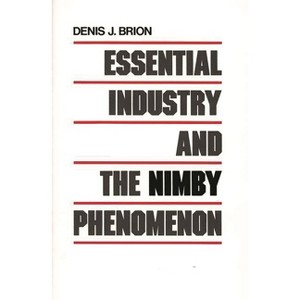
Essential Industry and the Nimby Phenomenon - by Denis J Brion (Hardcover)
In Stock
Sponsored
About this item
Highlights
- This pioneering study explores the problems of politics and law that lie behind the growing phenomenon of NIMBY (Not In My Back Yard), a stance taken by residential property owners attempting to keep various types of facilities out of their neighborhoods.
- About the Author: DENIS J. BRION has been a member of the faculty of Washington & Lee University School of Law since 1978.
- 240 Pages
- Nature, Natural Resources
Description
About the Book
This pioneering study explores the problems of politics and law that lie behind the growing phenomenon of NIMBY (Not In My Back Yard), a stance taken by residential property owners attempting to keep various types of facilities out of their neighborhoods. Denis J. Brion argues that the pejorative connotation that NIMBY carries is both unfortunate and unwarranted and seeks to expose the underlying problems for which NIMBY is a symptom. In particular, Brion examines the impact of siting decisions on those who will be the neighbors of a potential project and the political gridlock that so often results when they become aware of the nature of this impact. The discussion is illuminated by a review of the journalistic accounts of particular episodes chosen to demonstrate the pervasiveness and complexity of the NIMBY phenomenon.
Divided into three sections, the study begins by analyzing how a system of public decisionmaking, founded on the ideal of participatory democracy and built on the structure of representative government, is peculiarly subject to capture by small groups intent on pursuing their own narrow agendas. The result, Brion shows, is often allocational choices which yield benefits to few and harm to many. In Part II, he demonstrates the failure of the public remedial process to provide traditional common-law remedies to those harmed by Locally Unwanted Land Uses (LULUs). Brion then looks at the consequences of this remedial failure from both traditional and non-traditional points of view in order to provide a basis for devising an approach to the problems that underly the NIMBY syndrome. The concluding section proposes a solution that involves both expanding the focus of political and constitutional debate to include the notion of communality and narrowing the traditional conception of right to property. As a unique full-length treatment of the subject, this study makes a significant contribution to the ongoing debate over the NIMBY phenomenon and its consequences.
Book Synopsis
This pioneering study explores the problems of politics and law that lie behind the growing phenomenon of NIMBY (Not In My Back Yard), a stance taken by residential property owners attempting to keep various types of facilities out of their neighborhoods. Denis J. Brion argues that the pejorative connotation that NIMBY carries is both unfortunate and unwarranted and seeks to expose the underlying problems for which NIMBY is a symptom. In particular, Brion examines the impact of siting decisions on those who will be the neighbors of a potential project and the political gridlock that so often results when they become aware of the nature of this impact. The discussion is illuminated by a review of the journalistic accounts of particular episodes chosen to demonstrate the pervasiveness and complexity of the NIMBY phenomenon.
Divided into three sections, the study begins by analyzing how a system of public decisionmaking, founded on the ideal of participatory democracy and built on the structure of representative government, is peculiarly subject to capture by small groups intent on pursuing their own narrow agendas. The result, Brion shows, is often allocational choices which yield benefits to few and harm to many. In Part II, he demonstrates the failure of the public remedial process to provide traditional common-law remedies to those harmed by Locally Unwanted Land Uses (LULUs). Brion then looks at the consequences of this remedial failure from both traditional and non-traditional points of view in order to provide a basis for devising an approach to the problems that underly the NIMBY syndrome. The concluding section proposes a solution that involves both expanding the focus of political and constitutional debate to include the notion of communality and narrowing the traditional conception of right to property. As a unique full-length treatment of the subject, this study makes a significant contribution to the ongoing debate over the NIMBY phenomenon and its consequences.About the Author
DENIS J. BRION has been a member of the faculty of Washington & Lee University School of Law since 1978. He holds a bachelor's degree in engineering from Northwestern University and a Juris Doctor from the University of Virginia. He writes extensively on the application of semiotics to the analysis of meaning in the law. During the mid-1970s, Brion was a member and later chair of Virginia's water pollution control agency, thereby enjoying a front row seat on the NIMBY phenomenon.Shipping details
Return details
Frequently bought together





Trending Non-Fiction



Discover more options